


Myeloid-derived suppressor cells (MDSC): When good intentions go awry
- PMID: 33592540
- PMCID: PMC8054443
- DOI: 10.1016/j.cellimm.2021.104302
Myeloid-derived suppressor cells (MDSC): When good intentions go awry
Abstract
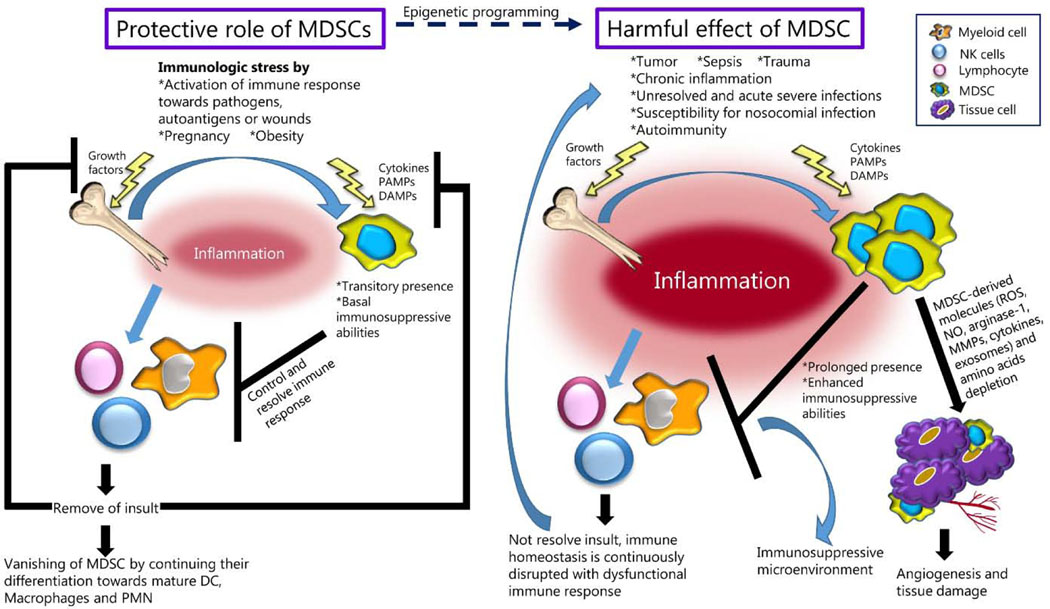
MDSC are a heterogeneous population of immature myeloid cells that are released by biological stress such as tissue damage and inflammation. Conventionally, MDSC are known for their detrimental role in chronic inflammation and neoplastic conditions. However, their intrinsic functions in immunoregulation, wound healing, and angiogenesis are intended to protect from over-reactive immune responses, maintenance of immunotolerance, tissue repair, and homeostasis. Paradoxically, under certain conditions, MDSC can impair protective immune responses and exacerbate the disease. The transition from protective to harmful MDSC is most likely driven by environmental and epigenetic mechanisms induced by prolonged exposure to unresolved inflammatory triggers. Here, we review several examples of the dual impact of MDSC in conditions such as maternal-fetal tolerance, self-antigens immunotolerance, obesity-associated cancer, sepsis and trauma. Moreover, we also highlighted the evidence indicating that MDSC have a role in COVID-19 pathophysiology. Finally, we have summarized the evidence indicating epigenetic mechanisms associated with MDSC function.
Keywords: COVID-19; Cancer; Chronic inflammation; Epigenetic regulation; Homeostasis; Immune tolerance; Immunosuppression; MDSC; Obesity; Wound healing.
Copyright © 2021 Elsevier Inc. All rights reserved.
Figures
References
-
- Medzhitov R, Origin and physiological roles of inflammation, Nature 454 (2008) 428–435. - PubMed
-
- Feehan KT, Gilroy DW, Is Resolution the End of Inflammation?, Trends in molecular medicine 25 (2019) 198–214. - PubMed
-
- Mahdipour E, Charnock JC, Mace KA, Hoxa3 promotes the differentiation of hematopoietic progenitor cells into proangiogenic Gr-1+CD11b+ myeloid cells, Blood 117 (2011) 815–826. - PubMed
Publication types
MeSH terms
Grants and funding
LinkOut - more resources
Full Text Sources
Other Literature Sources
