


Embracing complexity with systems thinking in general practitioners' clinical reasoning helps handling uncertainty
- PMID: 33592677
- PMCID: PMC8518614
- DOI: 10.1111/jep.13549
Embracing complexity with systems thinking in general practitioners' clinical reasoning helps handling uncertainty
Abstract
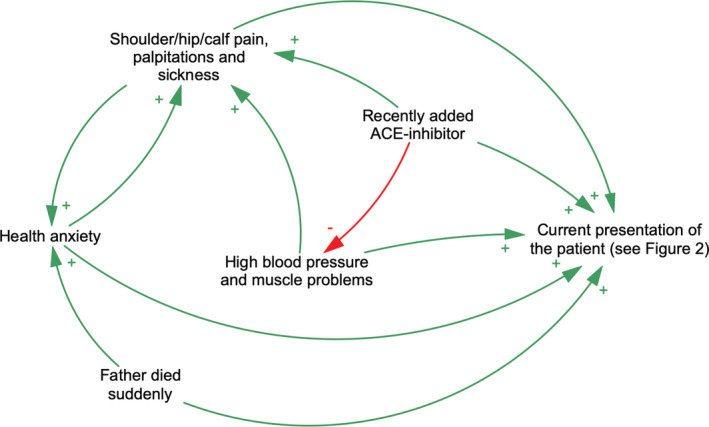
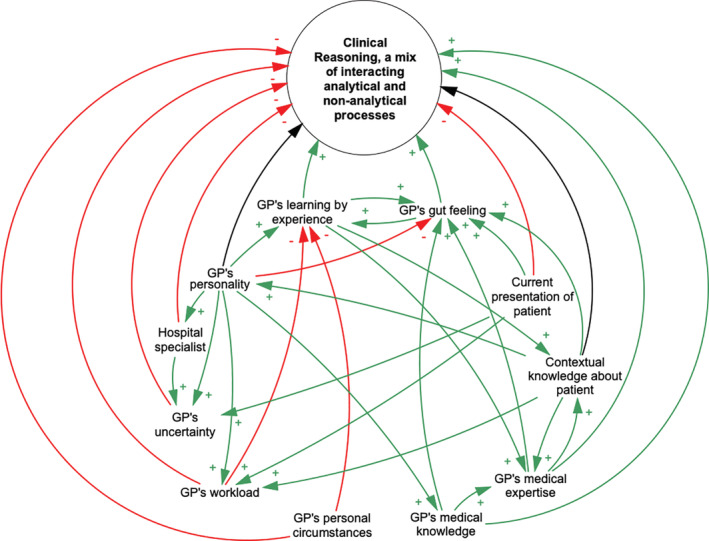
Clinical reasoning in general practice is increasingly challenging because of the rise in the number of patients with multimorbidity. This creates uncertainty because of unpredictable interactions between the symptoms from multiple medical problems and the patient's personality, psychosocial context and life history. Case analysis may then be more appropriately managed by systems thinking than by hypothetic-deductive reasoning, the predominant paradigm in the current teaching of clinical reasoning. Application of "systems thinking" tools such as causal loop diagrams allows the patient's problems to be viewed holistically and facilitates understanding of the complex interactions. We will show how complexity levels can be graded in clinical reasoning and demonstrate where and how systems thinking can have added value by means of a case history.
Keywords: clinical reasoning; complexity-informed; general practice; gut feelings; multimorbidity; uncertainty.
© 2021 The Authors. Journal of Evaluation in Clinical Practice published by John Wiley & Sons Ltd.
Conflict of interest statement
The authors declare that they have no competing interests.
Figures
References
-
- Andre D, Fernand G. Sherlock Holmes ‐ an expert's view of expertise. Br J Psychol. 2008;99(1):109‐125. - PubMed
MeSH terms
LinkOut - more resources
Full Text Sources
Other Literature Sources
