


Impact of pharmacist-conducted anticoagulation patient education and telephone follow-up on transitions of care: a randomized controlled trial
- PMID: 33593336
- PMCID: PMC7885504
- DOI: 10.1186/s12913-021-06156-2
Impact of pharmacist-conducted anticoagulation patient education and telephone follow-up on transitions of care: a randomized controlled trial
Abstract
Background: There is limited published data in Lebanon evaluating the impact of supplemental education for anticoagulants use, especially DOACs, on clinical outcomes such as bleeding. The study aims to assess the impact of pharmacist-conducted anticoagulation education and follow-up on bleeding and readmission rates.
Methods: This study was a randomized, non-blinded interventional study conducted between August 2017 and July 2019 in a tertiary care teaching Lebanese hospital. Participants were inpatients ≥18 years discharged on an oral anticoagulant for treatment. Block randomization was used. The control group received the standard nursing counseling while the intervention group additionally received pharmacy counseling. Phone call follow-ups were done on day 3 and 30 post-discharge. Primary outcomes included readmission rates and any bleeding event at day 3 and 30 post-discharge. Secondary outcomes included documented elements of education in the medical records and reported mortality upon day 30 post-discharge.
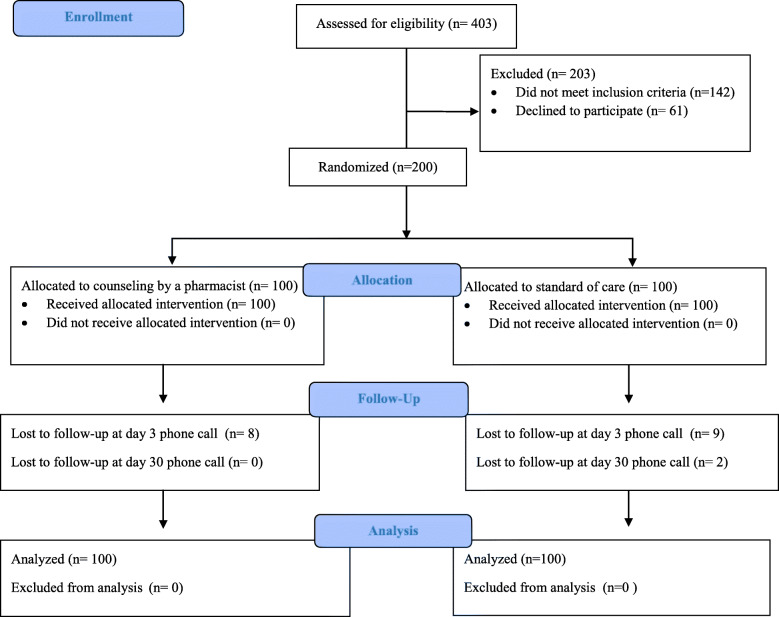
Results: Two hundred patients were recruited in the study (100 patients in each study arm) with a mean age of 73.9 years. In the pharmacist-counseled group, more patients contacted their physician within 3 days (14% versus 4%; p = 0.010), received explicit elements of education (p < 0.001) and documentation in the chart was better (p < 0.05). In the standard of care group, patients were more aware of their next physician appointment date (52% versus 31%, p < 0.001). No difference in bleeding rates at day 3 and 30 post-discharge was observed between the groups.
Conclusions: Although pharmacist-conducted anticoagulation education did not appear to reduce bleeding or readmission rates at day 30, pharmacist education significantly increased patient communication with their providers in the early days post-discharge.
Trial registration: Lebanon Clinical Trial Registry LBCTR2020033424 . Retrospectively registered. Date of registration: 06/03/2020.
Keywords: Anticoagulation; Bleeding; Discharge counseling; Readmissions; Transitions of care.
Conflict of interest statement
The study was performed in accordance with the ethical standards as laid down in the 1964 Declaration of Helsinki and its later amendments. Before initiation of the data collection, the investigators secured the approval of the Lebanese American University Institutional Review Board (IRB). IRB approval number: LAU.SOP.LK2.11/Jul/2017.
The authors also registered the study in the Lebanese Clinical Trials Registry (LBCTR). Registration Number LBCTR2020033424.
The purpose of the study was elucidated and written consent was obtained before the participants were interviewed, respecting their autonomy and anonymity. The authors report no conflicts of interest in this work.
The authors declare that they have no competing interests.
Figures
References
-
- Huisman MV, Ma CS, Diener H-C, et al. Antithrombotic therapy use in patients with atrial fibrillation before the era of non-vitamin K antagonist Oral anticoagulants: the global registry on long-term oral antithrombotic treatment in patients with atrial fibrillation (GLORIA-AF) phase I cohort. EP Europace. 2016;18:1308–1318. doi: 10.1093/europace/euw073. - DOI - PMC - PubMed
-
- van der Hulle T, Kooiman J, den Exter PL, et al. Effectiveness and safety of novel oral anticoagulants as compared with vitamin K antagonists in the treatment of acute symptomatic venous thromboembolism: a systematic review and meta-analysis. J Thromb Haemost. 2014;12:320–328. doi: 10.1111/jth.12485. - DOI - PubMed
Publication types
MeSH terms
Substances
LinkOut - more resources
Full Text Sources
Other Literature Sources
Miscellaneous
