. 2021 Feb 16;11(1):3911.
doi: 10.1038/s41598-021-83316-8.

Protective role of Chlorella vulgaris with Thiamine against Paracetamol induced toxic effects on haematological, biochemical, oxidative stress parameters and histopathological changes in Wistar rats

Affiliations

Protective role of Chlorella vulgaris with Thiamine against Paracetamol induced toxic effects on haematological, biochemical, oxidative stress parameters and histopathological changes in Wistar rats

Amera Abd El Latif et al. Sci Rep. .

Abstract

Paracetamol is extensively consumed as an analgesic and antipyretic drug, but at a high dose level, it leads to deleterious side effects, such as hepatic and nephrotoxicity. This research aimed to estimate the prophylactic efficacy of Chlorella vulgaris and/or thiamine against paracetamol (P) induced hepatorenal and cardiac toxicity. Forty-eight female Wistar rats were randomly divided into eight equal groups (n = 6 rats). Group 1, normal control group. Group 2, Paracetamol group. Groups 3, 4 and 5 were treated with Silymarin drug, Chlorella vulgaris alga, Chlorella vulgaris alga supplemented with thiamine, respectively daily for 7 successive days, then all were administered Paracetamol (2gm/kg. bwt.). While, Groups 6, 7 and 8 were treated by Silymarin, Chlorella vulgaris alga, Chlorella vulgaris supplemented with thiamine, respectively daily for 7 successive days without paracetamol administration. Our results clarified that Paracetamol toxicity caused significant adverse effects on hematological, serum biochemical parameters, and oxidant -antioxidant status as well as histopathological picture of heart, liver, and kidney. However, in the Paracetamol intoxicated groups pretreatment either with Chlorella vulgaris alone or plus thiamine successfully improved the undesirable deleterious effects of paracetamol, and restored almost all variables to near their control levels. This study has finished to that oxidative stress participates in the pathogenesis of paracetamol-induced toxicity in rats and using Chlorella vulgaris alga either alone or plus thiamine alongside their health benefits can protect against oxidative harmful effects induced by paracetamol through their free radical scavenging and powerful antioxidant effects, and they can be used as propylactic agents against paracetamol-induced toxicity.


Conflict of interest statement

The authors declare no competing interests.

Figures
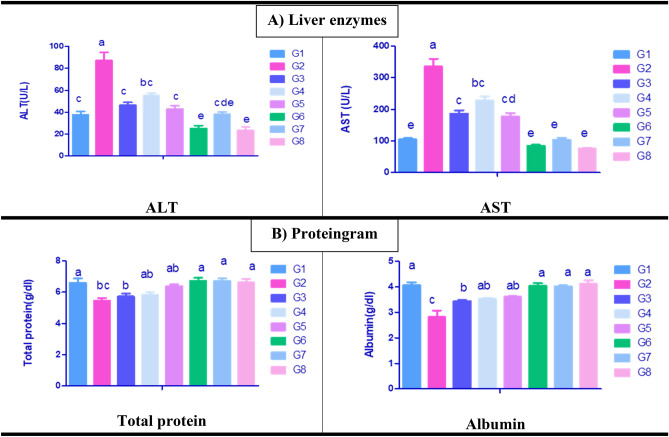
Figure 1
Figure 1
Serum biochemical parameters of liver enzymes and proteinogram of control and different treated rat groups. G1 = Control group, G2 = Paracetamol, G3 = Silymarin + Paracetamol, G4 = Chlorella vulgaris + Paracetamol, G5 = Chlorella vulgaris + Thiamine + Paracetamol, G6 = Silymarin, G7 = Chlorella vulgaris, G8 = Chlorella vulgaris + Thiamine. ALT = Alanine amino transferase, AST = Aspartate amino transferase. Data are presented as means ± SEM (n = 6). Different letter means significant difference effects in the same time period.
Figure 2
Figure 2
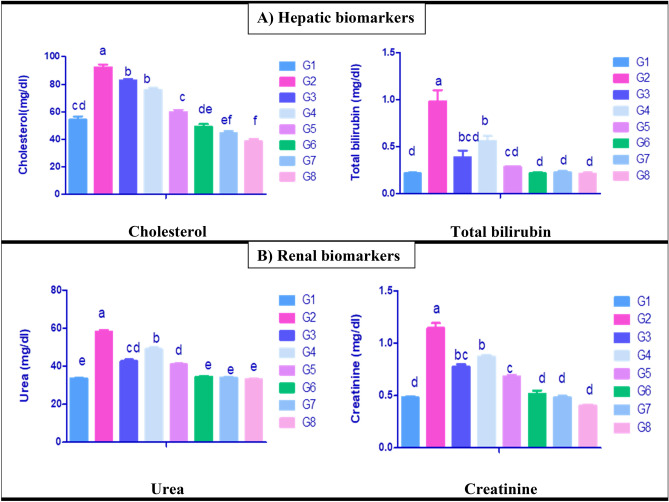
Serum biochemical parameters of hepatic and renal biomarkers of control and different treated rat groups. G1 = Control group, G2 = Paracetamol, G3 = Silymarin + Paracetamol, G4 = Chlorella vulgaris + Paracetamol, G5 = Chlorella vulgaris + Thiamine + Paracetamol, G6 = Silymarin, G7 = Chlorella vulgaris, G8 = Chlorella vulgaris + Thiamine. Data are presented as means ± SEM (n = 6). Different letter means significant difference effects in the same time period.
Figure 3
Figure 3
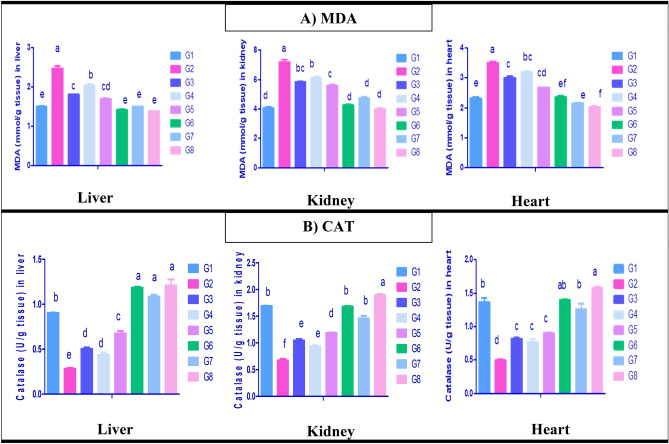
Oxidative stress and antioxidant status. (A) Malondialdehyde (MDA) (nmol/gm tissue), (B) Catalase activity (CAT) (μmol/mg) of liver, kidney and heart tissues of control and different treated rat groups. G1 = Control group, G2 = Paracetamol, G3 = Silymarin + Paracetamol, G4 = Chlorella vulgaris + Paracetamol, G5 = Chlorella vulgaris + Thiamine + Paracetamol, G6 = Silymarin, G7 = Chlorella vulgaris, G8 = Chlorella vulgaris + Thiamine. Data are presented as means ± SEM (n = 6). Different letter means significant difference effects in the same time period.
Figure 4
Figure 4
Liver sections showing normal appearance in (A) Control group, (B) Silymarin group, (C) Chlorella vulgaris group and (D) Chlorella vulgaris + thiamine group. (E) Paracetamol group showing severe congestion (black thin arrow) with marked vacuolar (yellow arrowheads) and ballooning degeneration in hepatocytes (black arrowheads) besides aggregation of lymphocytes in portal area (thick arrows). (F) Silymarin + Paracetamol group and (H) Chlorella vulgaris + Thiamine + Paracetamol group showing mild hydropic degeneration in hepatocytes (arrows). (G) Chlorella vulgaris + Paracetamol group showing moderate congestion (black thin arrow) vacuolar (yellow arrowheads) and ballooning degeneration (black arrowheads) in hepatocytes. (H) and (E) X: 400 bar 50.
Figure 5
Figure 5
Kidney sections showing normal appearance in (A) control group, (B) Silymarin group, (C) Chlorella vulgaris group and (D) Chlorella vulgaris + Thiamine group. (E) Paracetamol group showing severe congestion (black arrow) and glomerular shrinkage (yellow arrows). (F) Silymarin + Paracetamol group and (H) Chlorella vulgaris + Thiamine + Paracetamol group showing mild congestion (black arrow). (G) Chlorella vulgaris + Paracetamol group showing moderate congestion (black arrow). (H) and (E) X: 400 bar 50.
Figure 6
Figure 6
Heart sections showing normal appearance in (A) Control group, (B) Silymarin group, (C) Chlorella vulgaris group (D) Chlorella vulgaris + Thiamine group. (E) Paracetamol group showing severely congested cardiac blood vessels (arrows) besides degeneration and vacuolation in cardiomyocytes (arrowheads). (F) Silymarin + Paracetamol group and (H) Chlorella vulgaris + Thiamine + Paracetamol showing mildly congested cardiac blood vessels (arrows). (G) Chlorella vulgaris + Paracetamol group showing moderately congested cardiac blood vessels. (H) and (E) X: 400 bar 50.

References

    1. Lancaster EM, Hiatt JR, Zarrinpar A. Acetaminophen hepatotoxicity: An updated review. Arch. Toxicol. 2015;89:193–1992. doi: 10.1007/s00204-014-1432-2. - DOI - PubMed
    1. Du K, Ramachandran A, Jaeschke H. Oxidative stress during acetaminophen hepatotoxicity: sources, pathophysiological role and therapeutic potential. Redox Biol. 2016;10:148–156. doi: 10.1016/j.redox.2016.10.001. - DOI - PMC - PubMed
    1. Abraham P. Oxidative stress in paracetamol-induced pathogenesis: (I). Renal damage. Indian J. Biochem. Biophys. 2005;42:59–62. - PubMed
    1. Mazer M, Perrone J. Acetaminophen-induced nephrotoxicity: Pathophysiology, clinical manifestations and management. J. Med. Toxicol. 2008;4:2–6. doi: 10.1007/BF03160941. - DOI - PMC - PubMed
    1. Jaeschke H, McGill MR, Williams CD, Ramachandran A. Current issues with acetaminophen hepatotoxicity: A clinically relevant model to test the efficacy of natural products. Life Sci. 2011;88:737–745. doi: 10.1016/j.lfs.2011.01.025PMID:21296090. - DOI - PMC - PubMed

Publication types