


Potential impact of COVID-19 on ongoing clinical trials: a simulation study with the neurological Yale Global Tic Severity Scale based on the CANNA-TICS study
- PMID: 33594741
- PMCID: PMC8014297
- DOI: 10.1002/pst.2100
Potential impact of COVID-19 on ongoing clinical trials: a simulation study with the neurological Yale Global Tic Severity Scale based on the CANNA-TICS study
Abstract
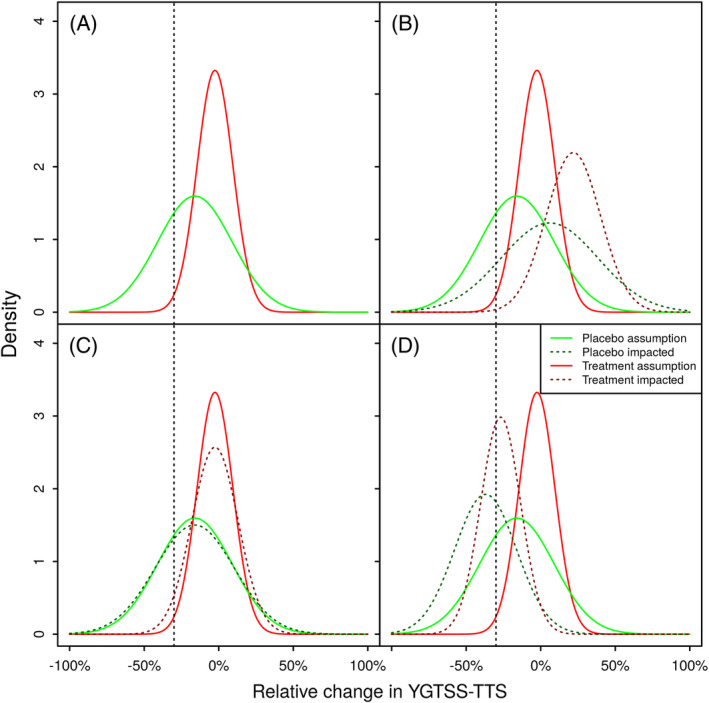
The COVID-19 pandemic has manifold impacts on clinical trials. In response, drug regulatory agencies and public health bodies have issued guidance on how to assess potential impacts on ongoing clinical trials and stress the importance of a risk-assessment as a pre-requisite for modifications to the clinical trial conduct. This article presents a simulation study to assess the impact on the power of an ongoing clinical trial without the need to unblind trial data and compromise trial integrity. In the context of the CANNA-TICS trial, investigating the effect of nabiximols on reducing the total tic score of the Yale Global Tic Severity Scale (YGTSS-TTS) in patients with chronic tic disorders and Tourette syndrome, the impact of the two COVID-19 related intercurrent events handled by a treatment policy strategy is investigated using a multiplicative and additive data generating model. The empirical power is examined for the analysis of the YGTSS-TTS as a continuous and dichotomized endpoint using analysis techniques adjusted and unadjusted for the occurrence of the intercurrent event. In the investigated scenarios, the simulation studies showed that substantial power losses are possible, potentially making sample size increases necessary to retain sufficient power. However, we were also able to identify scenarios with only limited loss of power. By adjusting for the occurrence of the intercurrent event, the power loss could be diminished to different degrees in most scenarios. In summary, the presented risk assessment approach may support decisions on trial modifications like sample size increases, while maintaining trial integrity.
Keywords: COVID-19; Yale Global Tic Severity Scale; power; risk assessment; simulation study.
© 2021 The Authors. Pharmaceutical Statistics published by John Wiley & Sons Ltd.
Conflict of interest statement
The authors declare no conflict of interest.
Figures
References
-
- European Commission , European Medicines Agency , National Head of Medicines Agencies . Guidance on the Management of Clinical Trials During the Covid‐19 (Coronavirus) Pandemic; 2020:1‐21 https://ec.europa.eu/health/sites/health/files/files/eudralex/vol-10/gui....
-
- European Medicines Agency . Points to Consider on Implications of Coronavirus Disease (COVID‐19) on Methodological Aspects of Ongoing Clinical Trials. 2020. https://www.ema.europa.eu/en/documents/scientific-guideline/points-consi...
-
- U.S. Department of Health and Human Services . Statistical Considerations for Clinical Trials During the COVID‐19 Public Health Emergency. 2020. https://www.fda.gov/media/139145/download
Publication types
MeSH terms
Substances
Grants and funding
LinkOut - more resources
Full Text Sources
Other Literature Sources
Medical
