


Neuropeptidomic Profiling and Localization in the Crustacean Cardiac Ganglion Using Mass Spectrometry Imaging with Multiple Platforms
- PMID: 33595330
- PMCID: PMC7893679
- DOI: 10.1021/jasms.0c00191
Neuropeptidomic Profiling and Localization in the Crustacean Cardiac Ganglion Using Mass Spectrometry Imaging with Multiple Platforms
Abstract
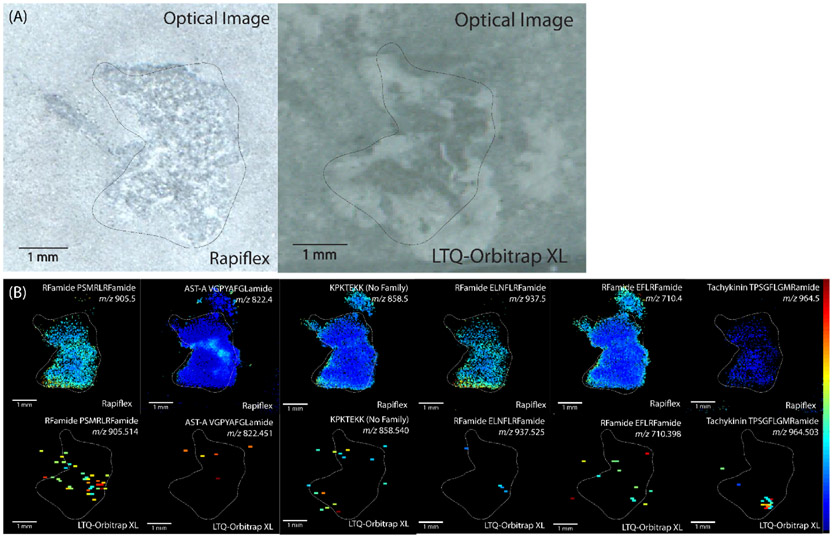
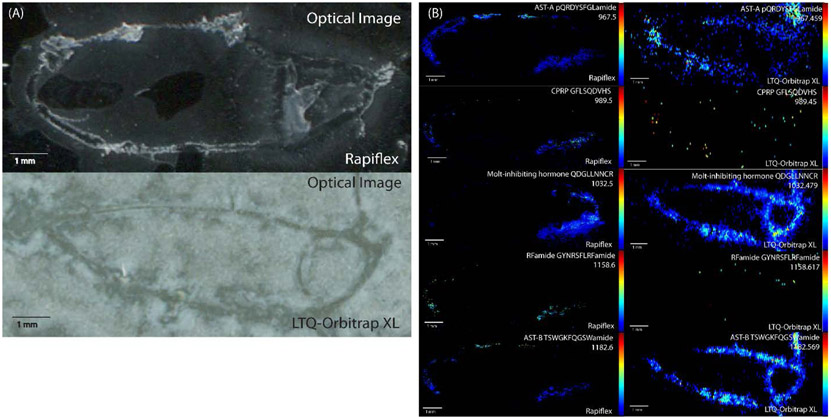
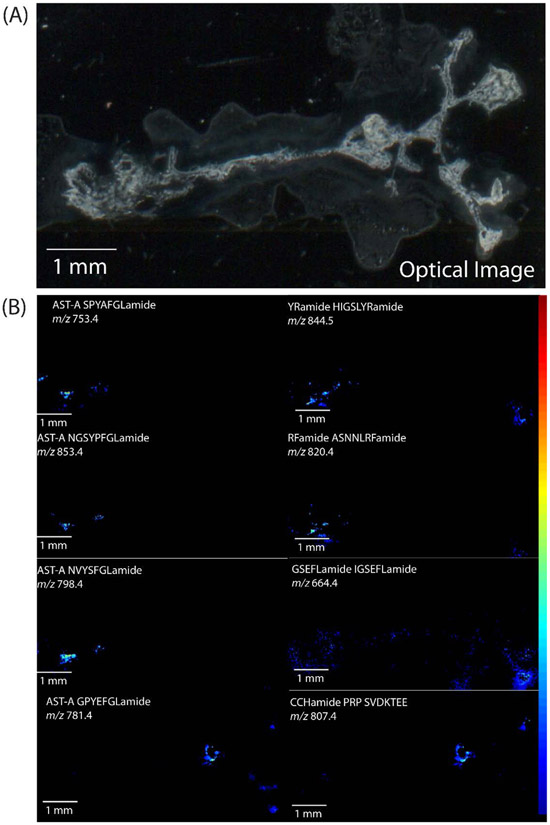
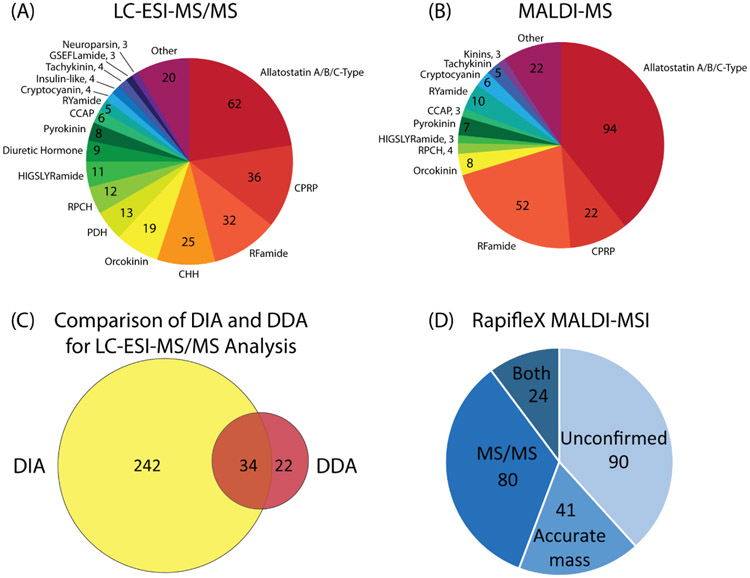
The crustacean cardiac neuromuscular system is a useful model for studying how neural circuits generate behavior, as it is comprised of a simple ganglion containing nine neurons, yet acts as a robust central pattern generator. The crustacean heart is neurogenic, receiving input from neuropeptides. However, the specific effects of neuropeptides on cardiac output is not fully understood, and the large degree of comodulation between multiple neuropeptides makes studying these effects more challenging. To address this challenge, matrix-assisted laser desorption/ionization (MALDI) mass spectrometry (MS) imaging was used to localize neuropeptides within the cardiac ganglion (CG), providing information about the identity and localization of neuropeptides being present. CG extracts were also profiled using liquid chromatography coupled to tandem mass spectrometry (MS/MS) with a data independent acquisition method, resulting in the confirmation of 316 neuropeptides. Two MS imaging (MSI) platforms were compared to provide comprehensive results, including a MALDI-Orbitrap instrument for high mass spectral resolution for accurate identifications and a MALDI TOF/TOF instrument for improved spatial resolution and sensitivity, providing more descriptive MS images. MS images for 235 putative neuropeptides were obtained, with the identification of 145 of these being confirmed by either complementary MS/MS data or accurate mass matching. The MSI studies demonstrate the sensitivity and power of this MALDI-based in situ analytical strategy for unraveling the chemical complexity present in a small nine-cell neuronal system. The results of this study will enable more informative assays of the functions of neuropeptides within this important neural circuit.
Keywords: cardiac neurophysiology; crustacean; mass spectrometry imaging; neuropeptides.
Figures
References
-
- Marder E, Bucher D: Understanding circuit dynamics using the stomatogastric nervous system of lobsters and crabs. Annu Rev Physiol. 69, 291–316 (2007) - PubMed
-
- Kuramoto T, Yamagishi H: Physiological anatomy, burst formation, and burst frequency of the cardiac ganglion of crustaceans. Physiological Zoology. 63, 102–116 (1990)
-
- Ransdell JL, Temporal S, West NL, Leyrer ML, Schulz DJ: Characterization of inward currents and channels underlying burst activity in motoneurons of crab cardiac ganglion. J Neurophysiol. 110, 42–54 (2013) - PubMed
-
- Cooke IM: Reliable, responsive pacemaking and pattern generation with minimal cell numbers: the crustacean cardiac ganglion. Biol Bull. 202, 108–136 (2002) - PubMed
MeSH terms
Substances
Grants and funding
LinkOut - more resources
Full Text Sources
