Review
. 2021 Mar;69(3):517-524.
doi: 10.4103/ijo.IJO_574_20.

Specular microscopy in clinical practice

Affiliations
Review

Specular microscopy in clinical practice

Sunita Chaurasia et al. Indian J Ophthalmol. 2021 Mar.

Abstract

Specular microscopy is a noninvasive diagnostic tool that allows for in vivo evaluation of corneal endothelium in health and various diseased states. Endothelial imaging helps in the diagnosis and management of several endothelial disorders. The review focuses on the principles of specular microscopy, limitations of endothelial imaging, and its interpretation in common conditions seen in the clinical practice. A thorough PubMed search was done using the keywords specular microscopy, corneal endothelium, and endothelial imaging.

Keywords: Cornea; Specular microscopy; corneal endothelium; endothelial dystrophy; endothelial keratoplasty; keratoplasty; penetrating keratoplasty.


Conflict of interest statement

None

Figures
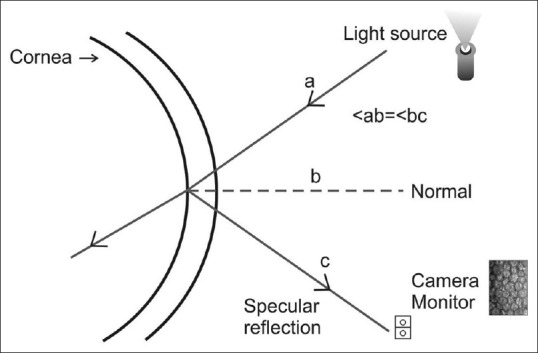
Figure 1
Figure 1
Schematic representation of principle of specular microscopy: A slit of light is focused on the endothelial surface. Specularly reflected light rays are focused onto a camera monitor to capture the image of endothelial cells. (a-incident light ray, b-normal, c-reflected light ray, ab- angle of incident light, bc- angle of the reflected light)
Figure 2
Figure 2
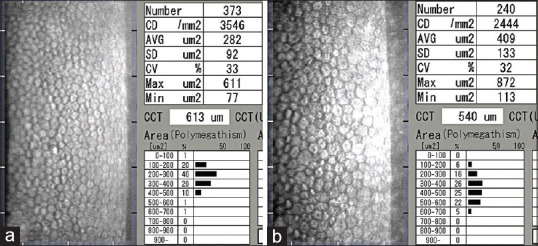
Representative specular microscopy images of the right eye of a 12-year-old (a) and a 40-year-old (b) male. Notice the difference in the mean cell area (282 versus 409 μm2) and the age related decline in endothelial cell density
Figure 3
Figure 3
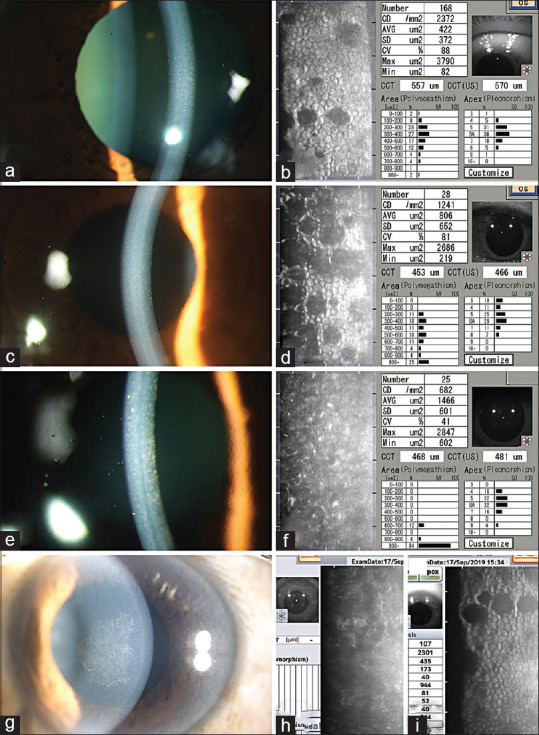
Specular Microscopy in Fuchs endothelial corneal dystrophy: (a and b) Specular microscopy (b) showing drop out areas corresponding to nonconfluent guttae in a 50 year old patient with FECD with nonconfluent guttae (a), normal endothelial cells are seen in most areas of the image frame. (c and d) Specular microscopy (d) showing more numerous drop out areas in the endothelial image frame of a 53 year old patient with FECD (c). Notice that the endothelial cells have larger mean cell area (806 μm2 vs 422 μm2) when compared to that in image b. (b and d are in the same scale). (e and f) Specular microscopy (e) in a 49 year old patient with confluent guttae in central cornea (d), fails to capture a readable image. The quantitative parameters such as ECD, mean cell area depicted in the image are erroneous values in view of the fact that the cell analysis was done in automatic mode. This image is 'non analysable' as the individual cells are not captured due to confluent guttae. Note that the patient has a well-functioning endothelium despite confluent guttae, cornea is noticeably clear without evidence of subepithelial scarring, and pachymetry of 481 μm. (g-i) Slit lamp photograph (g) of a patient with confluent guttae; specular microscopy image from the central cornea is 'non analysable'(h); the specular microscopy from the mid peripheral cornea shows a readable image with few guttae, reasonably good endothelial cell density of 2301 cells/mm2(i)
Figure 4
Figure 4
Specular microscopy imaging in a pseudophakic eye with anterior uveitis showing dark lesions corresponding to endothelial pigments and swollen endothelial cells (pseudoguttae)
Figure 5
Figure 5
Specular microscopy images in PPCD: (a-c) Slit lamp photograph (a) of right of a 25 year old male showing serpentine bands at posterior membrane level; the specular microscopy of the same eye (b) shows the bands, reduced endothelial cell density (1176 cells/mm2), increased mean cell area (851 μm) when compared to the specular microscopy image of the normal left eye of the patient. (Images b and c have the same scale)
Figure 6
Figure 6
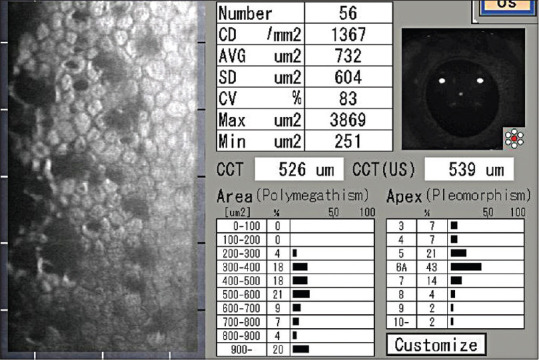
Specular microscopy in ICE syndrome: (a and b) Slit lamp photograph (a) of a 45 year old patient with ICE syndrome showing broad peripheral synechiae, central to paracentral corneal haze in the inferotemporal quadrant; the specular image (b) from the superior mid peripheral cornea (clear area of the cornea) shows enlarged endothelial cells, rounding of the cellular boundaries and increased black out areas within the cells. (c and d) Slit lamp photograph (c) of a 25 year old patient with ICE syndrome; the specular microscopy (d) shows the characteristic dark-light reversal pattern
Figure 7
Figure 7
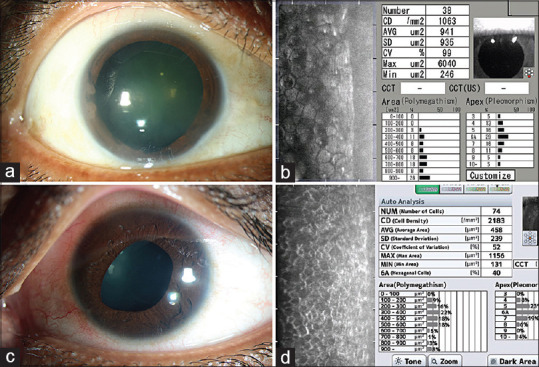
Specular microscopy after therapeutic penetrating keratoplasty: (a-c) Slit lamp photograph (a) of a 36 year old patient who had a therapeutic penetrating keratoplasty in the right eye 11 years ago; the specular image of the right eye (b) shows a lower endothelial cell density, increased mean cell area when compared to the specular image of the normal left eye (c). (Images b and c are in same scale)
Figure 8
Figure 8
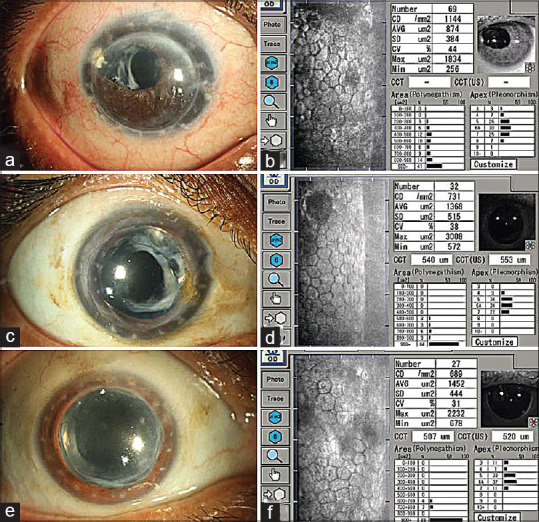
Endothelial imaging in 30-year-old penetrating keratoplasty grafts: (a-f) Slit lamp photographs (a-e) of 3 patients who had penetrating keratoplasty 30 years ago. All the grafts were clear and their corresponding specular images (b, d and f) show the endothelial cell densities (1144, 731, 689 cells/mm2)
Figure 9
Figure 9
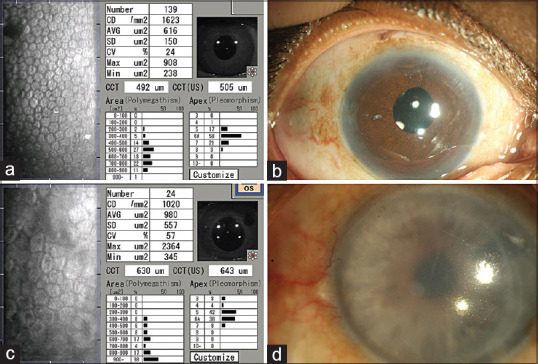
Specular Microscopy after Descemet stripping endothelial keratoplasty: (a and b) Specular microscopy (a) of a patient who had Descemet stripping endothelial keratoplasty 11 years ago, the endothelial cell density is 1623 cells/mm2. The posterior lamellar graft is compact and cornea is clear (b). (c and d) Specular microscopy of another patient who had a Descemet stripping endothelial keratoplasty 11 years ago. Notice the increased mean cell area, lowered cell density in this specular image compared to that in (c), suggesting the likelihood of an imminent endothelial failure. This patient as anticipated, presented a year later with decrease in vision and secondary graft failure as seen in (d)
Figure 10
Figure 10
Specular Microscopy of the right (a) and left eye (b) of a patient who was on Amantadine treatment for a movement disorder. Both eyes have abnormal endothelial cell morphology at the visit images were captured. Patient eventually presented with bilateral corneal edema
Figure 11
Figure 11
Specular microscopy in secondary endothelial disorders: (a and b) Slit lamp photograph (a) of a patient who had recurrent episodes of endothelitis and immune stromal keratitis in the left eye; the specular microscopy (b) of the left eye shows a reduced cell counts compared to the normal right eye image (c).[Images b and c have the same scale]. (d-f) Slit lamp photograph (d) of a patient who had a forceps injury in the right eye; the specular microscopy of the right eye (e) shows a reduced cell density compared to the normal left eye (f). [Images e and f have the same scale]
Figure 12
Figure 12
Specular microscopy after Deep anterior lamellar keratoplasty (DALK) in Macular Corneal Dystrophy. Specular microscopy images (1c, 2c and 3c) showing the drop out areas/guttae similar to that is seen in FECD. Pre-operative endothelial imaging is not possible due to stromal deposits, but after DALK, restoration of stromal clarity helps in capturing the endothelial images. Notice the severe Descemet membrane changes (3c) in the third patient compared to the first (1a-c) and the second patient (3a-c).

References

    1. Sayegh RR, Benetz BA, Lass JH. Specular microscopy. In: Mannis MJ, Holland EJ, editors. Cornea. 4th ed. Mosby: Elsevier Health Sciences; 2017. pp. 160–79.
    1. Laing RA, Sandstorm MM, Leibowitz HM. Clinical specular microscopy. I. Optical principles. Arch Ophthalmol. 1979;97:1714–9. - PubMed
    1. Maurice DM. Cellular membrane activity in the corneal endothelium of intact eye. Experientia. 1968;24:1094–5. - PubMed
    1. McCarey BE, Edelhauser HF, Lynn MJ. Review of corneal endothelial specular microscopy for FDA clinical trials of refractive procedures, surgical devices, and new intraocular drugs and solutions. Cornea. 2008;27:1–16. - PMC - PubMed
    1. Joyce NC, Navon SE, Roy S, Zieske JD. Expression of cell cycle associated proteins in human and rabbit corneal endothelium in situ. Invest Ophthalmol Vis Sci. 1996;37:1566–75. - PubMed