


Capacity building for diabetic retinopathy screening by optometrists in India: Model description and pilot results
- PMID: 33595495
- PMCID: PMC7942067
- DOI: 10.4103/ijo.IJO_1944_20
Capacity building for diabetic retinopathy screening by optometrists in India: Model description and pilot results
Abstract
Purpose: The present study's objectives are 1) to describe a novel model of Diabetic Retinopathy Capacity Building (DRCB) for optometrists in the detection of diabetes-related retinal pathology in India and 2) to assess the outcomes of this model by comparing the ability of optometrists to detect these diseases using retinal photographs, vis-à-vis, a specialist ophthalmologist.
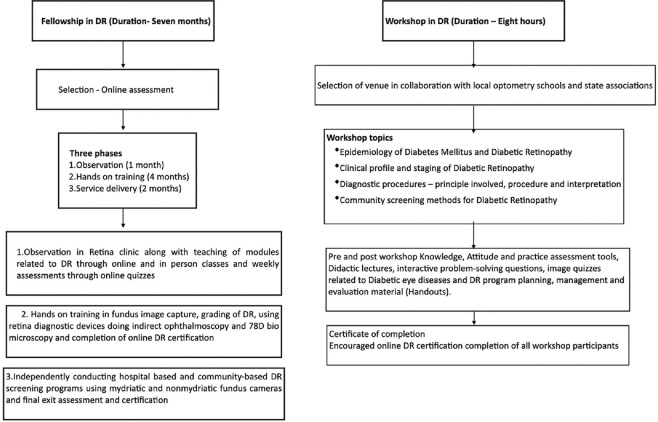
Methods: The DRCB model for optometrists conducted between August 2016 and August 2018 included training, certification in the screening, and referral guidelines for Diabetic Retinopathy (DR) and hospital-and community-based service delivery. Training included a 7-month long fellowship in DR and mentored participation as cofacilitators in 1-day orientation workshops on DR screening guidelines across India. The sensitivity and specificity of study optometrists in screening for DR by fundus photography were compared to a retina specialist before certification.
Results: A total of eight optometrists successfully completed their DR fellowship in the project duration of 24 months. The sensitivity and specificity of detection of any DR were 95 and 79%, any Diabetic macular edema (DME) was 80 and 86%. The sensitivity and specificity of detection of sight threatening DR were 88 and 90% and DME was 72% and 92% respectively. Seven workshops were cofacilitated by study optometrists training 870 optometrists in DR screening guidelines across India.
Conclusion: The present DRCB model results advocate for an optometry coordinated DR screening in India. Lessons learnt from this model can be useful in designing community-based task sharing initiatives for optometrists in DR screening.
Keywords: Diabetic retinopathy; India; optometrist training; task sharing.
Conflict of interest statement
None
Figures
Comment in
-
Commentary: Training optometrists and allied ophthalmic personnel: Expanding horizon of diabetic retinopathy screening in India.Indian J Ophthalmol. 2021 Mar;69(3):659-660. doi: 10.4103/ijo.IJO_250_21. Indian J Ophthalmol. 2021. PMID: 33595496 Free PMC article. No abstract available.
References
-
- Saeedi P, Petersohn I, Salpea P, Malanda B, Karuranga S, Unwin N, et al. Global and regional diabetes prevalence estimates for 2019 and projections for 2030 and 2045: Results from the International diabetes federation diabetes atlas, 9th edition. Diabetes Res Clin Pract. 2019;157:107843. - PubMed
-
- Flaxman SR, Bourne RRA, Resnikoff S, Ackland P, Braithwaite T, Cicinelli MV, et al. Global causes of blindness and distance vision impairment 1990-2020: A systematic review and meta-analysis. Lancet Glob Health. 2017;5:e1221–34. - PubMed
-
- Henriques J, Vaz-Pereira S, Nascimento J, Rosa PC. Diabetic eye disease. Acta Med Port. 2015;28:107–13. - PubMed
-
- International Centre for Eyecare Education Delhi declaration on optometry and blindness prevention. http://www.icee.org/pdf/10-may/20100416_Delhi%20Declaration_FINAL.pdf . In Edition 2009.
MeSH terms
LinkOut - more resources
Full Text Sources
Other Literature Sources
Medical
