Lactate: a multifunctional signaling molecule
- PMID: 33596629
- PMCID: PMC8225492
- DOI: 10.12701/yujm.2020.00892
Lactate: a multifunctional signaling molecule
Abstract
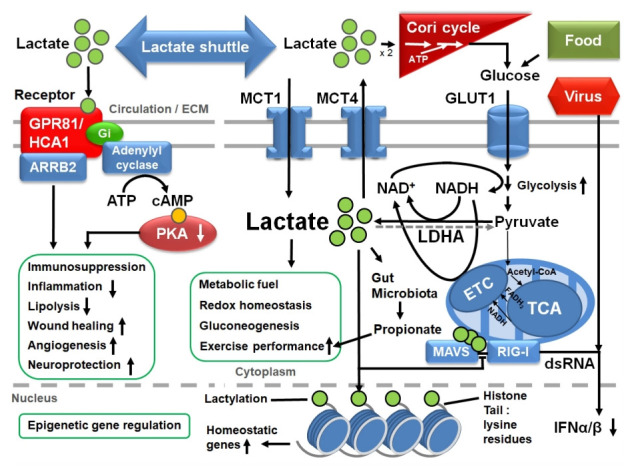
Since its discovery in 1780, lactate has long been misunderstood as a waste by-product of anaerobic glycolysis with multiple deleterious effects. Owing to the lactate shuttle concept introduced in the early 1980s, a paradigm shift began to occur. Increasing evidence indicates that lactate is a coordinator of whole-body metabolism. Lactate is not only a readily accessible fuel that is shuttled throughout the body but also a metabolic buffer that bridges glycolysis and oxidative phosphorylation between cells and intracellular compartments. Lactate also acts as a multifunctional signaling molecule through receptors expressed in various cells and tissues, resulting in diverse biological consequences including decreased lipolysis, immune regulation, anti-inflammation, wound healing, and enhanced exercise performance in association with the gut microbiome. Furthermore, lactate contributes to epigenetic gene regulation by lactylating lysine residues of histones, accounting for its key role in immune modulation and maintenance of homeostasis.
Keywords: Glycolysis; Homeostasis; Lactate; Lactylation; Shuttle; Warburg effect.
Conflict of interest statement
No potential conflict of interest relevant to this article was reported.
Figures
References
-
- Hsu PP, Sabatini DM. Cancer cell metabolism: Warburg and beyond. Cell. 2008;134:703–7. - PubMed
-
- Warburg O, Minami S. Versuche an überlebendem carcinom-gewebe. Klin Wochenschr. 1923;2:776–7.
-
- Warburg O. On the origin of cancer cells. Science. 1956;123:309–14. - PubMed
-
- Ferguson BS, Rogatzki MJ, Goodwin ML, Kane DA, Rightmire Z, Gladden LB. Lactate metabolism: historical context, prior misinterpretations, and current understanding. Eur J Appl Physiol. 2018;118:691–728. - PubMed
LinkOut - more resources
Full Text Sources
Other Literature Sources