


Does insulin resistance influence neurodegeneration in non-diabetic Alzheimer's subjects?
- PMID: 33597002
- PMCID: PMC7890851
- DOI: 10.1186/s13195-021-00784-w
Does insulin resistance influence neurodegeneration in non-diabetic Alzheimer's subjects?
Abstract
Background: Type 2 diabetes is a risk factor for Alzheimer's disease (AD), and AD brain shows impaired insulin signalling. The role of peripheral insulin resistance on AD aetiopathogenesis in non-diabetic patients is still debated. Here we evaluated the influence of insulin resistance on brain glucose metabolism, grey matter volume and white matter lesions (WMLs) in non-diabetic AD subjects.
Methods: In total, 130 non-diabetic AD subjects underwent MRI and [18F]FDG PET scans with arterial cannula insertion for radioactivity measurement. T1 Volumetric and FLAIR sequences were acquired on a 3-T MRI scanner. These subjects also had measurement of glucose and insulin levels after a 4-h fast on the same day of the scan. Insulin resistance was calculated by the updated homeostatic model assessment (HOMA2). For [18F]FDG analysis, cerebral glucose metabolic rate (rCMRGlc) parametric images were generated using spectral analysis with arterial plasma input function.
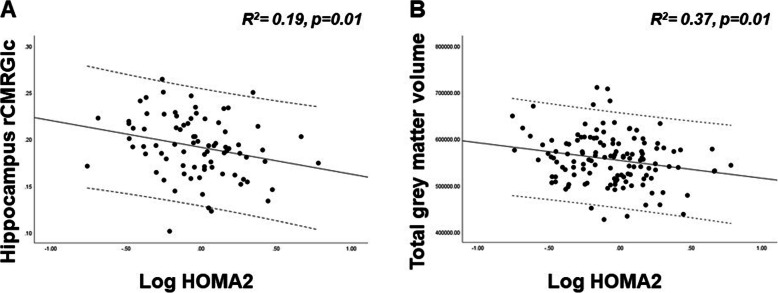
Results: In this non-diabetic AD population, HOMA2 was negatively associated with hippocampal rCMRGlc, along with total grey matter volumes. No significant correlation was observed between HOMA2, hippocampal volume and WMLs.
Conclusions: In non-diabetic AD, peripheral insulin resistance is independently associated with reduced hippocampal glucose metabolism and with lower grey matter volume, suggesting that peripheral insulin resistance might influence AD pathology by its action on cerebral glucose metabolism and on neurodegeneration.
Keywords: Alzheimer’s disease; Insulin resistance; Magnetic resonance imaging; Positron emission tomography imaging.
Conflict of interest statement
The other authors have nothing to declare in relation to this manuscript.
Figures
References
-
- Ngandu T, Lehtisalo J, Solomon A, Levalahti E, Ahtiluoto S, Antikainen R, et al. A 2 year multidomain intervention of diet, exercise, cognitive training, and vascular risk monitoring versus control to prevent cognitive decline in at-risk elderly people (FINGER): a randomised controlled trial. Lancet. 2015;385(9984):2255–2263. doi: 10.1016/S0140-6736(15)60461-5. - DOI - PubMed
Publication types
MeSH terms
Substances
LinkOut - more resources
Full Text Sources
Other Literature Sources
Medical
