


Polyparasitism with Schistosoma haematobium, Plasmodium and soil-transmitted helminths in school-aged children in Muyuka-Cameroon following implementation of control measures: a cross sectional study
- PMID: 33597042
- PMCID: PMC7890808
- DOI: 10.1186/s40249-021-00802-x
Polyparasitism with Schistosoma haematobium, Plasmodium and soil-transmitted helminths in school-aged children in Muyuka-Cameroon following implementation of control measures: a cross sectional study
Abstract
Background: Despite the ubiquity of polyparasitism, its health impacts have been inadequately studied. The aim of this study was to determine the prevalence and determinants of polyparasitism with Schistosoma haematobium, Plasmodium and soil-transmitted helminths (STH) following sustained control measures, as well as evaluate the outcomes and clinical correlates of infection in school-aged children (SAC) living in the schistosomiasis endemic focus of Muyuka-Cameroon.
Methods: In a cross-sectional study, urine, blood and stool samples were each collected from SAC (4-14 years) selected at random between March and June 2015. Microhaematuria in urine was detected using reagent strip and S. haematobium ova by filtration/microscopy methods. Plasmodium was detected using Giemsa-stained blood films and complete blood count was obtained using an auto-haematology analyser. STH in stool was detected by the Kato-Katz method. Categorical and continuous variables were compared as required, Kappa value estimated and the adjusted odds ratio (aOR) in the multivariate analysis was used to evaluate association of the risk factors with infection.
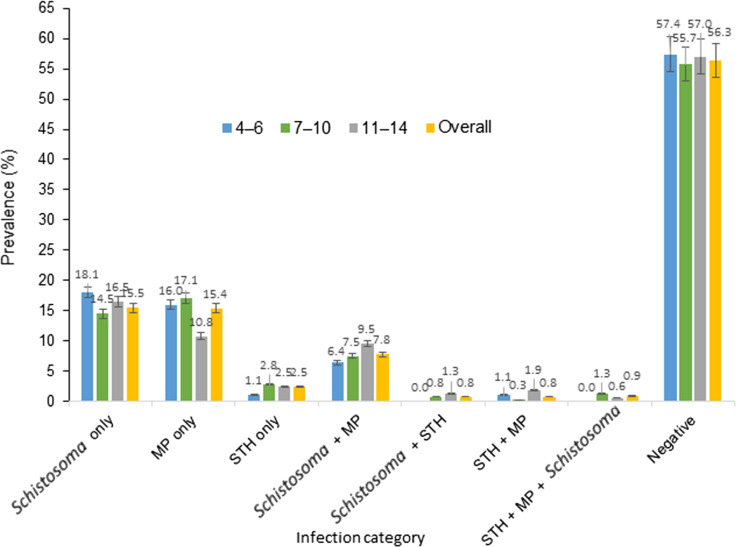
Results: Out of the 638 SAC examined, single infection was prevalent in 33.4% while polyparasitism was 19.9%. Prevalence of S. haematobium + Plasmodium was 7.8%; S. haematobium + STH was 0.8%; Plasmodium + STH was 0.8%; while S. haematobium + Plasmodium + STH was 0.9%. Higher preponderance of S. haematobium + Plasmodium infection occurred in females, those from Likoko, did not use potable water, practiced bathing in stream and carried out open defecation than their equivalents. However, being female (aOR = 2.38, P = 0.009) was the only significant risk factor identified. Anaemia was a common morbidity (74.3%) with a slight agreement with microscopy in predicting S. haematobium and Plasmodium infections. The sensitivity and specificity of haematuria (13.0%) in predicting S. haematobium infection was 46.5% and 100% with a moderate agreement with microscopy. Co-infection with S. haematobium and malaria parasite was significantly associated with threefold odds of history of fever in the last three days.
Conclusions: Polyparasitism is a public health problem in Muyuka with females most at risk. Anaemia prevalence is exacerbated in co- and triple-infections and together with a history of fever are of value in predicting polyparasitism.
Keywords: Cameroon; Morbidity; Plasmodium; Polyparasitism; Risk factor; Schistosoma haematobium; School-age children; Soil-transmitted helminths.
Conflict of interest statement
The authors declare that they have no competing interests.
Figures

References
-
- WHO. Schistosomiasis fact sheet. Global Health Observatory (GHO) data. Schistosomiasis: Situations and trends. 2020. https://www.who.int/gho/neglected_diseases/schistosomiasis/en/. Accessed 17 Dec 2020.
-
- WHO Fact sheets soil-transmitted helminth infections. 2020. https://www.soil-transmittedhelminthinfections (who.int). Accessed 17 Dec 2020.
-
- WHO. World Malaria report 2019. World Health Organization 2019. https://reliefweb.int/sites/reliefweb.int/files/resources/9789241565721-.... Accessed 17 Dec 2020.
Publication types
MeSH terms
Substances
LinkOut - more resources
Full Text Sources
Other Literature Sources
Medical
