Review
. 2021 Jun 4;48(3-4):kuab017.
doi: 10.1093/jimb/kuab017.

Effective approaches to discover new microbial metabolites in a large strain library

Affiliations
Review

Effective approaches to discover new microbial metabolites in a large strain library

Mitja M Zdouc et al. J Ind Microbiol Biotechnol. .

Abstract

Natural products have provided many molecules to treat and prevent illnesses in humans, animals and plants. While only a small fraction of the existing microbial diversity has been explored for bioactive metabolites, tens of thousands of molecules have been reported in the literature over the past 80 years. Thus, the main challenge in microbial metabolite screening is to avoid the re-discovery of known metabolites in a cost-effective manner. In this perspective, we report and discuss different approaches used in our laboratory over the past few years, ranging from bioactivity-based screening to looking for metabolic rarity in different datasets to deeply investigating a single Streptomyces strain. Our results show that it is possible to find novel chemistry through a limited screening effort, provided that appropriate selection criteria are in place.

Keywords: Planomonospora; Streptomyces; Actinomycetes; Antibiotics; New RiPP family; Pseudouridimycin.


Figures

Fig. 1
Fig. 1
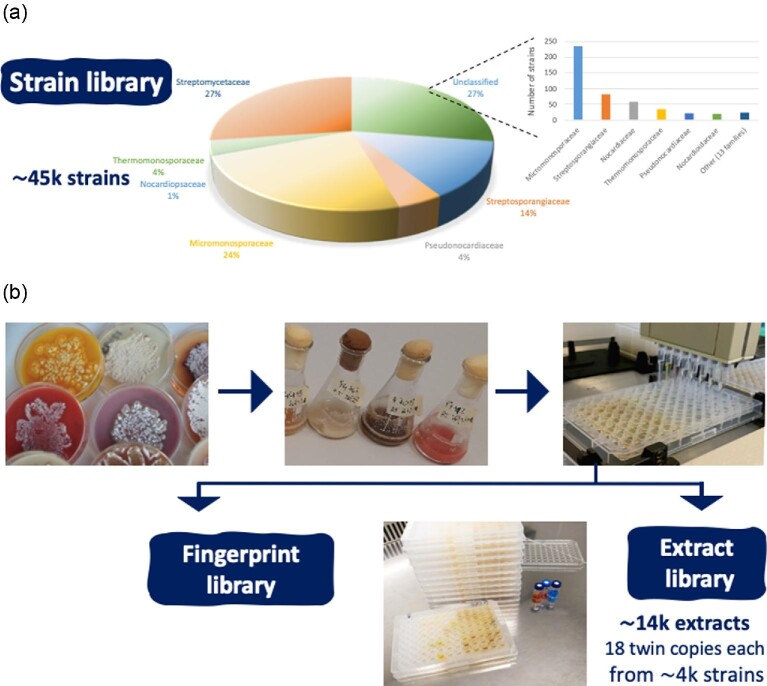
The NAICONS strain (a) and extract libraries (b) as of September 2020. (a) The top portion shows the distribution of strains at family level as previously reported (Monciardini et al., 2014). The enlargement shows the distribution into families of an “unclassified” portion of the strain library, as detailed in the text. (b) Schematic flow for the preparation of the extract library and the generation of the LC–MS fingerprints.
Fig. 2
Fig. 2
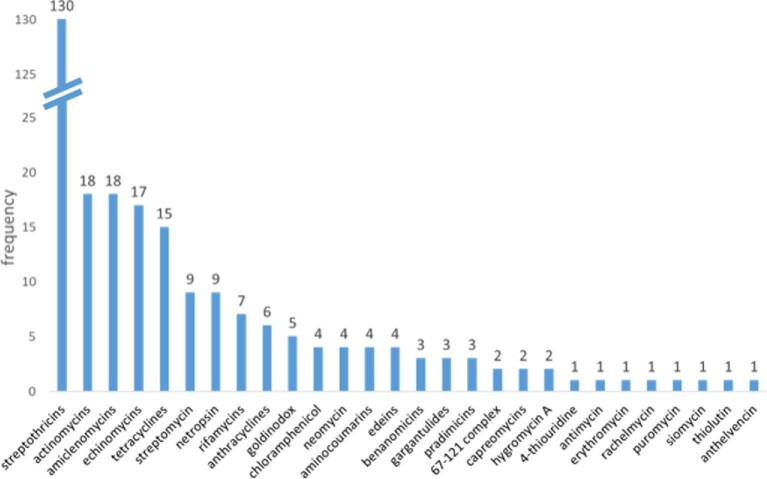
Frequency of molecules dereplicated in about 300 extracts inhibiting growth of either Klebsiella pneumoniae and/or Acinetobacter baumannii. Each bar may represent different metabolite belonging to the same molecular family.
Fig. 3
Fig. 3
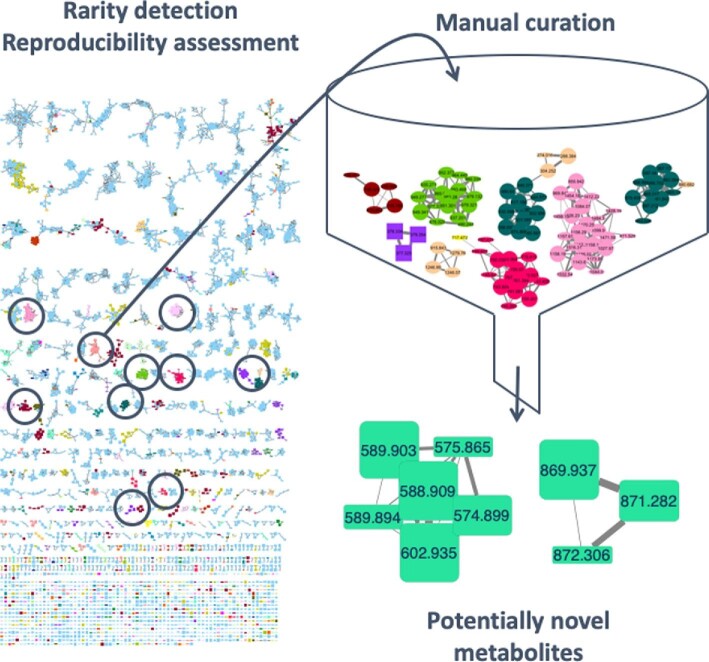
Rarity-based approach for finding novel metabolites. Families identified by molecular networking were searched for rarity and reproducibility (left portion), followed by manual curation, leading to the identification of two molecular families (bottom right).
Fig. 4
Fig. 4
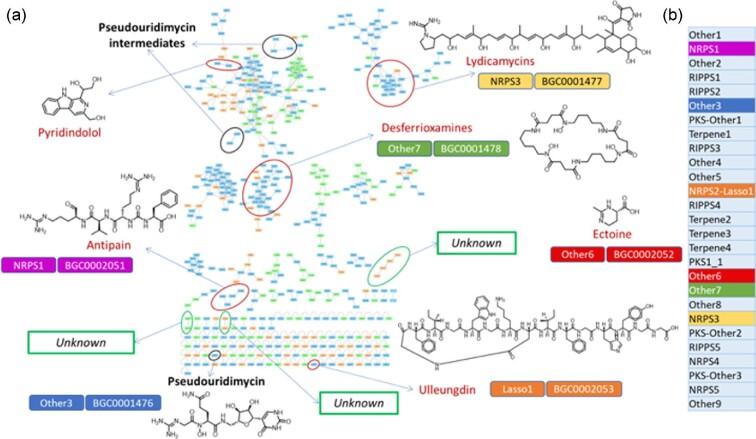
Metabolite investigation of the pseudouridimycin producer Streptomyces sp. ID38640. (a) Complete molecular network of 44 extracts from the wild-type strain and its knockout pum mutant strains. The network encompasses 475 features (= nodes), of which 369 were organized in 36 molecular families. Node colors give the contributing medium: orange for M8, green for PumP1, light blue for both. Black circles indicate PUM-related nodes, red circles indicate nodes corresponding to known compounds, green circles show potentially novel metabolites. The identified biosynthetic gene clusters are shown next to each metabolite, while the AntiSMASH (Montalbán-López et al., 2021) output of the entire genome in panel B. Note that ectoine is not present in the molecular network because of its limited number of MS/MS fragments. See Iorio et al. for further details (Iorio et al., 2021).
Fig. 5
Fig. 5
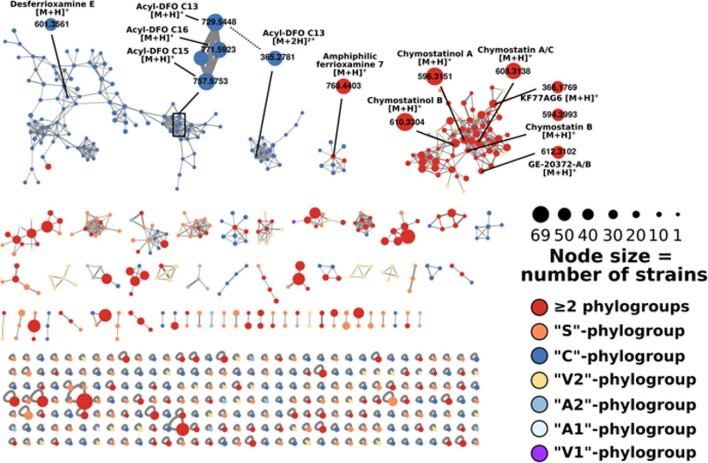
Complete molecular network of 286 Planomonospora extracts (obtained from 72 strains) and selected annotated molecular families. Node size correlates to the number of contributing strains, while the colors give the contributing phylogroup(s). Adapted from Zdouc et al. (2021).
Fig. 6
Fig. 6
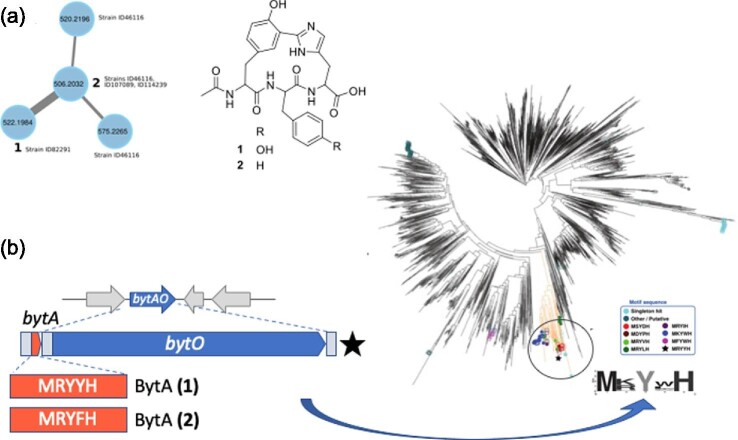
The discovery of biarylitides. (a) Molecular network analysis showing the molecular family consisting of biarylitides YYH (1; m/z 522.19) and YFH (2; m/z 506.2), and the corresponding chemical structures. (b) Left portion, the bytAO-containing region of the Planomonospora sp. ID82291 genome. bytA encodes the 5-aa precursor peptide of 1 and bytO encodes a cytochrome P450 monooxygenase. The 5-aa precursor peptide of 2 from the Planomonospora sp. ID107089 genome is shown below. The DNA segment marked by a start was used for heterologous expression (Zdouc et al., 2020). Right portion: phylogenomic analysis of BytO-related sequences, with the clade containing closely linked pentapeptide-encoding genes shown in orange and highlighted by the circle. The frequency of amino acid occurrence in the pentapeptides at the bottom right. See Zdouc et al. (2020) for further details.

References

    1. Aoyagi T., Kumagai M., Hazato T., Hamada M., Takeuchi T., Umezawa H. (1975). Pyridindolol, a new β-galactosidase inhibitor produced by actinomycetes. Journal of Antibiotics, 28, 555–557. - PubMed
    1. Arnison P. G., Bibb M. J., Bierbaum G., Bowers A. A., Bugni T. S., Bulaj G., Camarero J. A., Campopiano D. J., Challis G. L., Clardy J., Cotter P. D., Craik D. J., Dawson M., Dittmann E., Donadio S., Dorrestein P. C., Entian K. D., Fischbach M. A., Garavelli J. S., van der Donk W. A. (2013). Ribosomally synthesized and post-translationally modified peptide natural products: Overview and recommendations for a universal nomenclature. Natural Product Reports, 30, 108–160. - PMC - PubMed
    1. Baltz R. H. (2019). Natural product drug discovery in the genomic era: Realities, conjectures, misconceptions and opportunities. Journal of Industrial Microbiology & Biotechnology, 46, 281–299. - PubMed
    1. Blin K., Shaw S., Steinke K., Villebro R., Ziemert N., Lee S. Y., Medema M. H., Weber T. (2019). AntiSMASH 5.0: Updates to the secondary metabolite genome mining pipeline. Nucleic Acids Research, 47, W81–W87. - PMC - PubMed
    1. Bruns H., Crüsemann M., Letzel A.-C., Alanjary M., McInerney J. O., Jensen P. R., Schulz S., Moore B. S., Ziemert N. (2018). Function-related replacement of bacterial siderophore pathways. ISME Journal, 12, 320–329. - PMC - PubMed

Substances