


Self-harm during the early period of the COVID-19 pandemic in England: Comparative trend analysis of hospital presentations
- PMID: 33601744
- PMCID: PMC7832687
- DOI: 10.1016/j.jad.2021.01.015
Self-harm during the early period of the COVID-19 pandemic in England: Comparative trend analysis of hospital presentations
Abstract
Background: The COVID-19 pandemic and public health measures necessary to address it may have major effects on mental health, including on self-harm. We have used well-established monitoring systems in two hospitals in England to investigate trends in self-harm presentations to hospitals during the early period of the pandemic.
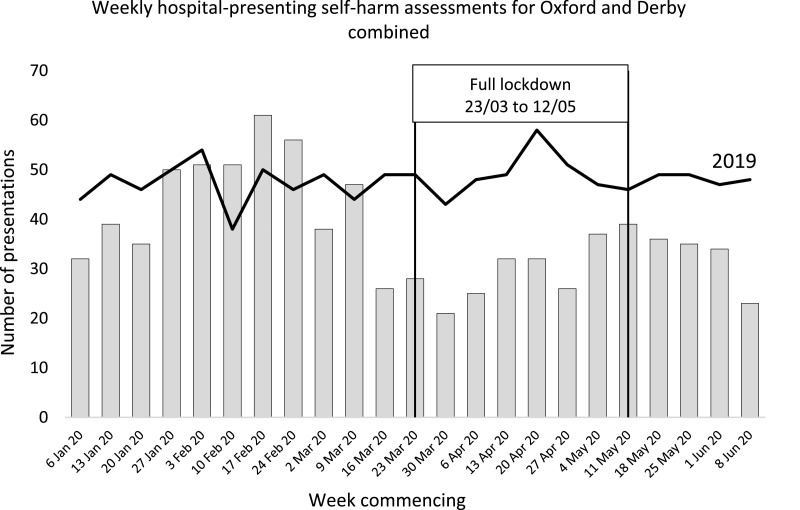
Method: Data collected in Oxford and Derby on patients aged 18 years and over who received a psychosocial assessment after presenting to the emergency departments following self-harm were used to compare trends during the three-month period following lockdown in the UK (23rd March 2020) to the period preceding lockdown and the equivalent period in 2019.
Results: During the 12 weeks following introduction of lockdown restrictions there was a large reduction in the number of self-harm presentations to hospitals by individuals aged 18 years and over compared to the pre-lockdown weeks in 2020 (mean weekly reduction of 13.5 (95% CI 5.6 - 21.4) and the equivalent period in 2019 (mean weekly reduction of 18.0 (95% CI 13.9 - 22.1). The reduction was greater in females than males, occurred in all age groups, with a larger reduction in presentations following self-poisoning than self-injury.
Conclusions: A substantial decline in hospital presentations for self-harm occurred during the three months following the introduction of lockdown restrictions. Reasons could include a reduction in self-harm at the community level and individuals avoiding presenting to hospital following self-harm. Longer-term monitoring of self-harm behaviour during the pandemic is essential, together with efforts to encourage help-seeking and the modification of care provision.
Copyright © 2021. Published by Elsevier B.V.
Conflict of interest statement
KH declare grants from the National Institute for Health Research and the Department of Health and Social Care. He is a member of the National Suicide Prevention Strategy for England Advisory Group. All other authors declare no competing interests.
KH is a National Institute for Health Research (NIHR) Senior Investigator (Emeritus). The views expressed are those of the authors and not necessarily those of the NHS, the NIHR, or the Department of Health and Social Care.
Figures
References
-
- Chen S., Jones P.B., Underwood B.R., Moore A., Bullmore E.T., Banerjee S., Osimo E.F., Deakin J.B., Hatfield C.F., Thompson F.J., Artingstall J.D., Slann M.P., Lewis J.R., Cardinal R.N. The early impact of COVID-19 on mental health and community physical health services and their patients’ mortality in Cambridgeshire and Peterborough, UK. J. Psychitr. Res. 2020;131:244–254. - PMC - PubMed
-
- Cooper J., Steeg S., Bennewith O., Lowe M., Gunnell D., House A., Hawton K., Kapur N. Are hospital services for self-harm getting better? An observational study examining management, service provision and temporal trends. BMJ Open. 2013;3 doi: 10.1136/bmjopen-2013-003444. e003444. - DOI - PMC - PubMed
-
- Fancourt D., Bu F., WanMak H., Steptoe A. University College London; 2020. Covid-19 Social Study.https://www.covidsocialstudy.org/results
MeSH terms
LinkOut - more resources
Full Text Sources
Other Literature Sources
Medical
Miscellaneous
