


Menstrual dysfunction in polycystic ovary syndrome: association with dynamic state insulin resistance rather than hyperandrogenism
- PMID: 33602559
- PMCID: PMC10322211
- DOI: 10.1016/j.fertnstert.2020.12.015
Menstrual dysfunction in polycystic ovary syndrome: association with dynamic state insulin resistance rather than hyperandrogenism
Abstract
Objective: To examine the relation of menstrual cyclicity abnormalities to hyperandrogenism (HA) and dynamic state insulin resistance (IR) in oligo-ovulatory women with polycystic ovary syndrome (PCOS).
Design: Prospective cross-sectional study.
Setting: Tertiary-care academic center.
Patient(s): Fifty-seven women with PCOS (1990 National Institutes of Health criteria) and 57 healthy control women matched by body mass index (BMI).
Intervention(s): Short insulin tolerance test (ITT).
Main outcome measure(s): Menstrual cyclicity, sex hormone-binding globulin (SHBG), measures of HA (i.e., modified Ferriman-Gallwey score, total and free testosterone, dehydroepiandrosterone sulfate), and the rate constant for plasma glucose disappearance (kITT) derived from the short ITT.
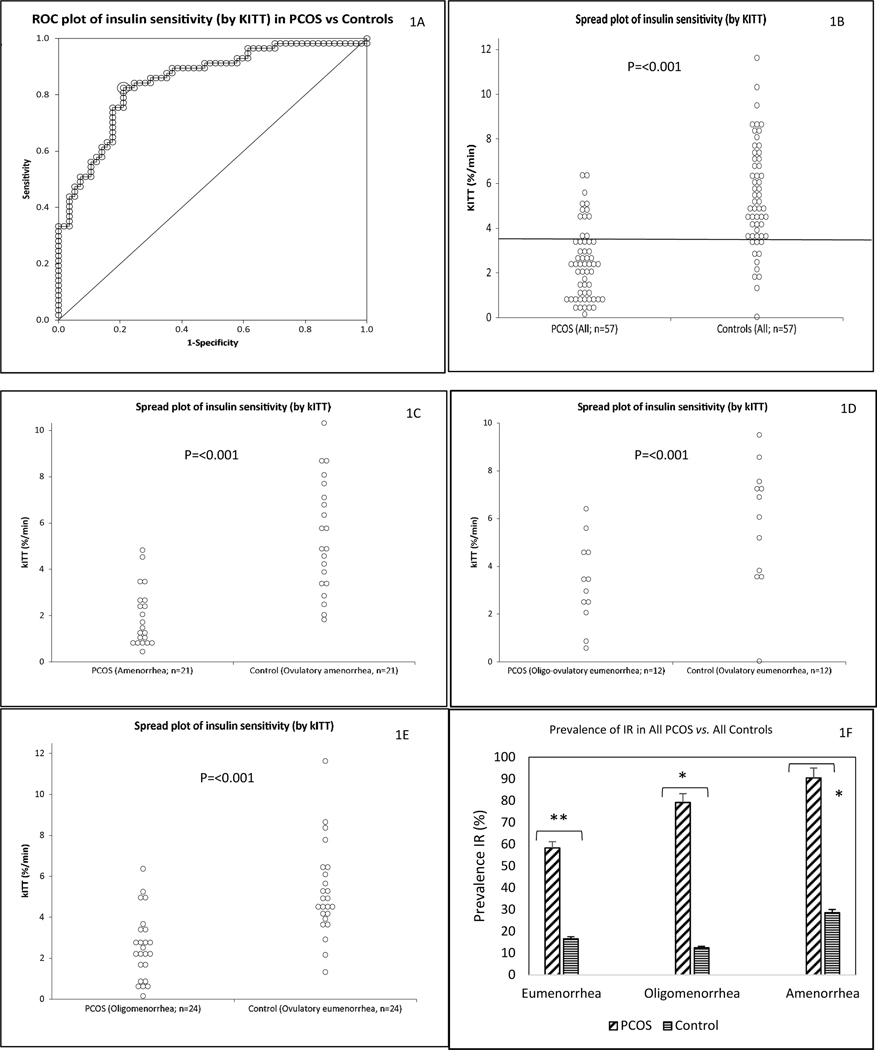
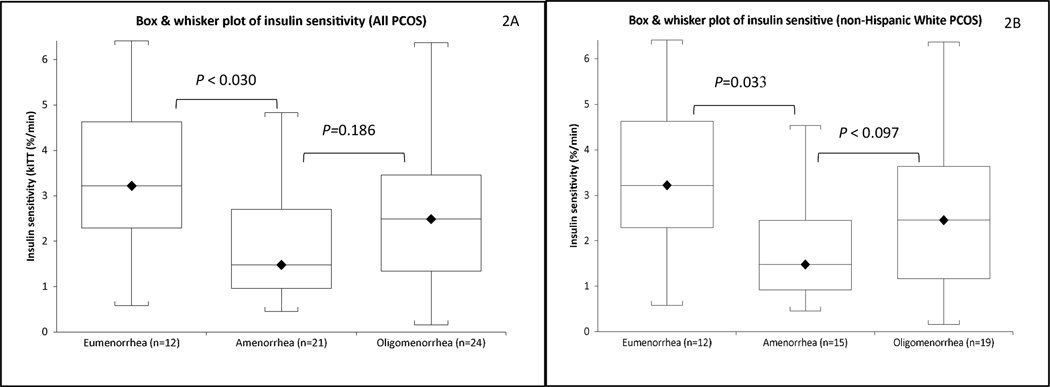
Result(s): Adjusting for age, BMI, and ethnicity, the mean androgen measures were higher and SHBG trended lower, kITT was lower, and the prevalence of IR was higher in PCOS than in controls, independent of menstrual cyclicity. The optimal cutoff point for IR was set at kITT value of 3.57%/minute or lower. Overall, 79% of the women with PCOS had IR. To control further for the effect of ethnicity, a subgroup of 46 non-Hispanic white PCOS participants were studied; those who exhibited amenorrhea (n = 15) or oligomenorrhea (n = 19) had or tended toward having a lower kITT and a higher prevalence of IR than the women with PCOS and oligo-ovulatory eumenorrhea (n = 12). The kITT trended lower and the prevalence of IR trended higher in women with PCOS and amenorrhea than those with oligomenorrhea. The measures of SHBG and HA were similar across the three menstrual groups.
Conclusion(s): Oligo-ovulatory women with PCOS and overt oligo/amenorrhea have greater degrees of IR but not HA when compared with oligo-ovulatory eumenorrheic women with PCOS, suggesting that IR and hyperinsulinemia but not HA play a role in determining the degree of menstrual dysfunction, which can be used as a clinical marker for the degree of IR in oligo-ovulatory PCOS.
Keywords: Dynamic state; PCOS; insulin resistance; menstrual dysfunction.
Copyright © 2020 American Society for Reproductive Medicine. Published by Elsevier Inc. All rights reserved.
Figures
Comment in
-
Insulin resistance: still an underestimated factor in polycystic ovary syndrome?Fertil Steril. 2021 Jun;115(6):1447-1448. doi: 10.1016/j.fertnstert.2021.03.020. Epub 2021 Apr 15. Fertil Steril. 2021. PMID: 33863552 No abstract available.
References
-
- Azziz R, Carmina E, Dewailly D, Diamanti-Kandarakis E; Escobar-Morreale HF; Futterweit W, et al. The Androgen Excess and PCOS Society criteria for the polycystic ovary syndrome: the complete task force report. Fertil Steril. 2009; 91: 456–88. - PubMed
-
- Dunaif A, Segal KR, Futterweit W, Dobrjansky A. Profound peripheral insulin resistance, independent of obesity, in polycystic ovary syndrome. Diabetes. 1989; 38: 1165–74. - PubMed
-
- Ezeh U, Ida Chen YD, Azziz R. Racial and ethnic differences in the metabolic response of polycystic ovary syndrome Clin Endocrinol (Oxf). 2020; 93: 163–72. - PubMed
-
- Azziz R, Marin C, Hoq L, Badamgarav E, Song P. Health care-related economic burden of the polycystic ovary syndrome during the reproductive life span. J Clin Endocrinol Metab. 2005; 90: 4650–58. - PubMed
Publication types
MeSH terms
Substances
Grants and funding
LinkOut - more resources
Full Text Sources
Other Literature Sources
Medical
Miscellaneous
