


Burnout syndrome in pediatric urology: A perspective during the COVID-19 pandemic - Ibero-American survey
- PMID: 33602610
- PMCID: PMC8658184
- DOI: 10.1016/j.jpurol.2021.01.015
Burnout syndrome in pediatric urology: A perspective during the COVID-19 pandemic - Ibero-American survey
Abstract
Introduction: Burnout syndrome is a major cause of decreased life quality, mental health, and productivity for physicians. It is strongly related to work overload and has been a scarcely studied topic in pediatric urology. During the COVID-19 pandemic, authorities' recommendations have led to big changes in pediatric urology practice worldwide. This study aimed to evaluate the level of burnout in Ibero-American pediatric urologists (IPUs) during this pandemic.
Material and methods: A cross-sectional study was conducted by applying an electronic survey during the COVID-19 pandemic peak to members of the two major associations of pediatric urology in Ibero-America (the Ibero-American Society of Pediatric Urology [SIUP] and the Brazilian School of Pediatric Urology [BSPU]) to evaluate demographic, pre-pandemic, and pandemic data. Burnout levels were assessed using the Copenhagen Burnout Inventory (CBI) questionnaire.
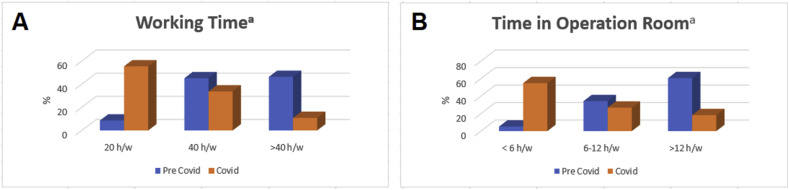
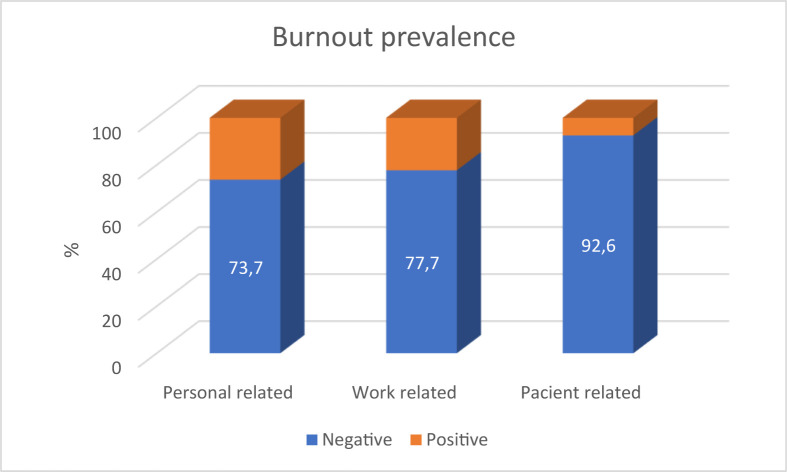
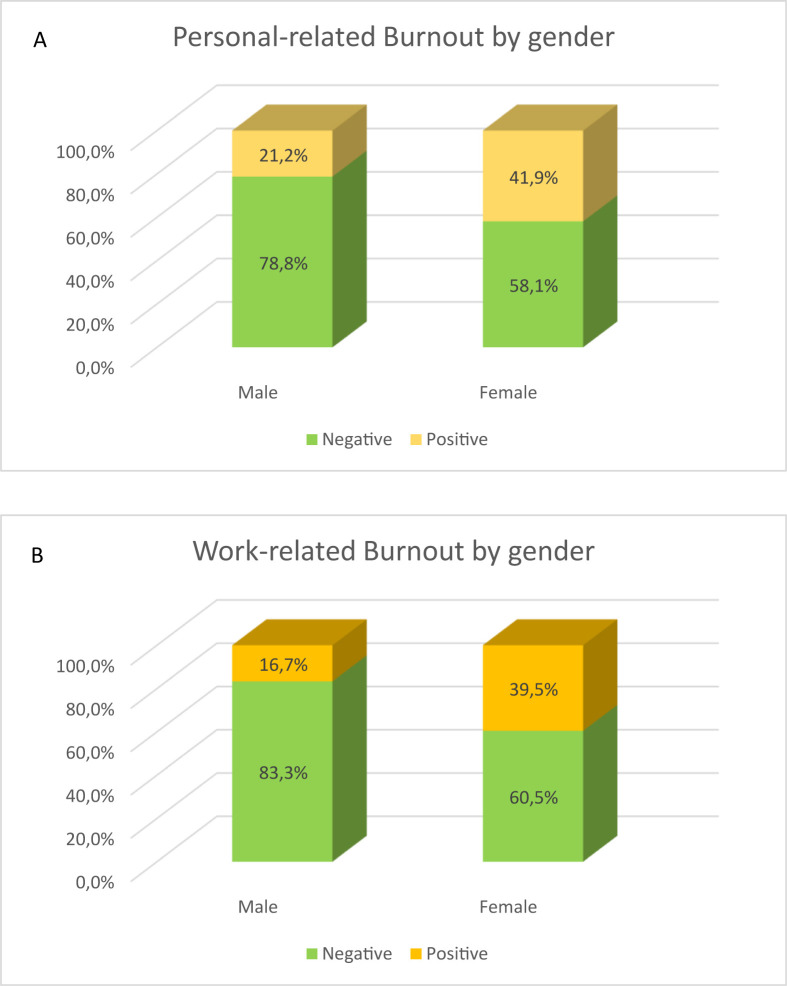
Results: A response rate of 40% was obtained (182 out of 455 IPU respondents). Participants were from 14 different countries in Ibero-America and 75.4% were male. Data showed that during the pandemic there was a significant decrease in weekly workload, that is: > 40 h per week (h/w) (91.4%-44.6%, p < 0.001); and >6 h/w (94.9%-45.1%%, p < 0.001) in operating room time (ORT). Personal (Pe-BO), work-related (W-BO), and patient-related (Pa-BO) burnout levels among IPUs were 26.3%, 22.3%, and 7.4%, respectively (Summary table). An important difference by gender was seen, with women suffering more from the syndrome (odds ratio of 2.67 [95% confidence interval, 1.285.58; p = 0.013] for Pe-BO and OR of 3.26 [95% CI, 1.52-7.01; p = 0.004] for W-BO).
Conclusion: A significant decrease in workload for IPU during the pandemic was observed, as well as a low level of burnout syndrome during this time. However, the predominance of burnout in women found in this study is notable.
Keywords: COVID-19; Mental health; Pandemic; Pediatric urology; Professional burnout.
Copyright © 2021 Journal of Pediatric Urology Company. Published by Elsevier Ltd. All rights reserved.
Figures
Comment in
-
Commentary to "Burnout syndrome in pediatric urology: A perspective during the COVID-19 pandemic - Ibero-American surveyˮ.J Pediatr Urol. 2021 Jun;17(3):404-405. doi: 10.1016/j.jpurol.2021.01.052. Epub 2021 Mar 11. J Pediatr Urol. 2021. PMID: 33775571 No abstract available.
-
Commentary to 'Burnout syndrome in pediatric urology: A perspective during the COVID-19 pandemic - Ibero-American survey'.J Pediatr Urol. 2021 Jun;17(3):403. doi: 10.1016/j.jpurol.2021.01.051. Epub 2021 Mar 11. J Pediatr Urol. 2021. PMID: 33785284 No abstract available.
References
-
- Maslach C., Jackson S.E. The measurement of experienced burnout. J Organ Behav. 1981;2:99–113. doi: 10.1002/job.4030020205. - DOI
-
- Kristensen T.S., Borritz M., Villadsen E., Christensen K.B. The Copenhagen Burnout Inventory: a new tool for the assessment of burnout. Work Stress. 2005;19:192–207. doi: 10.1080/02678370500297720. - DOI
-
- Fonte CMS da. Universidade de Coimbra; 2011. Adaptação E validação para português do questionário de copenhagen burnout inventory (CBI)
-
- Molinero-Ruiz E., Basart-Gómez Quintero H., Moncada-Lluis S. Validation OF the Spanish version OF the copenhagen burnout inventory questionnaire. Rev Esp Salud Publica. 2013;87:165–179. - PubMed
Publication types
MeSH terms
LinkOut - more resources
Full Text Sources
Other Literature Sources
Medical
