


Concurrent prescriptions for opioids and benzodiazepines and risk of opioid overdose: protocol for a retrospective cohort study using linked administrative data
- PMID: 33602708
- PMCID: PMC7896580
- DOI: 10.1136/bmjopen-2020-042299
Concurrent prescriptions for opioids and benzodiazepines and risk of opioid overdose: protocol for a retrospective cohort study using linked administrative data
Abstract
Introduction: Opioid overdoses have increased substantially over the last 20 years, with over 400 000 deaths in North America. While opioid prescribing has been a target of research, benzodiazepine and opioid co-intoxication has emerged as a potential risk factor. Our aim was to assess the risk of opioid overdose associated with concurrent use of opioids and benzodiazepines relative to opioids alone.
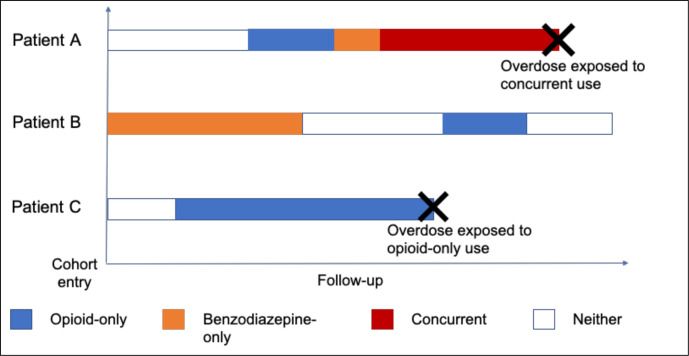
Methods and analysis: A retrospective cohort study will be conducted using medical claims data from adult residents of Montréal, Canada. We will create a cohort of new users of opioids (ie, no opioid dispensations in prior year) in 2000-2014 from people with at least 2 years of continuous health insurance. Those with any diagnosis or hospitalisation for cancer or palliative care in the 2 years before their first opioid dispensation will be excluded. On each person-day of follow-up, exposure status will be classified into one of four mutually exclusive categories: (1) opioid-only, (2) benzodiazepine-only, (3) both opioid and benzodiazepine (concurrent use) or (4) neither. Opioid overdose will be measured using diagnostic codes documented in the hospital discharge abstract database, physician billing claims from emergency department visits and death records. Using a marginal structural Cox proportional hazards model, we will compare the hazard of overdose during intervals of concurrent opioid and benzodiazepine use to intervals of opioid use alone, adjusted for sociodemographics, medical and psychiatric comorbidities, and substance use disorders.
Ethics and dissemination: This study is approved by the McGill Faculty of Medicine Institutional Review Board and the Commission d'access à l'information (Québec privacy commission). Results will be relevant to clinicians, policymakers and other researchers interested in co-prescribing practices of opioids and benzodiazepines. Study findings will be disseminated at relevant conferences and published in biomedical and epidemiological peer-reviewed journals.
Keywords: adverse events; epidemiology; public health.
© Author(s) (or their employer(s)) 2021. Re-use permitted under CC BY-NC. No commercial re-use. See rights and permissions. Published by BMJ.
Conflict of interest statement
Competing interests: None declared.
Figures
References
-
- Hedegaard H, Miniño AM, Warner M. Drug overdose deaths in the United States, 1999-2017. NCHS Data Brief 2018;329:1–8. - PubMed
-
- Canadian Institute for Health Information Opioid-Related harms in Canada. Ottawa, Ontario, 2017. https://www.longwoods.com/articles/images/opioid-harms-chart-book-en.pdf
-
- Public Health Agency of Canada Opioid-related harms in Canada - Age-adjusted rate (per 100,000 population) of total opioid-related poisoning hospitalizations by province or territory, in 2019. Available: https://health-infobase.canada.ca/substance-related-harms/opioids/graphs... [Accessed 14 Oct 2020].
-
- Public Health Agency of Canada Opioid-related harms in Canada - Deaths (September 2020). Available: https://health-infobase.canada.ca/substance-related-harms/opioids/ [Accessed 14 Oct 2020].
Publication types
MeSH terms
Substances
Grants and funding
LinkOut - more resources
Full Text Sources
Other Literature Sources
Medical
