Review
. 2021 Feb 11:13:153-162.
doi: 10.2147/NSS.S278088. eCollection 2021.

Current Understanding of the Chronobiology of Cluster Headache and the Role of Sleep in Its Management

Affiliations
Review

Current Understanding of the Chronobiology of Cluster Headache and the Role of Sleep in Its Management

Mads Barloese. Nat Sci Sleep. .

Abstract

Cluster headache is uniquely rhythmic in its occurrence both diurnally and annually. This has implications for the clinical approach to the patient but also for our understanding of the role of central structures in its pathological basis. Many intrinsic and extrinsic factors seem to influence CH rhythmicity, including genetics. The proclivity for attacks to occur at night and the possible association with particular sleep phenomena, including sleep apnea, have motivated a number of studies which has improved our understanding but many questions remain unanswered. The sleep-headache interaction seems to be bidirectional and possibly both direct and indirect. The latter could involve more disperse networks of homeostatic regulation, which may better encompass recent observations. Treatment of the headache patient with concurrent sleep problems can be particularly challenging, especially considering side-effects and interactions of commonly used medications. While current treatment guidelines do not incorporate chronotherapeutic thinking, some evidence may suggest that application of such principles on an individual level may be beneficial.

Keywords: chronobiology; chronotherapy; cluster headache; sleep.


Conflict of interest statement

The author reports no conflicts of interest for this work.

Figures
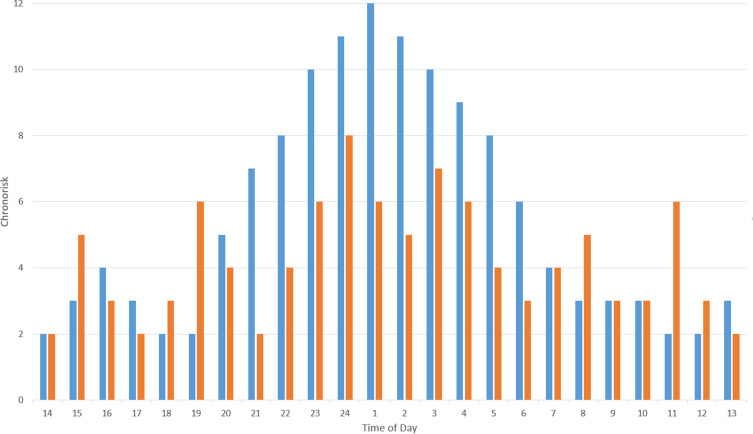
Figure 1
Figure 1
Representative chronorisk analysis of episodic (eCH, blue bars) and chronic (cCH, orange bars) cluster headache patients showing peaks of chronorisk during the 24 hours of the day. Chronic patients have more peaks throughout the day indicating more ultradian oscillation in chronorisk compared to eCH. A detailed description of the methodology behind this analysis is available in references.30,36
Figure 2
Figure 2
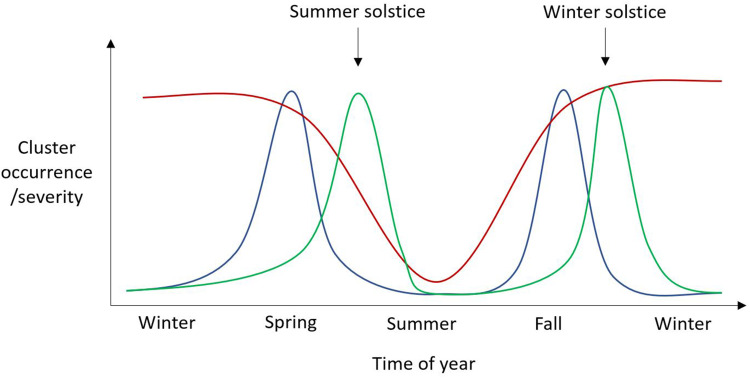
Schematic representation of three possible annual patterns of cluster occurrence/severity. Red line – cluster occurrence/severity improves during the summer months, possibly due to number of daylight hours. Blue line – Clusters occur during the spring and autumn months. Green line – clusters occur around the time of the solstices, possibly due to an inability to synchronize the internal circannual pacemaker.

References

    1. Goadsby PJ. Pathophysiology of cluster headache: a trigeminal autonomic cephalgia. Lancet Neurol. 2002;1(4):251–257. doi: 10.1016/S1474-4422(02)00104-7 - DOI - PubMed
    1. Headache Classification Committee of the International Headache Society (IHS). The International Classification of Headache Disorders, 3rd edition. Cephalalgia. 2018;38(1):1–211. doi: 10.1177/0333102417738202. - DOI - PubMed
    1. Barloese M, Lund N, Jensen R. Sleep in trigeminal autonomic cephalagias: a review. Cephalalgia. 2014;34(10):813–822. doi: 10.1177/0333102414537726 - DOI - PubMed
    1. Burish MJ, Chen Z, Yoo SH. Cluster headache is in part a disorder of the circadian system. JAMA Neurol. 2018;75(7):783–784. doi: 10.1001/jamaneurol.2018.1049 - DOI - PMC - PubMed
    1. Lund N, Barloese M, Petersen A, Haddock B, Jensen R. Chronobiology differs between men and women with cluster headache, clinical phenotype does not. Neurology. 2017;88(11):1069–1076. doi: 10.1212/WNL.0000000000003715 - DOI - PubMed

LinkOut - more resources