. 2021 Jan 27;12(2):295-301.
doi: 10.1021/acsmedchemlett.0c00674. eCollection 2021 Feb 11.

Discovery of Dipeptides as Potent Botulinum Neurotoxin A Light-Chain Inhibitors

Affiliations

Discovery of Dipeptides as Potent Botulinum Neurotoxin A Light-Chain Inhibitors

Martin Amezcua et al. ACS Med Chem Lett. .

Abstract

The botulinum neurotoxin, the caustic agent that causes botulism, is the most lethal toxin known to man. The neurotoxin composed of a heavy chain (HC) and a light chain (LC) enters neurons and cleaves SNARE proteins, leading to flaccid paralysis, which, in severe occurrences, can result in death. A therapeutic target for botulinum neurotoxin (BoNT) intoxication is the LC, a zinc metalloprotease that directly cleaves SNARE proteins. Herein we report dipeptides containing an aromatic connected to the N-terminus via a sulfonamide and a hydroxamic acid at the C-terminus as BoNT/A LC inhibitors. On the basis of a structure-activity relationship study, 33 was discovered to inhibit the BoNT/A LC with an IC50 of 21 nM. X-ray crystallography analysis of 30 and 33 revealed that the dipeptides inhibit through a competitive mechanism and identified several key intermolecular interactions.


Conflict of interest statement

The authors declare no competing financial interest.

Figures
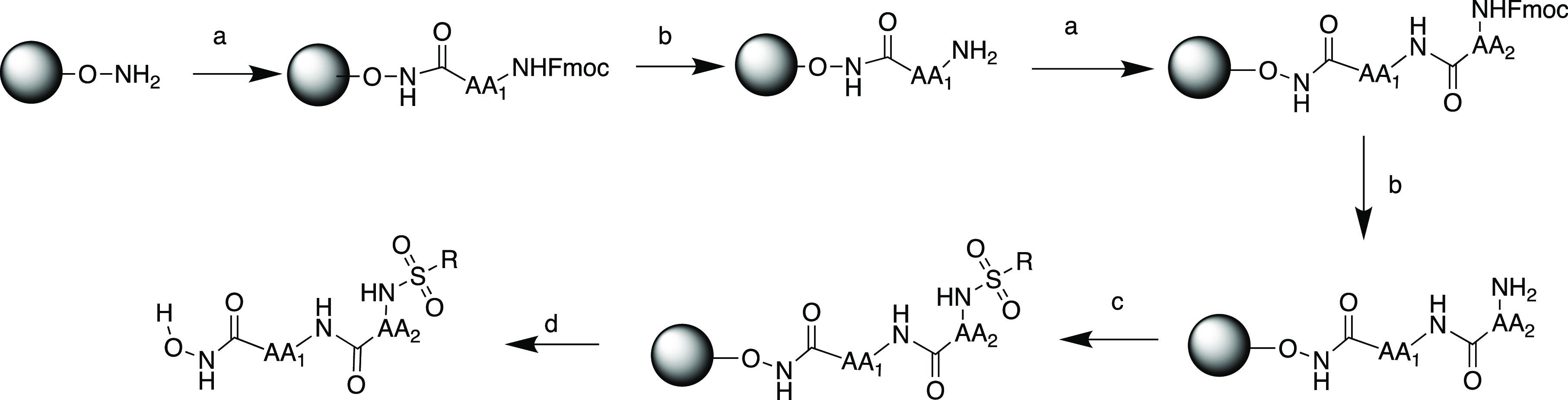
Scheme 1
Scheme 1. Synthesis of Dipeptides
Reagents and conditions: (a) Fmoc-protected amino acid, HOBt, DIC, DMF; (b) 25% PIP in DMF; (c) sulfonyl chloride, 2,6-lutidine, DCM; (d) 50% TFA in DCM.
Figure 1
Figure 1
X-ray crystal structure of 30 bound to the BoNT/A LC active site (PDB 7KYF). Green dashed lines represent intermolecular contacts generated with ChimeraX.
Figure 2
Figure 2
X-ray crystal structure of 33 bound to the BoNT/A LC active site (PDB 7KYH). Green dashed lines represent intermolecular contacts generated with ChimeraX.

References

    1. Pirazzini M.; Rossetto O.; Eleopra R.; Montecucco C. Botulinum Neurotoxins: Biology, Pharmacology, and Toxicology. Pharmacol. Rev. 2017, 69 (2), 200–235. 10.1124/pr.116.012658. - DOI - PMC - PubMed
    1. Simpson L. The life history of a botulinum toxin molecule. Toxicon 2013, 68, 40–59. 10.1016/j.toxicon.2013.02.014. - DOI - PubMed
    1. Gill D. M. Bacterial toxins: a table of lethal amounts. Microbiol. Rev. 1982, 46 (1), 86–94. 10.1128/MR.46.1.86-94.1982. - DOI - PMC - PubMed
    1. Rossetto O.; Montecucco C. Tables of Toxicity of Botulinum and Tetanus Neurotoxins. Toxins 2019, 11 (12), 686. 10.3390/toxins11120686. - DOI - PMC - PubMed
    1. Arnon S. S.; Schechter R.; Inglesby T. V.; et al. Botulinum toxin as a biological weapon: Medical and public health management. JAMA 2001, 285 (8), 1059–1070. 10.1001/jama.285.8.1059. - DOI - PubMed

LinkOut - more resources
