


The Influence of Mode-of-Injury on Psychological Readiness for Return-To-Sport Following Anterior Cruciate Ligament Reconstruction: A Matched-Controlled Study
- PMID: 33604148
- PMCID: PMC7872442
- DOI: 10.26603/001c.18794
The Influence of Mode-of-Injury on Psychological Readiness for Return-To-Sport Following Anterior Cruciate Ligament Reconstruction: A Matched-Controlled Study
Abstract
Background: Self-efficacy and fear of re-injury have been documented as factors related to an athlete's ability to return-to-sport after anterior cruciate ligament (ACL) reconstruction. The purpose of this study was to compare psychological readiness between athletes injured in their primary mode of sport versus those injured outside of their primary sport following ACL reconstruction.
Hypothesis: Athletes sustaining 'in-sport' injuries will demonstrate poorer psychological readiness when compared their matched counterparts injured outside of their primary sport.
Study design: Case-Control Study.
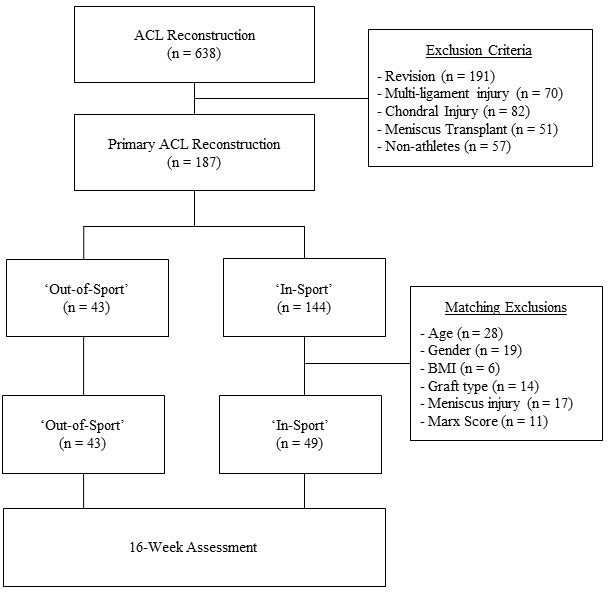
Methods: A single-surgeon database of 638 patients following ACL reconstruction was used to conduct a matched case-control analysis. Psychological readiness was examined 16-weeks postoperatively using the ACL-Return to Sport after Injury (ACL-RSI) questionnaire with subgroup analyses for the 'emotional', 'confidence' and 'injury-risk' subscales. Subject matching was performed for baseline patient and surgical demographics. All statistical comparisons were performed using a one-way (group) analysis variance (ANOVA) at a significance level of α = .05.
Results: Ninety-two matched patients (49 'in-sport' injuries, 43 'out-of-sport' injuries) were included in the final analysis. The 'in-sport' group exhibited significantly lower total ACL-RSI scores (55.3 ±12.9 versus 60.8 ±11.6, t = 2.747, P < .001) when compared to the 'out-of-sport' group. Subscale comparisons indicated lower 'emotional' (P < .016) and higher 'injury risk' (P < .001) psychological constructs for 'in-sport' athletes versus 'out-of-sport' athletes. No differences were found between groups for the 'confidence' subscale (P = .987).
Conclusions: Athletes sustaining 'in-sport' ACL injuries demonstrated poorer psychological readiness when compared to athletes injured outside their primary sport when in preparation for return-to-sport activities following ACL reconstruction.
Clinical relevance: Clinicians should consider the potential impact of mode of injury on psychological readiness when returning athletes to sport after ACL reconstruction.
Keywords: acl injury; mode-of-injury; psychological readiness; return to sport.
Conflict of interest statement
Dr. Walter Lowe, MD is a paid consultant for DonJoy Inc. & Arthrex Inc. Neither DonJoy Inc. or Arthrex Inc had involvement with any phase of this study.
References
-
- Satisfaction With Knee Function After Primary Anterior Cruciate Ligament Reconstruction Is Associated With Self-Efficacy, Quality of Life, and Returning to the Preinjury Physical Activity. Ardern C. L., Osterberg A., Sonesson S., Gauffin H., Webster K. E., Kvist J. 2016Arthroscopy. 32(8):1631–1638 e1633. doi: 10.1016/j.arthro.2016.01.035. - DOI - PubMed
-
- The association of pain and fear of movement/reinjury with function during anterior cruciate ligament reconstruction rehabilitation. Chmielewski T. L., Jones D., Day T., Tillman S. M., Lentz T. A., George S. Z. 20080190-6011 (Print) 0190-6011 (Linking)J Orthop Sports Phys Ther. 38(12):746–53. doi: 10.2519/jospt.2008.2887. - DOI - PubMed
-
- Comparison of physical impairment, functional, and psychosocial measures based on fear of reinjury/lack of confidence and return-to-sport status after ACL reconstruction. Lentz T. A., Zeppieri, G., Jr. George S. Z., Tillman S. M., Moser M. W., Farmer K. W., Chmielewski T. L. 20151552-3365 (Electronic) 0363-5465 (Linking)Am J Sports Med. 43(2):345–53. doi: 10.1177/0363546514559707. - DOI - PubMed
-
- A longitudinal examination of athletes' emotional and cognitive responses to anterior cruciate ligament injury. Morrey M. A., Stuart M. J., Smith A. M., Wiese-Bjornstal D. M. 19991050-642X (Print) 1050-642X (Linking)Clin J Sport Med. 9(2):63–9. - PubMed
LinkOut - more resources
Full Text Sources