. 2021 Nov;140(11):1569-1579.
doi: 10.1007/s00439-021-02266-3. Epub 2021 Feb 19.

A missense variant in IFT122 associated with a canine model of retinitis pigmentosa

Affiliations

A missense variant in IFT122 associated with a canine model of retinitis pigmentosa

Maria Kaukonen et al. Hum Genet. 2021 Nov.

Abstract

Retinitis pigmentosa (RP) is a blinding eye disease affecting nearly two million people worldwide. Dogs are affected with a similar illness termed progressive retinal atrophy (PRA). Lapponian herders (LHs) are affected with several types of inherited retinal dystrophies, and variants in PRCD and BEST1 genes have been associated with generalized PRA and canine multifocal retinopathy 3 (cmr3), respectively. However, all retinal dystrophy cases in LHs are not explained by these variants, indicating additional genetic causes of disease in the breed. We collected DNA samples from 10 PRA affected LHs, with known PRCD and BEST1 variants excluded, and 34 unaffected LHs. A genome-wide association study identified a locus on CFA20 (praw = 2.4 × 10⁻⁷, pBonf = 0.035), and subsequent whole-genome sequencing of an affected LH revealed a missense variant, c.3176G>A, in the intraflagellar transport 122 (IFT122) gene. The variant was also found in Finnish Lapphunds, in which its clinical relevancy needs to be studied further. The variant interrupts a highly conserved residue, p.(R1059H), in IFT122 and likely impairs its function. Variants in IFT122 have not been associated with retinal degeneration in mammals, but the loss of ift122 in zebrafish larvae impaired opsin transport and resulted in progressive photoreceptor degeneration. Our study establishes a new spontaneous dog model to study the role of IFT122 in RP biology, while the affected breed will benefit from a genetic test for a recessive condition.


Conflict of interest statement

HL is a paid consultant to, and JD an employee of Genoscoper Laboratories Ltd, which will provide a genetic test for IFT122-PRA in LHs.

Figures
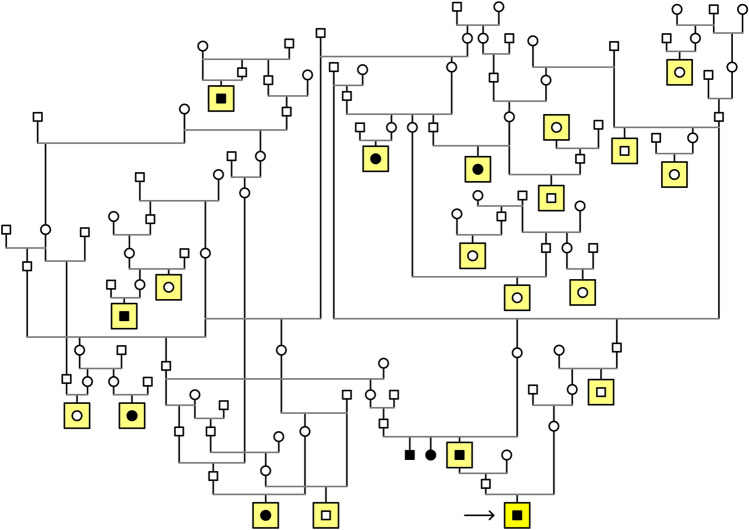
Fig. 1
Fig. 1
Pedigree analysis suggested autosomal recessive PRA in LH, as affected dogs were born to unaffected individuals, there were multiple cases in one of the affected litters, and both sexes were equally affected. The black symbol denotes affected dogs; squares indicate males and circles females, respectively. Dogs included in the GWAS are marked with a yellow background and the whole-genome sequenced case with a black arrow
Fig. 2
Fig. 2
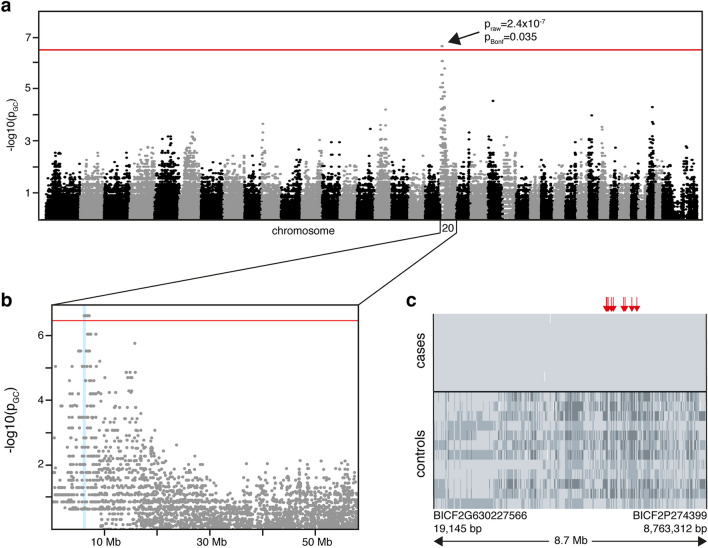
GWAS reveals a PRA locus on chromosome 20. a, b Results from the GWAS with 8 cases and 12 controls indicate a PRA locus on the canine chromosome 20 (praw = 2.4 × 10–7, pBonf = 0.035, λ = 1), where 9 markers meet genome-wide significance (threshold p = 3.4 × 10–7 marked with red line). c In-depth analysis of the genotypes in the associated locus reveals a shared homozygous haplotype block of 8.7 Mb in the cases absent in control dogs. Rows represent individual dogs and columns each SNP with light gray denoting affected genotypes, intermediate heterozygotes, and dark gray opposite homozygotes. The locations of the nine markers with genome-wide significance are marked with red arrows
Fig. 3
Fig. 3
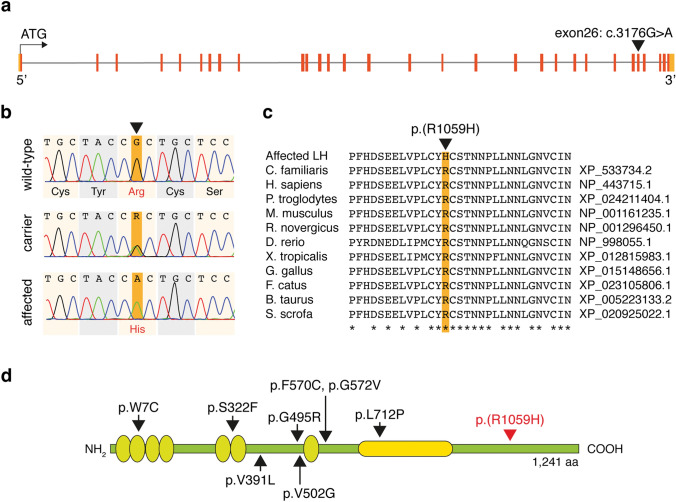
The IFT122 sequence and protein structure. a Schematic presentation of the IFT122 gene with exons marked in red, UTR sequences in orange and introns in gray. A missense variant c.3176G>A in exon 26 was identified in whole-genome sequencing data. b Chromatograms of the variant site (highlighted with orange background) and its surrounding sequence in wild-type, carrier and affected LH. c The variant site p.(R1059H) and its surrounding amino acids are highly conserved among different species. d Schematic presentation of the IFT122 protein with the canine PRA associated missense variant p.(R1059H) highlighted in red. The previously reported variants in human CED patients, all in relation to NP_443715.1, are marked with black arrows (Walczak-Sztulpa et al. ; Alazami et al. ; Tsurusaki et al. ; Moosa et al. 2016). The human IFT122 contains seven WD repeat domains, marked with light green circles, and a C-terminal TPR domain, marked with yellow
Fig. 4
Fig. 4
SD-OCT images of a healthy control (left-hand side) and a PRA affected IFT122 variant homozygote (right-hand side) indicate reduced thickness of the whole retina and RPE (a) and the outer retinal layers, including the outer nuclear layer, inner and outer segments of photoreceptors, and RPE (b) in the affected dog (113 μm and 53 μm, respectively) compared to the control dog (185 μm and 92 μm, respectively)

References

    1. Abugessaisa I, Shimoji H, Sahin S, Kondo A, Harshbarger J, Lizio M, Hayashizaki Y, Carninci P, Forrest A, Kasukawa T (2016) FANTOM5 transcriptome catalog of cellular states based on Semantic MediaWiki. Database - PMC - PubMed
    1. Alazami AM, Seidahmed MZ, Alzahrani F, Mohammed AO, Alkuraya FS. Novel IFT122 mutation associated with impaired ciliogenesis and cranioectodermal dysplasia. Mol Genet Genom Med. 2014;2:103–106. doi: 10.1002/mgg3.44. - DOI - PMC - PubMed
    1. Arumilli M, Layer RM, Hytönen MK, Lohi H. webGQT: a shiny server for genotype query tools for model-based variant filtering. Front Genet. 2020;11:152. doi: 10.3389/fgene.2020.00152. - DOI - PMC - PubMed
    1. Boubakri M, Chaya T, Hirata H, Kajimura N, Kuwahara R, Ueno A, Malicki J, Furukawa T, Omori Y. Loss of ift122, a retrograde intraflagellar transport (IFT) complex component, leads to slow, progressive photoreceptor degeneration due to inefficient opsin transport. J Biol Chem. 2016;291:24465–24474. doi: 10.1074/jbc.M116.738658. - DOI - PMC - PubMed
    1. Bunel M, Chaudieu G, Hamel C, Lagoutte L, Manes G, Botherel N, Brabet P, Pilorge P, André C, Quignon P. Natural models for retinitis pigmentosa: progressive retinal atrophy in dog breeds. Hum Genet. 2019;138:441–453. doi: 10.1007/s00439-019-01999-6. - DOI - PubMed

MeSH terms

Substances

LinkOut - more resources