


Coronavirus risk perception and compliance with social distancing measures in a sample of young adults: Evidence from Switzerland
- PMID: 33606826
- PMCID: PMC7894933
- DOI: 10.1371/journal.pone.0247447
Coronavirus risk perception and compliance with social distancing measures in a sample of young adults: Evidence from Switzerland
Abstract
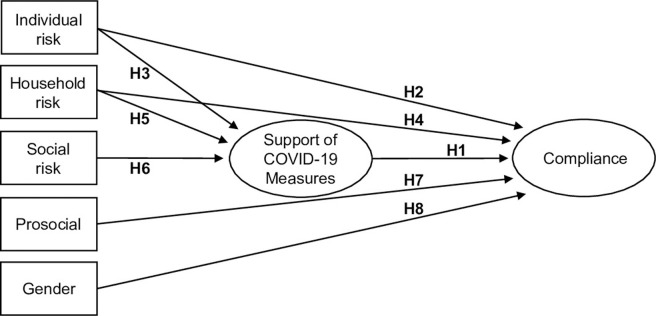
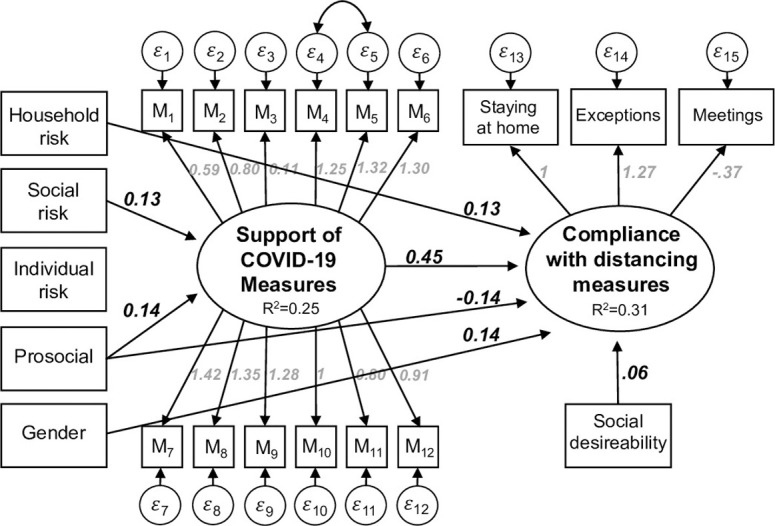
The health risk of the coronavirus pandemic is age-specific. The symptoms of a COVID-19 infection are usually mild in the healthy population below the age of 65; however, the measures laid down to prevent the spread of the virus apply typically to the whole population. Hence, those who have a low risk of severe symptoms face a social dilemma in cooperating and complying with the safety measures: Cooperating in preventing the spread of the disease is good for society but comes with individual costs. These costs provide an incentive not to cooperate with the safety measures. In this paper we analyze via structural equation modelling a sample of young adults (N = 510) who were surveyed right after the end of the first lockdown period in Switzerland. We investigate why and to what extent they cooperated in preventing the epidemic by following the recommendation to stay at home as much as possible. We hypothesize that those respondents who perceive themselves to be personally at risk, or who have relatives belonging to the risk group, complied more often with the safety measures as compared to those without severe risks. Cooperating should also be linked to individuals' pro-social orientation. Furthermore, we hypothesize that those who believe that the virus is dangerous for society or who have a personal interest in protection show higher support for the general safety measures. Our empirical results show that compliance with the coronavirus social distancing measures was generally very high during the first lockdown. Although young adults perceived themselves to be at low personal risk, they still believed that the virus is dangerous for society. Those who had a personal interest in staying at home because they had relatives belonging to the risk group complied more often with the safety measures. Overall, the results suggest that the support of the preventive measures is the most important promoter of cooperation to prevent the spread of COVID-19.
Conflict of interest statement
The authors have declared that no competing interests exist.
Figures

References
-
- FOPH. Weekly situation report on the epidemiological situation in Switzerland and the Principality of Liechtenstein: Week 53. Federal Office of Public Health, Switzerland 2021.
-
- FSO. Death according to age, week, and canton. Federal Statistical Office, Switzerland. 2020. FSO number: cc-d-01.04.02.01.32.
-
- FOPH. COVID-19 Switzerland. Information on the current situation. Laboratory-confirmed deaths. Distribution by age group. Federal Office of Public Health, Switzerland 01/2021.
-
- FSO. Permanent resident population by age, category of citizenship and sex, 1999–2019. Federal Statistical Office, Switzerland. 2020. FSO number: je-e-01.02.03.03
-
- FSO. Swiss Health Survey. Federal Statistical Office, Switzerland. 2020.
MeSH terms
LinkOut - more resources
Full Text Sources
Other Literature Sources
Medical
