


Evaluation of the durability and use of long-lasting insecticidal nets in Nicaragua
- PMID: 33608024
- PMCID: PMC7893764
- DOI: 10.1186/s12936-021-03604-6
Evaluation of the durability and use of long-lasting insecticidal nets in Nicaragua
Abstract
Background: Vector control for malaria prevention relies most often on the use of insecticide-treated bed net (ITNs) and indoor residual spraying. Little is known about the longevity of long-lasting insecticidal nets (LLINs) in the Americas. The physical integrity and insecticide retention of LLINs over time were monitored after a bed net distribution campaign to assess community practices around LLIN care and use in Waspam, northeastern Nicaragua.
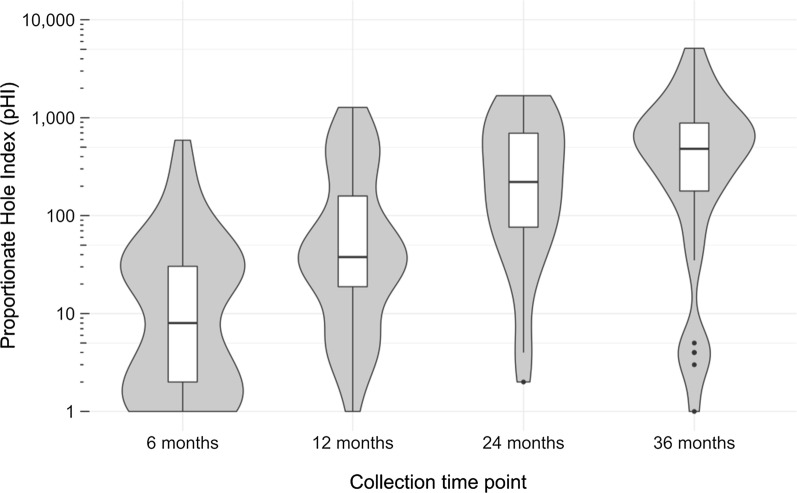
Methods: At least 30 nets were collected at 6, 12, 24, and 36 months post distribution. Physical integrity was measured by counting holes and classifying nets into categories (good, damaged, and too torn) depending on a proportionate hole index (pHI). Insecticide bioefficacy was assessed using cone bioassays, and insecticide content measured using a cyanopyrethroid field test (CFT).
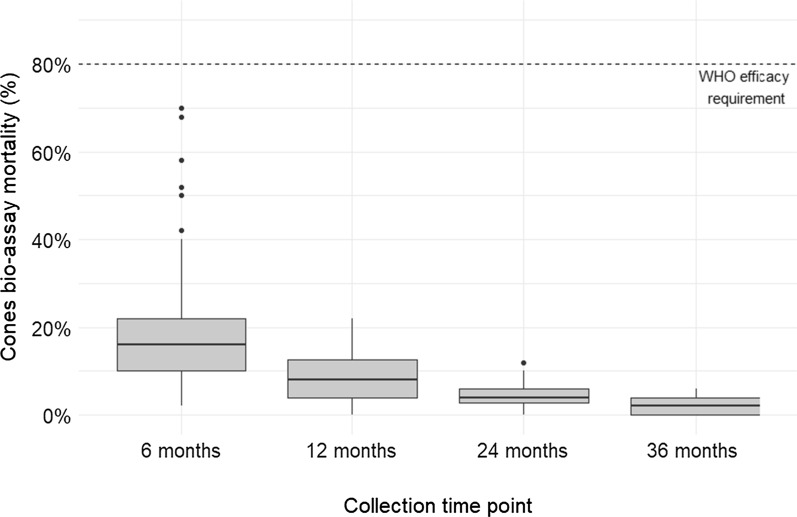
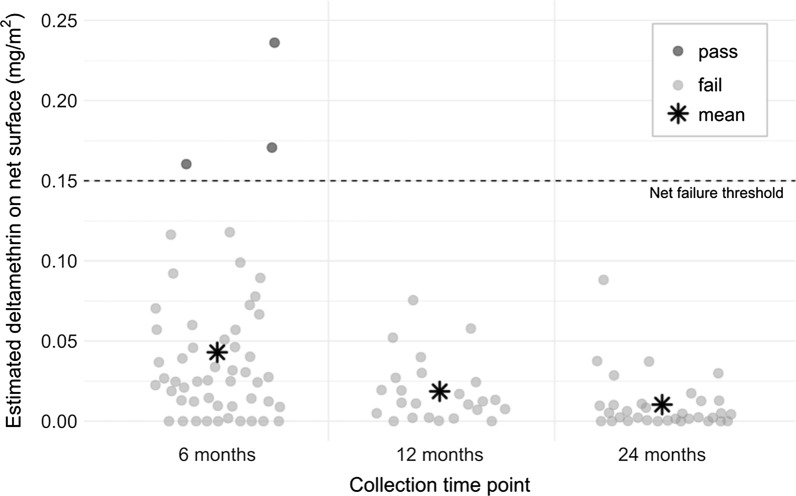
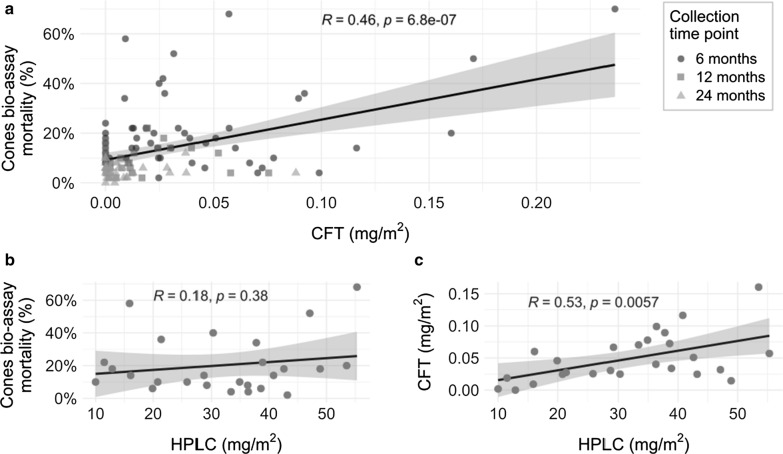
Results: At 6 months, 87.3 % of LLINs were in good physical condition, while by 36 months this decreased to 20.6 %, with 38.2 % considered 'too torn.' The median pHI increased from 7 at the 6-month time point to 480.5 by 36 months. After 36 months of use, median mortality in cone bioassays was 2 % (range: 0-6 %) compared to 16 % (range: 2-70 %) at 6 months. There was a decrease in the level of deltamethrin detected on the surface of the LLINs with 100 % of tested LLINs tested at 12 months and 24 months crossing the threshold for being considered a failed net by CFT.
Conclusions: This first comprehensive analysis of LLIN durability in Central America revealed rapid loss of chemical bioefficacy and progressive physical damage over a 36-month period. Use of these findings to guide future LLIN interventions in malaria elimination settings in Nicaragua, and potentially elsewhere in the Americas, could help optimize the successful implementation of vector control strategies.
Conflict of interest statement
The authors declare that they have no competing interests.
Figures
References
-
- WHO. World malaria report. Geneva: World Health Organization; 2019. https://www.who.int/publications/i/item/world-malaria-report-2019.
-
- Sahu SS, Gunasekaran K, Vijayakumar KN, Jambulingam P. Bio-efficacy, physical integrity, community usage and washing practices of mosquito nets treated with ICON MAXX long-lasting insecticidal treatment in India. Mem Inst Oswaldo Cruz. 2017;112:108–15. doi: 10.1590/0074-02760160287. - DOI - PMC - PubMed
MeSH terms
Substances
LinkOut - more resources
Full Text Sources
Other Literature Sources
Medical
