. 2021 Apr 13;87(9):e02584-20.
doi: 10.1128/AEM.02584-20. Print 2021 Apr 13.

" Sifarchaeota," a Novel Asgard Phylum from Costa Rican Sediment Capable of Polysaccharide Degradation and Anaerobic Methylotrophy

Affiliations

" Sifarchaeota," a Novel Asgard Phylum from Costa Rican Sediment Capable of Polysaccharide Degradation and Anaerobic Methylotrophy

Ibrahim F Farag et al. Appl Environ Microbiol. .

Abstract

The Asgard superphylum is a deeply branching monophyletic group of Archaea, recently described as some of the closest relatives of the eukaryotic ancestor. The wide application of genomic analyses from metagenome sequencing has established six distinct phyla, whose genomes encode diverse metabolic capacities and which play important biogeochemical and ecological roles in marine sediments. Here, we describe two metagenome-assembled genomes (MAGs) recovered from deep marine sediments off the Costa Rica margin, defining a novel lineage phylogenetically married to "Candidatus Thorarchaeota"; as such, we propose the name "Sifarchaeota" for this phylum. The two Sifarchaeota MAGs encode an anaerobic pathway for methylotrophy enabling the utilization of C1 to C3 compounds (methanol and methylamines) to synthesize acetyl coenzyme A (acetyl-CoA). The MAGs showed a remarkable saccharolytic capabilities compared to other Asgard lineages and encoded diverse classes of carbohydrate active enzymes (CAZymes) targeting different mono-, di-, and oligosaccharides. Comparative genomic analysis based on the full metabolic profiles of different Asgard lineages revealed the close relation between Sifarchaeota and "Candidatus Odinarchaeota" MAGs, which suggested similar metabolic potentials and ecological roles. Furthermore, we identified multiple HGT events from different bacterial donors within Sifarchaeota MAGs, which hypothetically expanded Sifarchaeota capacities for substrate utilization, energy production, and niche adaptation.IMPORTANCE The exploration of deep marine sediments has unearthed many new lineages of microbes. The finding of this novel phylum of Asgard archaea is important, since understanding the diversity and evolution of Asgard archaea may inform also about the evolution of eukaryotic cells. The comparison of metabolic potentials of the Asgard archaea can help inform about selective pressures the lineages have faced during evolution.

Keywords: Asgard; metagenomics; subsurface.


Figures

FIG 1
FIG 1
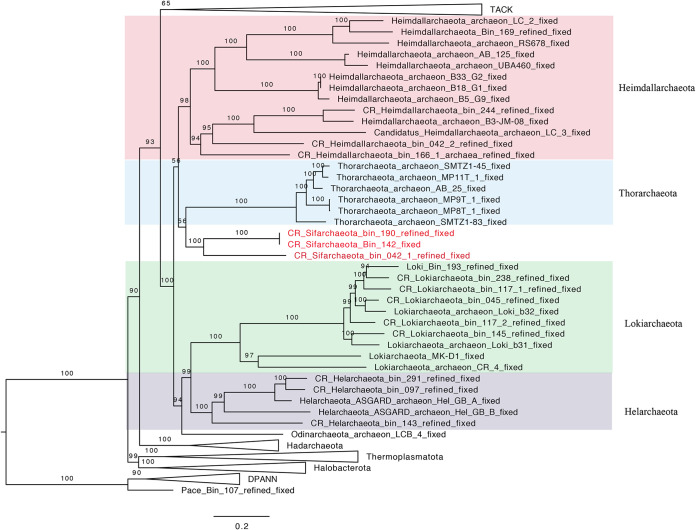
Maximum-likelihood phylogenetic tree of archaeal genomes based on 16 concatenated ribosomal proteins. This tree was inferred using IQ-TREE v1.6.10 applying ModelFinder (-m option) to select the best-fit evolutionary model, which is LG+R8 model and 1,000 ultrafast bootstraps. The Sifarchaeota MAGs recovered in this study are highlighted in red. Lineages of the Asgard superphylum are expanded, while the other lineages were collapsed, if possible. The bar shows estimated sequence substitutions per residue.
FIG 2
FIG 2
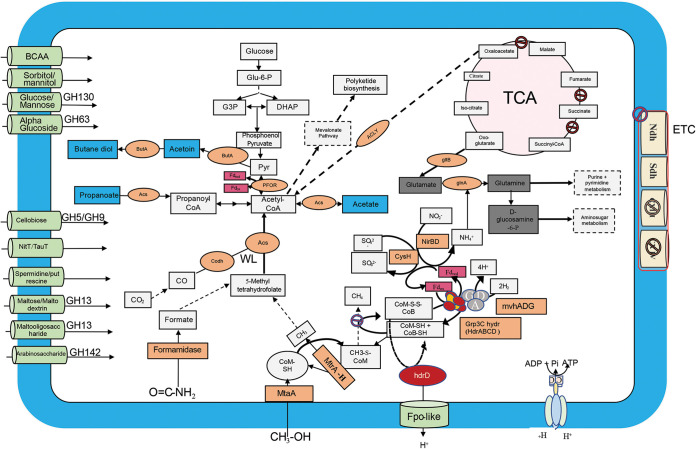
Metabolic reconstruction of the key metabolic pathways encoded by the Sifarchaeota MAGs. Central metabolic pathways are shown in gray boxes, carbon fixation pathways (WL and reverse tricarboxylic acid [rTCA] cycles) are shown in pink, electron transport chain (ETC) proteins are shown in yellow, fermentation products are shown in blue boxes, enzymes and enzyme complexes are shown in orange circles, energy carriers are shown in red, and metabolite and amino acid transporters are shown in light green.
FIG 3
FIG 3
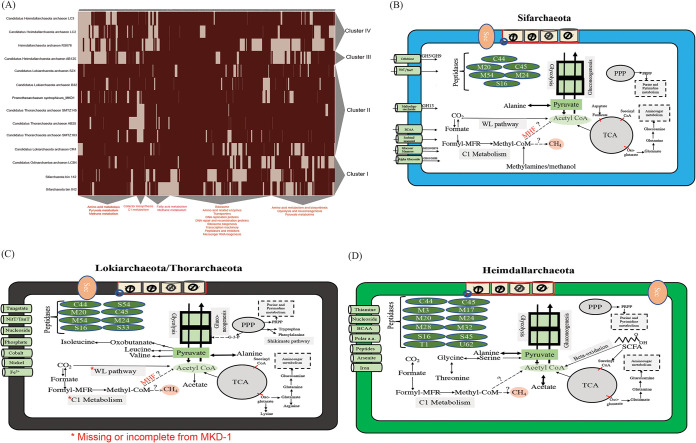
Comparative analysis between MAGs representing different Asgard members. (A) Heat map clustering the different Asgard MAGs (x axis) based on their total metabolic profiles as predicted by the KOfam database (y axis). The clustering was performed using Euclidean distance and complete linkage methods. (B) Metabolic model illustrating the key metabolic features identified in the Sifarchaeota cluster. (C) Metabolic model illustrating the key metabolic features identified in the cluster comprising “Candidatus Lokiarchaeota” and “Candidatus Thorarchaeota.” (D) Metabolic model illustrating the key metabolic features identified in “Candidatus Heimdallarchaeota” clusters.
FIG 4
FIG 4
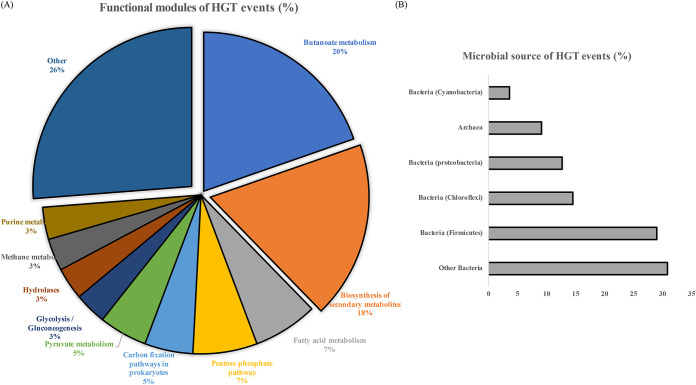
Summary of HGT events detected in the Sifarchaeota MAGs. (A) Different functional modules of horizontally transferred genes. (B) Major donors of the horizontally transferred genes.
FIG 5
FIG 5
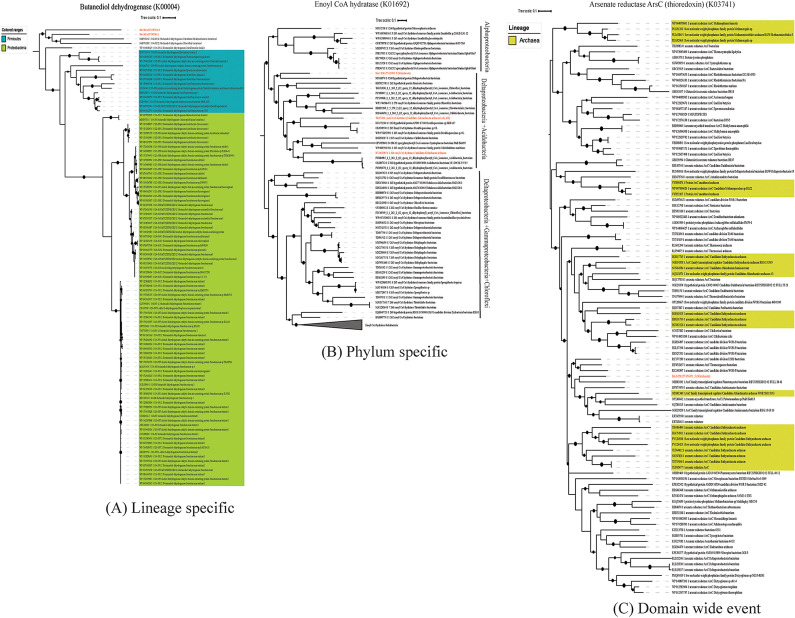
Examples of horizontally transferred genes in Sifarchaeota MAGs. (A) Lineage-specific HGT event. Maximum-likelihood phylogenetic tree of butanediol dehydrogenase gene sequences. Shaded areas correspond to the potential source organisms. The tree was constructed on the basis of butanediol dehydrogenase gene sequences using FastTree. Reference sequences were obtained using AnnoTree (K00004). (B) Phylum-specific HGT event. Maximum-likelihood phylogenetic tree of enoyl-CoA hydratase gene sequences. The tree was constructed on the basis of enoyl-CoA hydratase gene sequences using FastTree. Reference sequences were obtained using AnnoTree (K01692). (C) Domain-wide HGT event. Maximum-likelihood phylogenetic tree of arsenate reductase (ArsC) thioredoxin gene sequences. The tree was constructed on the basis of ArsC thioredoxin gene sequences using FastTree. Reference sequences were obtained using AnnoTree (K03741).

References

    1. Teske A, Sørensen KB. 2008. Uncultured archaea in deep marine subsurface sediments: have we caught them all? ISME J 2:3–18. 10.1038/ismej.2007.90. - DOI - PubMed
    1. Solden L, Lloyd K, Wrighton K. 2016. The bright side of microbial dark matter: lessons learned from the uncultivated majority. Curr Opin Microbiol 31:217–226. 10.1016/j.mib.2016.04.020. - DOI - PubMed
    1. Spang A, Saw JH, Jørgensen SL, Zaremba-Niedzwiedzka K, Martijn J, Lind AE, van Eijk R, Schleper C, Guy L, Ettema TJG. 2015. Complex archaea that bridge the gap between prokaryotes and eukaryotes. Nature 521:173–179. 10.1038/nature14447. - DOI - PMC - PubMed
    1. Zaremba-Niedzwiedzka K, Caceres EF, Saw JH, Bäckström D, Juzokaite L, Vancaester E, Seitz KW, Anantharaman K, Starnawski P, Kjeldsen KU, Stott MB, Nunoura T, Banfield JF, Schramm A, Baker BJ, Spang A, Ettema TJG. 2017. Asgard archaea illuminate the origin of eukaryotic cellular complexity. Nature 541:353–358. 10.1038/nature21031. - DOI - PubMed
    1. Seitz KW, Dombrowski N, Eme L, Spang A, Lombard J, Sieber JR, Teske AP, Ettema TJG, Baker BJ. 2019. Asgard archaea capable of anaerobic hydrocarbon cycling. Nat Commun 10:1822. 10.1038/s41467-019-09364-x. - DOI - PMC - PubMed

Publication types

Substances

LinkOut - more resources