Review
. 2021 Jul 1;27(13):3528-3539.
doi: 10.1158/1078-0432.CCR-20-4465. Epub 2021 Feb 19.

Thirty Years of HER3: From Basic Biology to Therapeutic Interventions

Affiliations
Review

Thirty Years of HER3: From Basic Biology to Therapeutic Interventions

Heidi M Haikala et al. Clin Cancer Res. .

Abstract

HER3 is a pseudokinase member of the EGFR family having a role in both tumor progression and drug resistance. Although HER3 was discovered more than 30 years ago, no therapeutic interventions have reached clinical approval to date. Because the evidence of the importance of HER3 is accumulating, increased amounts of preclinical and clinical trials with HER3-targeting agents are emerging. In this review article, we discuss the most recent HER3 biology in tumorigenic events and drug resistance and provide an overview of the current and emerging strategies to target HER3.


Conflict of interest statement

Conflicts of Interest:

P.A.J. has received consulting fees from AstraZeneca, Boehringer-Ingelheim, Pfizer, Roche/Genentech, Takeda Oncology, ACEA Biosciences, Eli Lilly and Company, Araxes Pharma, Ignyta, Mirati Therapeutics, Novartis, LOXO Oncology, Daiichi Sankyo, Sanofi Oncology, Voronoi, SFJ Pharmaceuticals, Takeda Oncology, Transcenta, Silicon Therapeutics, Syndax, Nuvalent, Bayer, Esai and Biocartis; receives post-marketing royalties from DFCI owned intellectual property on EGFR mutations licensed to Lab Corp; has sponsored research agreements with AstraZeneca, Daichi-Sankyo, PUMA, Boehringer Ingelheim, Eli Lilly and Company, Revolution Medicines and Astellas Pharmaceuticals; and has stock ownership in LOXO Oncology and Gatekeeper Pharmaceuticals.

Figures
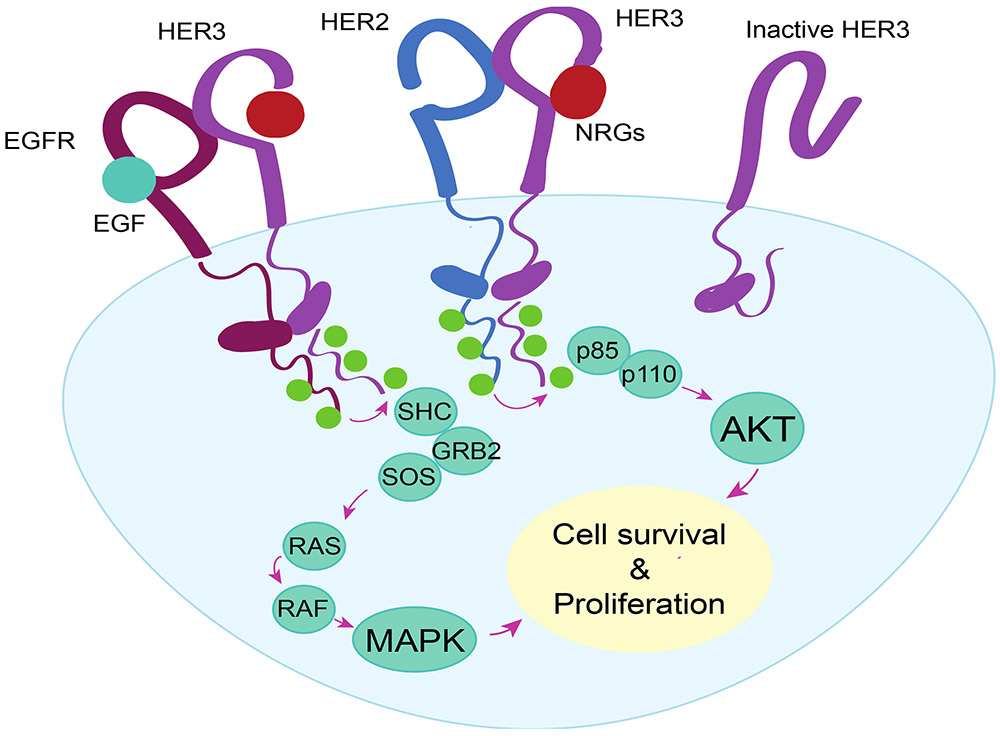
Figure 1:
Figure 1:. HER3 dimerization and signaling cascade.
Upon ligand binding, HER3 preferentially dimerizes with EGFR or HER2 inducing a conformational change in the receptor pair. The conformational change leads into transphosphorylation event in the intracellular kinase tail, where the C-terminal tail of HER3 acts as an acceptor for multiple phosphorylations. This induces activation of signaling cascades promoting cell survival and proliferation. EGFR: Epidermal growth factor receptor, EGF: Epidermal growth factor, HER2: Human epidermal growth factor receptor 2, HER3: Human epidermal growth factor receptor 3, NRG: Neuregulin, p85: 85kDa regulator subunit of phosphoinositide 3-kinase, p110: 110kDa catalytic subunit of phosphoinositide 3-kinase, AKT: protein kinase B, SHC: SHC-transforming protein 1, GRB2: growth factor receptor bound protein 2, SOS: Son of sevenless, RAS: RAS GTPase, RAF: Raf kinase, MAPK: Mitogen-activated protein kinase.
Figure 2:
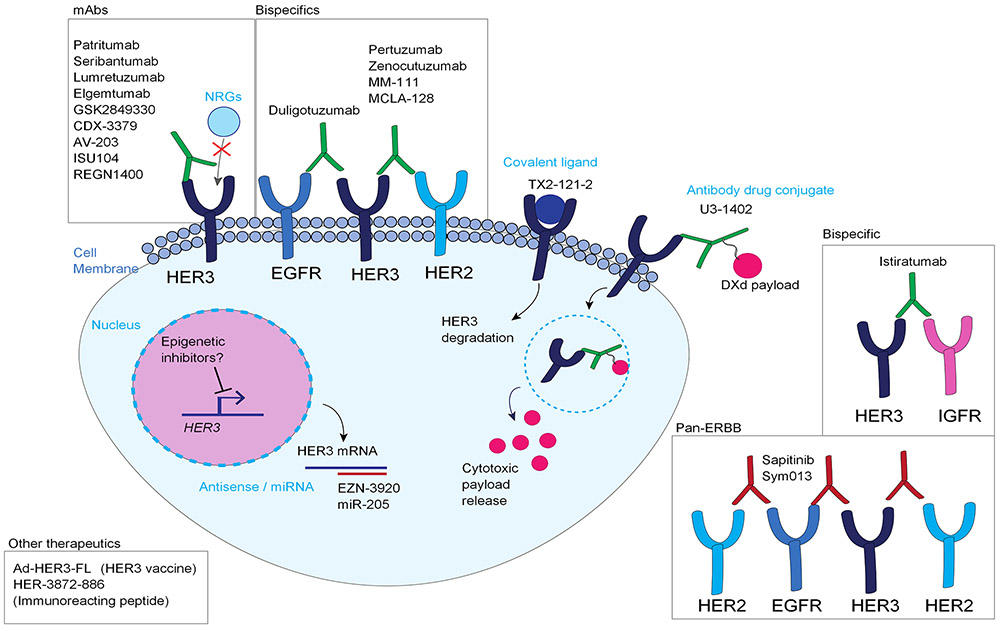
Figure 2:. Therapeutic strategies to target HER3.
The most popular strategies to target HER3 have been monoclonal and bispecific antibodies, as well as pan-HER strategies. Emerging strategies to target HER3 include antibody drug conjugates, HER3-targeting vaccines, and different ways to affect HER3 degradation either in mRNA or protein level. Epigenetic inhibitors could potentially be useful for inhibiting HER3 gene expression, although the mechanisms and feasibility of these strategies will have to be further validated. EGFR: Epidermal growth factor receptor, HER2: Human epidermal growth factor receptor 2, HER3: Human epidermal growth factor receptor 3, NRG: Neuregulin, mAbs: Monoclonal antibodies, IGFR: Insulin-like growth factor receptor. DXd: DX-8951 derivative.

References

    1. Sheng Q, Liu J. The therapeutic potential of targeting the EGFR family in epithelial ovarian cancer. Br J Cancer 2011;104(8):1241–5 doi 10.1038/bjc.2011.62. - DOI - PMC - PubMed
    1. Ogiso H, Ishitani R, Nureki O, Fukai S, Yamanaka M, Kim JH, et al. Crystal structure of the complex of human epidermal growth factor and receptor extracellular domains. Cell 2002;110(6):775–87 doi 10.1016/s0092-8674(02)00963-7. - DOI - PubMed
    1. Schlessinger J. Ligand-induced, receptor-mediated dimerization and activation of EGF receptor. Cell 2002;110(6):669–72 doi 10.1016/s0092-8674(02)00966-2. - DOI - PubMed
    1. Yu X, Sharma KD, Takahashi T, Iwamoto R, Mekada E. Ligand-independent dimer formation of epidermal growth factor receptor (EGFR) is a step separable from ligand-induced EGFR signaling. Mol Biol Cell 2002;13(7):2547–57 doi 10.1091/mbc.01-08-0411. - DOI - PMC - PubMed
    1. Tomas A, Futter CE, Eden ER. EGF receptor trafficking: consequences for signaling and cancer. Trends Cell Biol 2014;24(1):26–34 doi 10.1016/j.tcb.2013.11.002. - DOI - PMC - PubMed

Publication types