


Ready-to-eat cereal and milk for breakfast compared with no breakfast has a positive acute effect on cognitive function and subjective state in 11-13-year-olds: a school-based, randomised, controlled, parallel groups trial
- PMID: 33609174
- PMCID: PMC8354968
- DOI: 10.1007/s00394-021-02506-2
Ready-to-eat cereal and milk for breakfast compared with no breakfast has a positive acute effect on cognitive function and subjective state in 11-13-year-olds: a school-based, randomised, controlled, parallel groups trial
Abstract
Purpose: We tested the acute effect of breakfast (ready-to-eat-cereal [RTEC] and milk) versus (vs.) no breakfast on cognitive function and subjective state in adolescents.
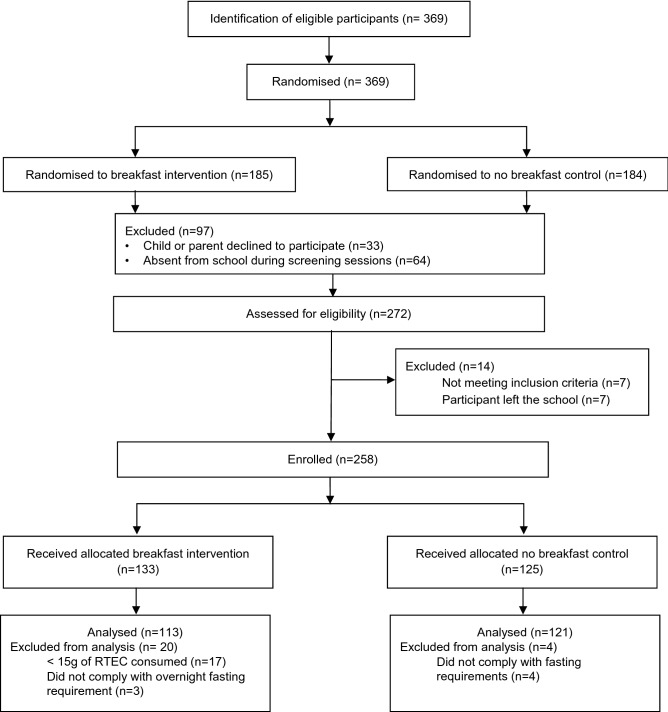
Methods: Healthy adolescents (n = 234) aged 11-13 years were recruited to take part in this school-based, acute, randomised, controlled, parallel groups trial with two interventions; Breakfast or No Breakfast. The breakfast intervention consisted of ad libitum intake of RTEC (up to 70 g) with milk (up to 300 ml) administered in a naturalistic school breakfast programme environment. Cognitive function was assessed at baseline and + 70 and + 215 min post-intervention in a group-testing situation, similar to a school classroom context. The CANTAB test battery included: Simple Reaction Time (SRT), 5-Choice Reaction Time (5-CRT), Rapid Visual Information Processing (RVIP), and Paired Associates Learning (PAL; primary outcome). Data collection commenced January 2011 and ended May 2011. This trial was retrospectively registered at www.clinicaltrials.gov as NCT03979027 on 07/06/2019.
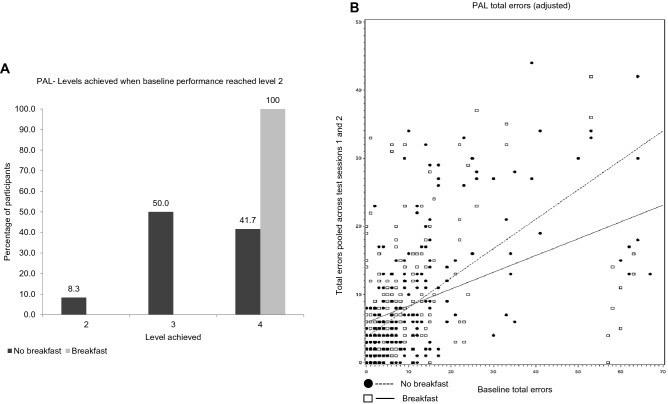
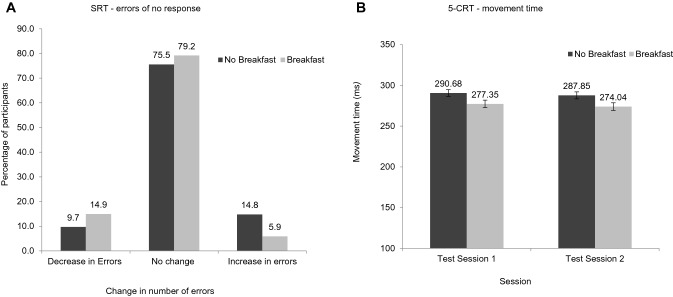
Results: A significant effect of the intervention (CMH[1] = 7.29, p < 0.01) was found for the number of levels achieved on the PAL task. A significant difference between interventions was found when baseline performance reached level 2 (JT, z = 2.58, p < 0.01), such that 100% of participants in the breakfast intervention reached the maximum level 4 but only 41.7% of those in the no breakfast intervention reached level 4. A significant baseline*intervention interaction (F[1,202] = 6.95, p < 0.01) was found for total errors made on the PAL task, indicating that participants who made above-average errors at baseline reduced the total number of errors made at subsequent test sessions following breakfast consumption whilst those in the no breakfast intervention did not. There was a positive effect of breakfast on reaction time and visual-sustained attention. The results also demonstrated interactions of intervention with baseline cognitive performance, such that breakfast conferred a greater advantage for performance when baseline performance was poorer.
Conclusion: Consuming breakfast has a positive acute effect on cognition in adolescents.
Keywords: Adolescents; Breakfast; Cognition; Cognitive function; Randomised controlled trial.
© 2021. The Author(s).
Conflict of interest statement
This study was conducted as part of a Knowledge Transfer Partnership between the University of Leeds and The Kellogg Company funded by ESRC, BBSRC, TSB and The Kellogg Company. The study was funded by additional funding from The Kellogg Company to supplement the ongoing Knowledge Transfer Partnership. Alexa Hoyland is currently an employee of The Kellogg Company. Katie Adolphus and Jenny Walton were previous employees of The Kellogg Company. At the time that the study was conceptualised, designed, and conducted, Alexa Hoyland was an employee of the University of Leeds and was the Knowledge Transfer Associate on the Knowledge Transfer Partnership between the University of Leeds and The Kellogg Company funded by ESRC, BBSRC, TSB and The Kellogg Company. At the time that the study was conceptualised, designed, and conducted, Katie Adolphus was a PhD student funded by the ESRC and the Schools Partnership Trust Academies.
Figures
References
Publication types
MeSH terms
Associated data
LinkOut - more resources
Full Text Sources
Other Literature Sources
Medical
Research Materials
