


Economic assessment of starting robot-assisted laparoscopic inguinal hernia repair in a single-centre retrospective comparative study: the EASTER study
- PMID: 33609369
- PMCID: PMC7893454
- DOI: 10.1093/bjsopen/zraa046
Economic assessment of starting robot-assisted laparoscopic inguinal hernia repair in a single-centre retrospective comparative study: the EASTER study
Abstract
Background: There has been a rapid adoption of robot-assisted laparoscopic inguinal hernia repair in the USA, despite a lack of proven clinical advantage and higher material cost. No studies have been published regarding the cost and outcome of robotic inguinal hernia surgery in a European Union setting.
Methods: A retrospective comparative study was performed on the early outcome and costs related to laparoscopic inguinal hernia repair, with either conventional or robot-assisted surgery.
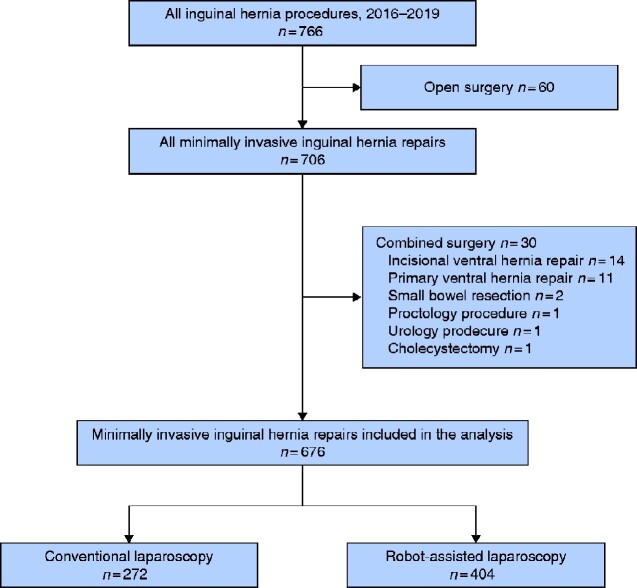
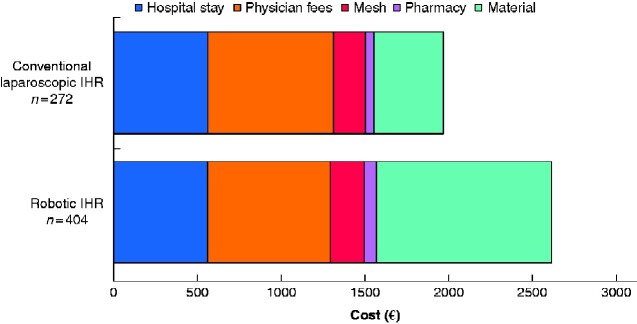
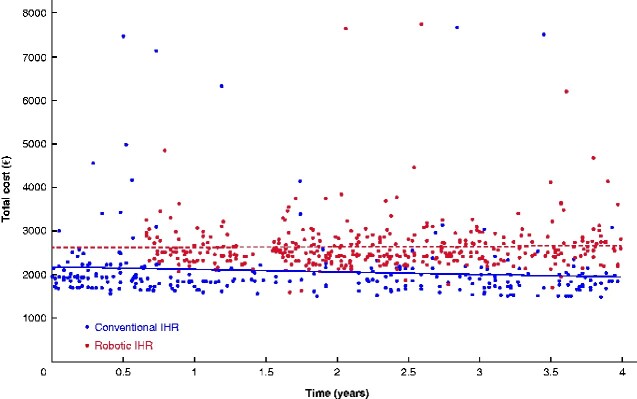
Results: The study analysed 676 patients undergoing laparoscopic inguinal hernia repair (272 conventional and 404 robotic repairs). Conventional laparoscopic and robotic repair groups were comparable in terms of duration of surgery (57.6 versus 56.2 min respectively; P = 0.224), intraoperative complication rate (1.1 versus 1.2 per cent; P = 0.990), in-hospital complication rate (4.4 versus 4.5 per cent; P = 0.230) and readmission rate (3.3 versus 1.2 per cent; P = 0.095). There was a significant difference in hospital stay in favour of the robotic approach (P = 0.014), with more patients treated on an outpatient basis in the robotic group (59.2 per cent versus 70.0 per cent for conventional repair). At 4-week follow-up, equal numbers of seromas or haematomas were recorded in the conventional laparoscopic and robotic groups (13.3 versus 15.7 per cent respectively; P = 0.431), but significantly more umbilical wound infections were seen in the conventional group (3.0 per cent versus 0 per cent in the robotic group; P = 0.001). Robotic inguinal hernia repair was significantly more expensive overall, with a mean cost of €2612 versus €1963 for the conventional laparoscopic approach (mean difference €649; P < 0.001).
Conclusion: Robot-assisted laparoscopic inguinal hernia repair was significantly more expensive than conventional laparoscopy. More patients were treated as outpatients in the robotic group. Postoperative complications were infrequent and mild.
© The Author(s) 2021. Published by Oxford University Press on behalf of BJS Society Ltd.
Figures
References
-
- Vossler JD, Pavlosky KK, Murayama SM, Moucharite MA, Murayama KM, Mikami DJ. Predictors of robotic versus laparoscopic inguinal hernia repair. J Surg Res 2019;241:247–253 - PubMed
-
- Abdelmoaty WF, Dunst CM, Neighorn C, Swanstrom LL, Hammill CW. Robotic-assisted versus laparoscopic unilateral inguinal hernia repair: a comprehensive cost analysis. Surg Endosc 2019;33:3436–3443 - PubMed
-
- AlMarzooqi R, Tish S, Huang LC, Prabhu A, Rosen M. Review of inguinal hernia repair techniques within the Americas Hernia Society Quality Collaborative. Hernia 2019; 23:429–438 - PubMed
-
- Pokala B, Armijo PR, Flores L, Hennings D, Oleynikov D. Minimally invasive inguinal hernia repair is superior to open: a National Database Review. Hernia 2019;23:593–599 - PubMed
-
- Henriksen NA, Jensen KK, Muysoms F. Robot-assisted abdominal wall surgery: a systematic review of the literature and meta-analysis. Hernia 2019;23:17–27 - PubMed
Publication types
MeSH terms
LinkOut - more resources
Full Text Sources
Other Literature Sources
