


RadTranslate: An Artificial Intelligence-Powered Intervention for Urgent Imaging to Enhance Care Equity for Patients With Limited English Proficiency During the COVID-19 Pandemic
- PMID: 33609456
- PMCID: PMC7847389
- DOI: 10.1016/j.jacr.2021.01.013
RadTranslate: An Artificial Intelligence-Powered Intervention for Urgent Imaging to Enhance Care Equity for Patients With Limited English Proficiency During the COVID-19 Pandemic
Abstract
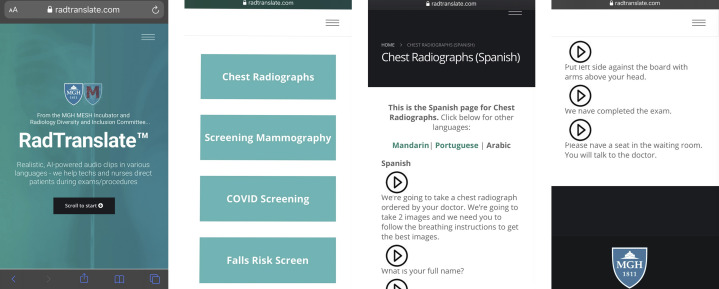
Purpose: Disproportionally high rates of coronavirus disease 2019 (COVID-19) have been noted among communities with limited English proficiency, resulting in an unmet need for improved multilingual care and interpreter services. To enhance multilingual care, the authors created a freely available web application, RadTranslate, that provides multilingual radiology examination instructions. The purpose of this study was to evaluate the implementation of this intervention in radiology.
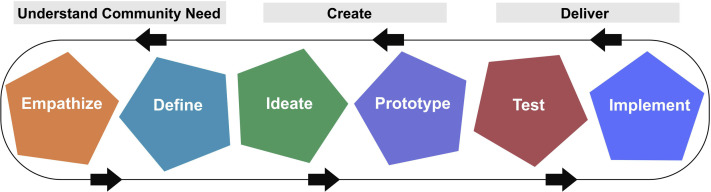
Methods: The device-agnostic web application leverages artificial intelligence text-to-speech technology to provide standardized, human-like spoken examination instructions in the patient's preferred language. Standardized phrases were collected from a consensus group consisting of technologists, radiologists, and ancillary staff members. RadTranslate was piloted in Spanish for chest radiography performed at a COVID-19 triage outpatient center that served a predominantly Spanish-speaking Latino community. Implementation included a tablet displaying the application in the chest radiography room. Imaging appointment duration was measured and compared between pre- and postimplementation groups.
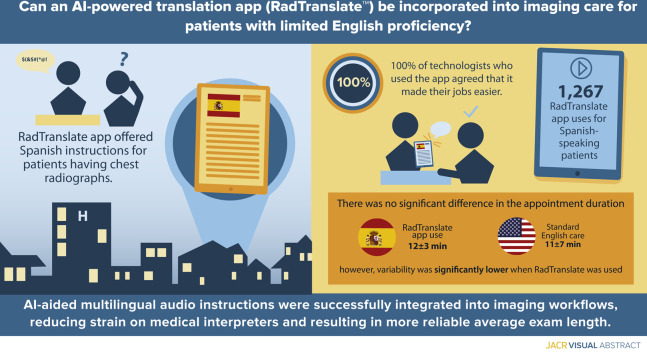
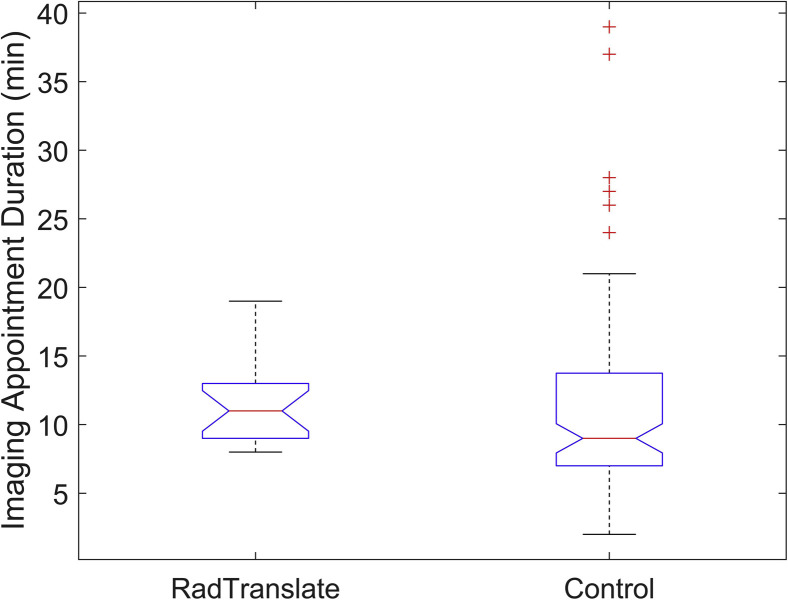
Results: In the 63-day test period after launch, there were 1,267 application uses, with technologists voluntarily switching exclusively to RadTranslate for Spanish-speaking patients. The most used phrases were a general explanation of the examination (30% of total), followed by instructions to disrobe and remove any jewelry (12%). There was no significant difference in imaging appointment duration (11 ± 7 and 12 ± 3 min for standard of care versus RadTranslate, respectively), but variability was significantly lower when RadTranslate was used (P = .003).
Conclusions: Artificial intelligence-aided multilingual audio instructions were successfully integrated into imaging workflows, reducing strain on medical interpreters and variance in throughput and resulting in more reliable average examination length.
Keywords: English proficiency; Innovation; disparities; operations.
Copyright © 2021 American College of Radiology. Published by Elsevier Inc. All rights reserved.
Figures
References
-
- Tam I., Huang M.Z., Patel A. Spanish interpreter services for the hospitalized pediatric patient: provider and interpreter perceptions. Acad Pediatr. 2020;20:216–224. - PubMed
-
- Taffel M.T., Huang C., Karajgikar J.A. Retrospective analysis of the effect of limited English proficiency on abdominal MRI image quality. Abdom Radiol (NY) 2020;45:2895–2901. - PubMed
MeSH terms
LinkOut - more resources
Full Text Sources
Other Literature Sources
Medical
