


The pro-inflammatory cytokines in COVID-19 pathogenesis: What goes wrong?
- PMID: 33609650
- PMCID: PMC7889464
- DOI: 10.1016/j.micpath.2021.104799
The pro-inflammatory cytokines in COVID-19 pathogenesis: What goes wrong?
Abstract
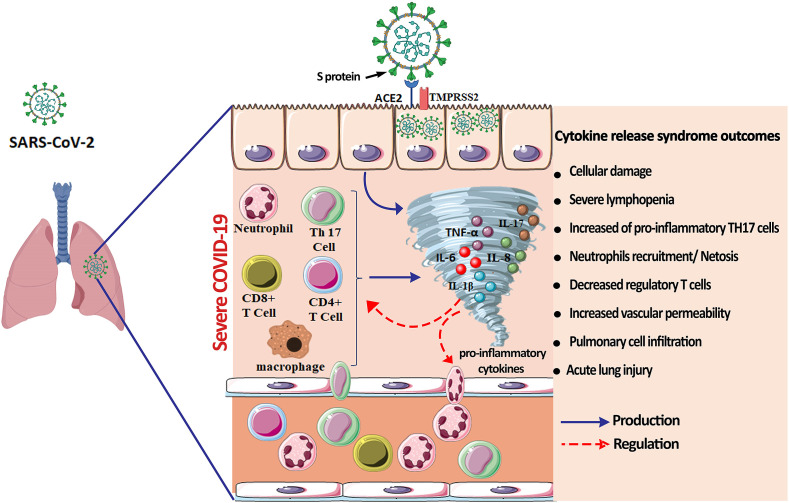
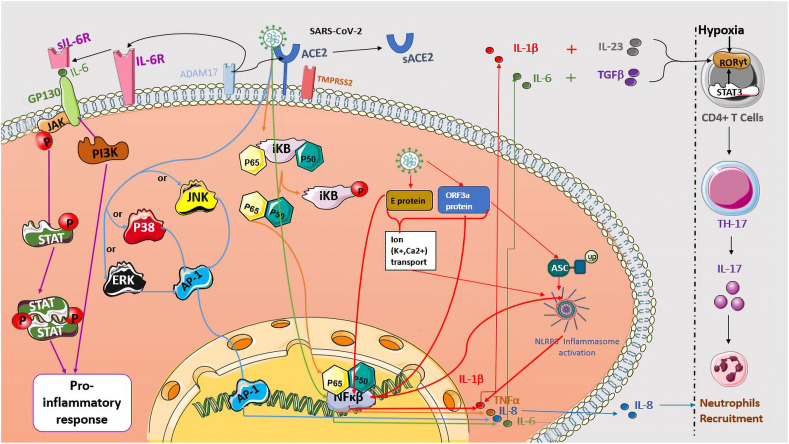
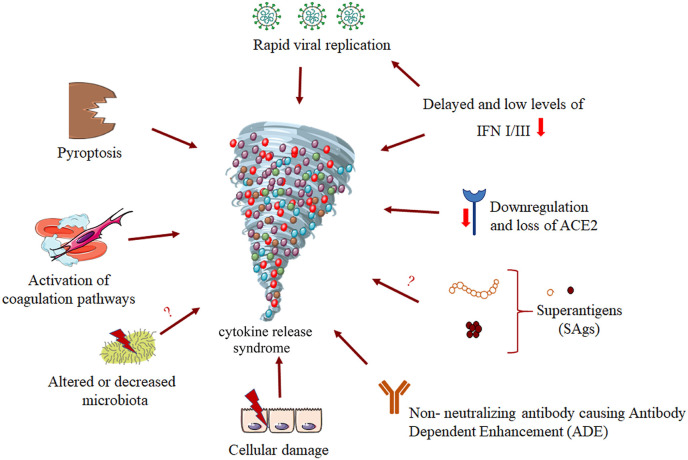
The outbreak of coronavirus disease 2019 (COVID-19), caused by Severe Acute Respiratory Syndrome Coronavirus 2 (SARS-CoV-2) infection, has emerged in China in December 2019 and rapidly spread to more than 196 countries worldwide. The physiopathology of human SARS-CoV-2 has not been completely understood, but its pathogenesis has been linked to a disproportionate response of the immune system. Just as described for SARS and MERS, an uncontrolled systemic inflammatory response, known as cytokine release syndrome (CRS) was observed in severe COVID-19 patients. It results from the release by immune and non-immune effector cells of substantial amounts of pro-inflammatory cytokines and appears to contribute to SARS-CoV-2 pulmonary inflammation and extensive lung damage. In addition, hyper-coagulation and thrombosis resulted from the important release of pro-inflammatory cytokines contribute to the lethality of subjects severely infected with SARS-CoV-2. It is therefore essential to have a deep understanding of the various cytokines involved in this exacerbated immune response, and that could be targeted by potential immunological treatments. The aim of this review was to gather the current knowledge about the role of pro-inflammatory cytokines, namely IL-1β, IL-6, IL-8, IL-17 and TNFα in SARS-CoV-2 CRS, the probable causes and clinical outcomes of this phenomenon in severe cases of COVID-19.
Keywords: COVID-19; Cytokines; Inflammation; SARS-CoV-2.
Copyright © 2021 Elsevier Ltd. All rights reserved.
Conflict of interest statement
The authors declare that they have no known competing financial interests or personal relationships that could have appeared to influence the work reported in this paper.
Figures
References
-
- WHO Coronavirus. 2020. https://www.who.int/health-topics/coronavirus#tab=tab_1 (accessed June 26, 2020)
-
- Chan J.F.W., Yuan S., Kok K.H., To K.K.W., Chu H., Yang J., Xing F., Liu J., Yip C.C.Y., Poon R.W.S., Tsoi H.W., Lo S.K.F., Chan K.H., Poon V.K.M., Chan W.M., Ip J.D., Cai J.P., Cheng V.C.C., Chen H., Hui C.K.M., Yuen K.Y. A familial cluster of pneumonia associated with the 2019 novel coronavirus indicating person-to-person transmission: a study of a family cluster. Lancet. 2020;395:514–523. doi: 10.1016/S0140-6736(20)30154-9. - DOI - PMC - PubMed
-
- Chen N., Zhou M., Dong X., Qu J., Gong F., Han Y., Qiu Y., Wang J., Liu Y., Wei Y., Xia J., Yu T., Zhang X., Zhang L. Epidemiological and clinical characteristics of 99 cases of 2019 novel coronavirus pneumonia in Wuhan, China: a descriptive study. Lancet. 2020;395:507–513. doi: 10.1016/S0140-6736(20)30211-7. - DOI - PMC - PubMed
-
- Liu Y., Zhang C., Huang F., Yang Y., Wang F., Yuan J., Zhang Z., Qin Y., Li X., Zhao D., Li S., Tan S., Wang Z., Li J., Shen C., Li J., Peng L., Weibo W., Cao M., Xing L., Xu Z., Chen L., Zhou C., Liu W., Liu L., Jiang C. ChinaXiv; 2020. 2019-novel Coronavirus (2019-nCoV) Infections Trigger an Exaggerated Cytokine Response Aggravating Lung Injury.
Publication types
MeSH terms
Substances
LinkOut - more resources
Full Text Sources
Other Literature Sources
Medical
Miscellaneous
