


Exposure to perfluoroalkyl substances and blood pressure in pregnancy among 1436 women from the Odense Child Cohort
- PMID: 33610053
- PMCID: PMC11149831
- DOI: 10.1016/j.envint.2021.106442
Exposure to perfluoroalkyl substances and blood pressure in pregnancy among 1436 women from the Odense Child Cohort
Abstract
Background: Previous studies of association between exposure to poly- and perfluoroalkyl substances (PFAS) and gestational hypertension (GH) and preeclampsia (PE) have shown conflicting results, but most dichotomized outcome and did not study continuous blood pressure (BP) changes.
Objectives: To study the association between PFAS exposure in early pregnancy and maternal BP trajectories in pregnancy, gestational hypertension and preeclampsia.
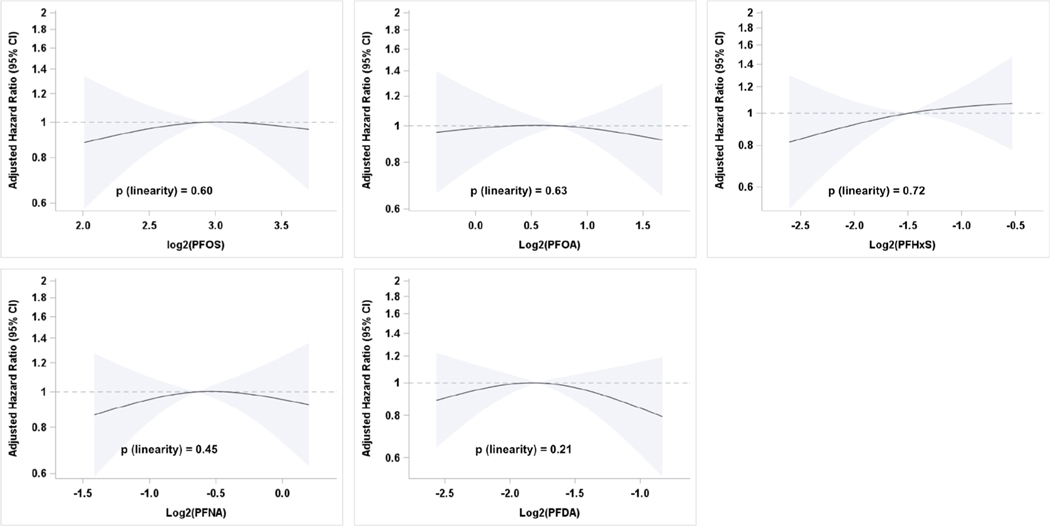
Methods: 1436 women were enrolled in the Odense Child Cohort in early pregnancy and had a serum sample drawn, from which perfluorohexane sulfonic acid (PFHxS), perfluorooctane sulfonic acid (PFOS), perfluorooctanoic acid (PFOA), perfluorononanoic acid (PFNA) and perfluorodecanoic acid (PFDA) were measured using LC-MS/MS. Repeated BP measurements through pregnancy and information on PE were obtained from hospital files. Adjusted linear mixed models were used to investigate association between PFAS exposure and BP trajectory. Associations between PFAS and PE and GH were assessed by Cox proportional hazards model.
Results: All women had measurable concentrations of PFAS. In all of many comparisons higher PFAS exposure (apart from PFHxS) was associated with higher systolic (SBP) and diastolic (DBP) blood pressures, although not all were significant, which is unlikely to be due to chance. After adjustment, each doubling in PFOS or PFOA exposure was associated with 0.47 mmHg (95% CI: -0.13; 1.08) and 0.36 mmHg (-0.19; 0.92) higher SBP; and 0.58 mmHg (0.13; 1.04) and 0.37 mmHg (-0.05; 0.79) higher DBP. No clear associations between PFAS exposure and PE or GH were found.
Discussion: The magnitude of the association between PFAS exposure and BP might appear small, statistically non-significant and the possible clinical importance low. However, at a population level this may slightly shift the distribution of BP towards an increased incidence of GH. If BP increases in pregnancy, it may have long-term impact on health not only of the pregnant woman but also of her offspring.
Keywords: Blood pressure; Environmental chemicals; Perfluoroalkyl substances (PFAS); Preeclampsia; Pregnancy.
Copyright © 2021 The Authors. Published by Elsevier Ltd.. All rights reserved.
Conflict of interest statement
Declaration of Competing Interest
The authors declare that they have no known competing financial interests or personal relationships that could have appeared to influence the work reported in this paper.
Figures

References
-
- Bach CC, Bech BH, Brix N, Nohr EA, Bonde JP, Henriksen TB, 2015. Perfluoroalkyl and polyfluoroalkyl substances and human fetal growth: a systematic review. Crit. Rev. Toxicol 45, 53–67. - PubMed
-
- Birukov A, Herse F, Nielsen JH, Kyhl HB, Golic M, Kraker K, et al. , 2020. Blood pressure and angiogenic markers in pregnancy: contributors to pregnancy-induced hypertension and offspring cardiovascular risk. Hypertension 76, 901–909. - PubMed
Publication types
MeSH terms
Substances
Grants and funding
LinkOut - more resources
Full Text Sources
Other Literature Sources
