


Recent Advances in Hypertension: Intersection of Metabolic and Blood Pressure Regulatory Circuits in the Central Nervous System
- PMID: 33611936
- PMCID: PMC7990288
- DOI: 10.1161/HYPERTENSIONAHA.120.14513
Recent Advances in Hypertension: Intersection of Metabolic and Blood Pressure Regulatory Circuits in the Central Nervous System
Abstract
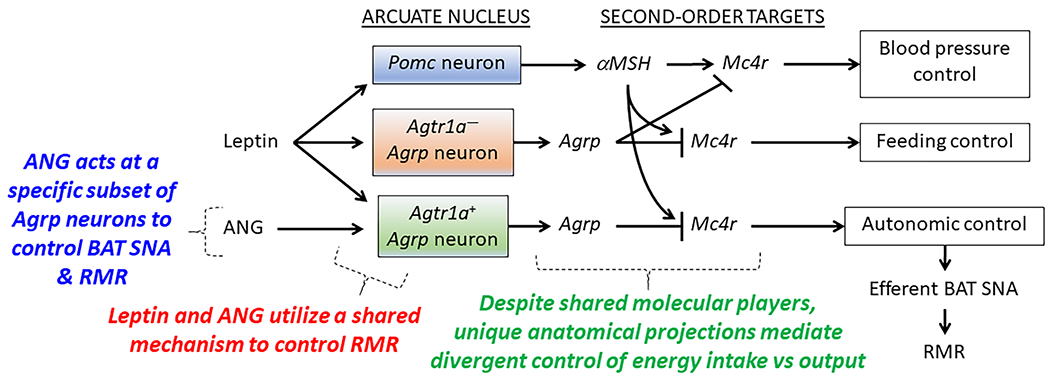
Obesity represents the single greatest ongoing roadblock to improving cardiovascular health. Prolonged obesity is associated with fundamental changes in the integrative control of energy balance, including the development of selective leptin resistance, which is thought to contribute to obesity-associated hypertension, and adaptation of resting metabolic rate (RMR) when excess weight is reduced. Leptin and the melanocortin system within the hypothalamus contribute to the control of both energy balance and blood pressure. While the development of drugs to stimulate RMR and thereby reverse obesity through activation of the melanocortin system has been pursued, most of the resulting compounds simultaneously cause hypertension. Evidence supports the concept that although feeding behaviors, RMR, and blood pressure are controlled through mechanisms that utilize similar molecular mediators, these mechanisms exist in anatomically dissociable networks. New evidence supports a major change in molecular signaling within AgRP (Agouti-related peptide) neurons of the arcuate nucleus of the hypothalamus during prolonged obesity and the existence of multiple distinct subtypes of AgRP neurons that individually contribute to control of feeding, RMR, or blood pressure. Finally, ongoing work by our laboratory and others support a unique role for AT1 (angiotensin II type 1 receptor) within one specific subtype of AgRP neuron for the control of RMR. We propose that understanding the unique biology of the AT1-expressing, RMR-controlling subtype of AgRP neurons will help to resolve the selective dysfunctions in RMR control that develop during prolonged obesity and potentially point toward novel druggable antiobesity targets that will not simultaneously cause hypertension.
Keywords: angiotensin; biology; hypertension; leptin; obesity.
Conflict of interest statement
Disclosures
None.
Figures
References
-
- Jones DW, Miller ME, Wofford MR, Anderson DC Jr., Cameron ME, Willoughby DL, Adair CT, King NS. The effect of weight loss intervention on antihypertensive medication requirements in the hypertension optimal treatment (hot) study. Am J Hypertens. 1999;12:1175–1180 - PubMed
-
- Garrison RJ, Kannel WB, Stokes J 3rd, Castelli WP. Incidence and precursors of hypertension in young adults: The framingham offspring study. Prev Med. 1987;16:235–251 - PubMed
-
- Stevens VJ, Obarzanek E, Cook NR, Lee IM, Appel LJ, Smith West D, Milas NC, Mattfeldt-Beman M, Belden L, Bragg C, Millstone M, Raczynski J, Brewer A, Singh B, Cohen J. Long-term weight loss and changes in blood pressure: Results of the trials of hypertension prevention, phase ii. Ann Intern Med. 2001;134:1–11 - PubMed
-
- Health implications of obesity. National institutes of health consensus development conference. 11–13 february 1985. Ann Intern Med. 1985;103:977–1077 - PubMed
Publication types
MeSH terms
Substances
Grants and funding
LinkOut - more resources
Full Text Sources
Other Literature Sources
Medical
Research Materials
