


Development of a SARS-CoV-2-derived receptor-binding domain-based ACE2 biosensor
- PMID: 33612970
- PMCID: PMC7885701
- DOI: 10.1016/j.snb.2021.129663
Development of a SARS-CoV-2-derived receptor-binding domain-based ACE2 biosensor
Abstract
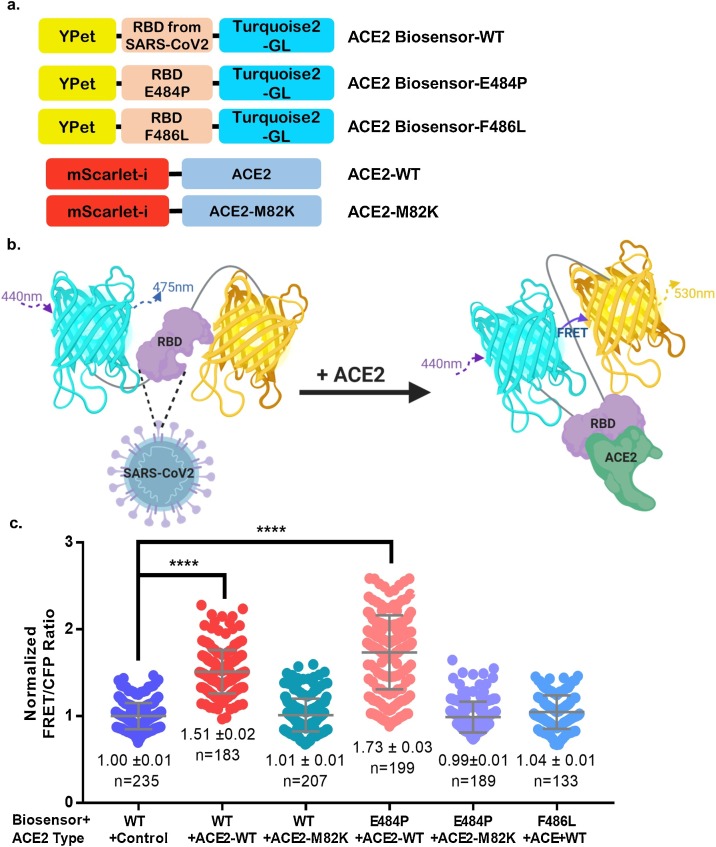
The global outbreak of coronavirus disease and rapid spread of the causative severe acute respiratory syndrome coronavirus 2 (SARS-CoV-2) represent a significant threat to human health. A key mechanism of human SARS-CoV-2 infection is initiated by the combination of human angiotensin-converting enzyme 2 (hACE2) and the receptor-binding domain (RBD) of the SARS-CoV-2-derived spike glycoprotein. Despite the importance of these protein interactions, there are still insufficient detection methods to observe their activity at the cellular level. Herein, we developed a novel fluorescence resonance energy transfer (FRET)-based hACE2 biosensor to monitor the interaction between hACE2 and SARS-CoV-2 RBD. This biosensor facilitated the visualization of hACE2-RBD activity with high spatiotemporal resolutions at the single-cell level. Further studies revealed that the FRET-based hACE2 biosensors were sensitive to both exogenous and endogenous hACE2 expression, suggesting that they might be safely applied to the early stage of SARS-CoV-2 infection without direct virus use. Therefore, our novel biosensor could potentially help develop drugs that target SARS-CoV-2 by inhibiting hACE2-RBD interaction.
Keywords: ACE2; Biosensor; CQ, chloroquine; FRET; HCQ, hydroxychloroquine; Live-cell imaging; NA, numerical aperture; RBD, receptor-binding domain; RBM, receptor-binding motif; ROI, region of interest; SARS-CoV-2; SARS-CoV-2, severe acute respiratory syndrome coronavirus 2; SEM, standard error of the mean; bg, background; hACE2, human angiotensin-converting enzyme 2.
© 2021 Elsevier B.V. All rights reserved.
Figures
References
-
- Li Q., Guan X., Wu P., Wang X., Zhou L., Tong Y., Ren R., Leung K.S.M., Lau E.H.Y., Wong J.Y., Xing X., Xiang N., Wu Y., Li C., Chen Q., Li D., Liu T., Zhao J., Liu M., Tu W., Chen C., Jin L., Yang R., Wang Q., Zhou S., Wang R., Liu H., Luo Y., Liu Y., Shao G., Li H., Tao Z., Yang Y., Deng Z., Liu B., Ma Z., Zhang Y., Shi G., Lam T.T.Y., Wu J.T., Gao G.F., Cowling B.J., Yang B., Leung G.M., Feng Z. Early transmission dynamics in Wuhan, China, of novel coronavirus-infected pneumonia. N. Engl. J. Med. 2020 doi: 10.1056/NEJMoa2001316. - DOI - PMC - PubMed
-
- Wu F., Zhao S., Yu B., Chen Y.M., Wang W., Song Z.G., Hu Y., Tao Z.W., Tian J.H., Pei Y.Y., Yuan M.L., Zhang Y.L., Dai F.H., Liu Y., Wang Q.M., Zheng J.J., Xu L., Holmes E.C., Zhang Y.Z. A new coronavirus associated with human respiratory disease in China. Nature. 2020 doi: 10.1038/s41586-020-2008-3. - DOI - PMC - PubMed
-
- Xu X., Yu C., Qu J., Zhang L., Jiang S., Huang D., Chen B., Zhang Z., Guan W., Ling Z., Jiang R., Hu T., Ding Y., Lin L., Gan Q., Luo L., Tang X., Liu J. Imaging and clinical features of patients with 2019 novel coronavirus SARS-CoV-2. Eur. J. Nucl. Med. Mol. Imaging. 2020 doi: 10.1007/s00259-020-04735-9. - DOI - PMC - PubMed
LinkOut - more resources
Full Text Sources
Other Literature Sources
Research Materials
Miscellaneous
