


Persistence of Hepatitis A Virus RNA in Water, on Non-porous Surfaces, and on Blueberries
- PMID: 33613487
- PMCID: PMC7890088
- DOI: 10.3389/fmicb.2021.618352
Persistence of Hepatitis A Virus RNA in Water, on Non-porous Surfaces, and on Blueberries
Abstract
Enteric viruses, such as human norovirus and hepatitis A virus (HAV), are the leading cause of transmissible foodborne illness. Fresh produce such as berries are often contaminated by infected food handlers, soiled water, or food contact surfaces. The gold-standard method for virus detection throughout the food chain is RT-qPCR, which detects portions of genomes including non-infectious viral particles and naked viral RNA. The aim of this study was to evaluate the persistence of heat-inactivated HAV in water, phosphate-buffered saline, on stainless steel and polyvinyl chloride, and on blueberries at -80°C, -20°C, 4°C, and room temperature. In water and phosphate-buffered saline, viral RNA could be detected for up to 90 days regardless of temperature when the initial load was 2.5 × 10⁴ or 2.5 × 10⁶ genome copies. It was detected on polyvinyl chloride and blueberries under most conditions. On stainless steel, the large initial load persisted for 90 days, while the medium-level load was detected only up to 16 days at room temperature or 60 days at 4°C. The detection of non-infectious viral RNA can confound investigations of gastroenteritis outbreaks. Pretreatments that discriminate between naked RNA, non-infectious virions and infectious virions need to be included in the RT-qPCR method in order to reduce the risk of positive results associated with non-infectious viral particles.
Keywords: RNA; blueberries; food contact surfaces; hepatitis A; persistence; water.
Copyright © 2021 Trudel-Ferland, Jubinville and Jean.
Conflict of interest statement
The authors declare that the research was conducted in the absence of any commercial or financial relationships that could be construed as a potential conflict of interest.
Figures
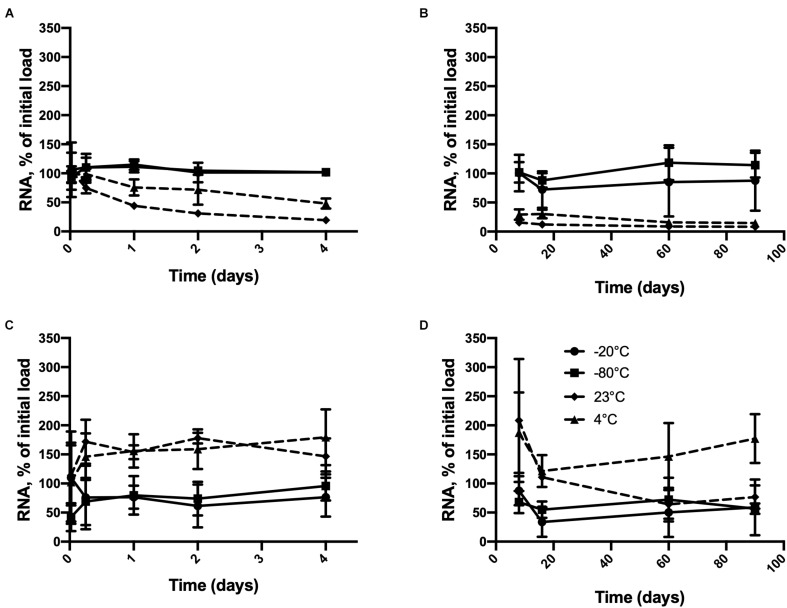
 ),–20°C (
 ), 4° C (
 ), and 23°C (
 ). Plotted values are means of 3 repetitions ± standard deviation.
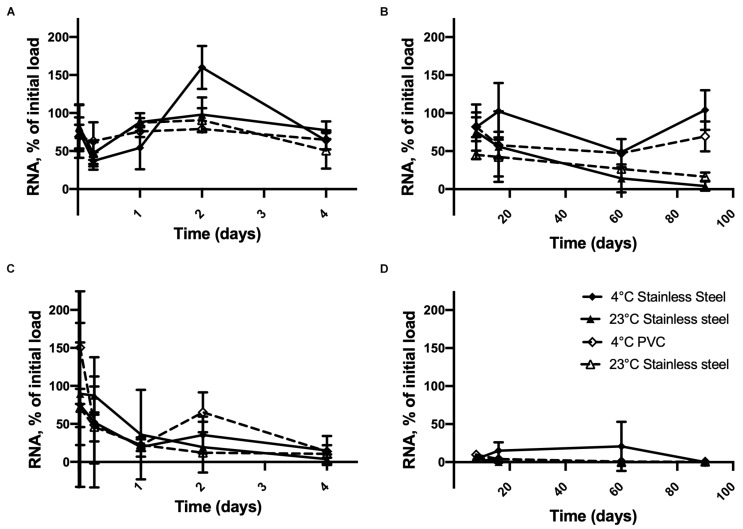 ), 23°C on SS (), 4° C on PVC (
 ), and 23°C on PVC (
 ). Plotted values are means of 3 repetitions ± standard deviation.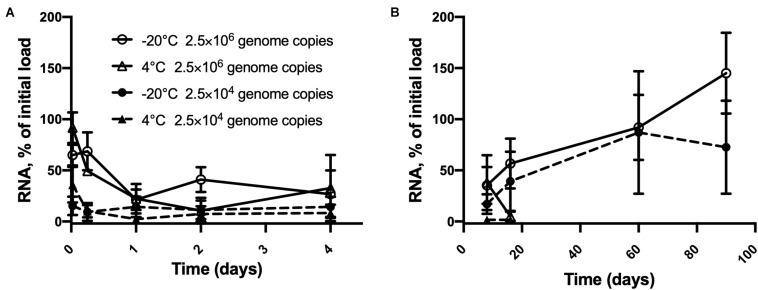
 ) and 4° C () and 2.5 × 10⁴ genome copies per blueberry at –20°C () and 4° C () Plotted values are means of 3 repetitions ± standard deviation.
Similar articles
-
Persistence of murine norovirus, bovine rotavirus, and hepatitis A virus on stainless steel surfaces, in spring water, and on blueberries.Food Microbiol. 2019 Dec;84:103257. doi: 10.1016/j.fm.2019.103257. Epub 2019 Jul 1. Food Microbiol. 2019. PMID: 31421763
-
Discrimination of infectious hepatitis A virus and rotavirus by combining dyes and surfactants with RT-qPCR.BMC Microbiol. 2013 Oct 1;13:216. doi: 10.1186/1471-2180-13-216. BMC Microbiol. 2013. PMID: 24083486 Free PMC article.
-
Quantitative PCR-based identification of enteric viruses contaminating fresh produce and surface water used for irrigation in Egypt.Environ Sci Pollut Res Int. 2019 Jul;26(21):21619-21628. doi: 10.1007/s11356-019-05435-0. Epub 2019 May 25. Environ Sci Pollut Res Int. 2019. PMID: 31129895
-
Foodborne viruses: an emerging problem.Int J Food Microbiol. 2004 Jan 1;90(1):23-41. doi: 10.1016/s0168-1605(03)00169-7. Int J Food Microbiol. 2004. PMID: 14672828 Free PMC article. Review.
-
Outbreaks, occurrence, and control of norovirus and hepatitis a virus contamination in berries: A review.Crit Rev Food Sci Nutr. 2021;61(1):116-138. doi: 10.1080/10408398.2020.1719383. Epub 2020 Feb 3. Crit Rev Food Sci Nutr. 2021. PMID: 32008374 Review.
Cited by
-
Inanimate Surfaces as a Source of Hospital Infections Caused by Fungi, Bacteria and Viruses with Particular Emphasis on SARS-CoV-2.Int J Environ Res Public Health. 2022 Jul 1;19(13):8121. doi: 10.3390/ijerph19138121. Int J Environ Res Public Health. 2022. PMID: 35805776 Free PMC article. Review.
-
Prevalence of Foodborne Viruses in Berries Harvested in Canada.Foods. 2023 Feb 7;12(4):723. doi: 10.3390/foods12040723. Foods. 2023. PMID: 36832797 Free PMC article.
-
A Useful Method to Provide Infectious and Cultivable In Vitro Naked Viral Particles of Hepatitis A Virus.Viruses. 2024 Aug 26;16(9):1360. doi: 10.3390/v16091360. Viruses. 2024. PMID: 39339837 Free PMC article.
-
Natural Products and Their Potential Anti-HAV Activity.Pathogens. 2021 Aug 28;10(9):1095. doi: 10.3390/pathogens10091095. Pathogens. 2021. PMID: 34578128 Free PMC article. Review.
-
A Cell-Based Electrochemical Biosensor for the Detection of Infectious Hepatitis A Virus.Biosensors (Basel). 2024 Nov 27;14(12):576. doi: 10.3390/bios14120576. Biosensors (Basel). 2024. PMID: 39727841 Free PMC article.
References
-
- Anonymous (2017). Microbiology of the Food Chain – Horizontal Method for Determination of Hepatitis A Virus and Norovirus Using Real-Time RT-PCR. Part 1: Method for Quantification – ISO 15216-1:2017, 1 Edn Genève: International Organization for Standardization.
-
- Baert L., Wobus C. E., Coillie E. V., Thackray L. B., Debevere J., Uyttendaele M. (2008). Detection of murine norovirus 1 by using plaque assay, transfection assay, and real-time reverse transcription-PCR before and after heat exposure. Appl. Environ. Microbiol. 74 543–546. 10.1128/AEM.01039-07 - DOI - PMC - PubMed
LinkOut - more resources
Full Text Sources
Other Literature Sources
