


Objective screening for olfactory and gustatory dysfunction during the COVID-19 pandemic: a prospective study in healthcare workers using self-administered testing
- PMID: 33614178
- PMCID: PMC7879131
- DOI: 10.1016/j.wjorl.2021.02.001
Objective screening for olfactory and gustatory dysfunction during the COVID-19 pandemic: a prospective study in healthcare workers using self-administered testing
Abstract
Background: Smell and taste loss are highly prevalent symptoms in coronavirus disease 2019 (COVID-19), although few studies have employed objective measures to quantify these symptoms, especially dysgeusia. Reports of unrecognized anosmia in COVID-19 patients suggests that self-reported measures are insufficient for capturing patients with chemosensory dysfunction.
Objectives: The purpose of this study was to quantify the impact of recent COVID-19 infection on chemosensory function and demonstrate the use of at-home objective smell and taste testing in an at-risk population of healthcare workers.
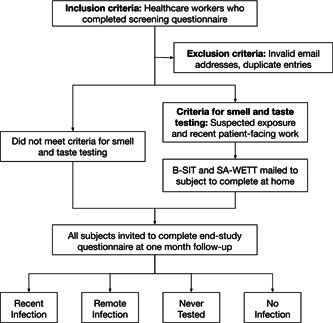
Methods: Two hundred and fifty healthcare workers were screened for possible loss of smell and taste using online surveys. Self-administered smell and taste tests were mailed to respondents meeting criteria for elevated risk of infection, and one-month follow-up surveys were completed.
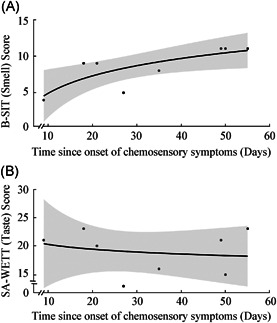
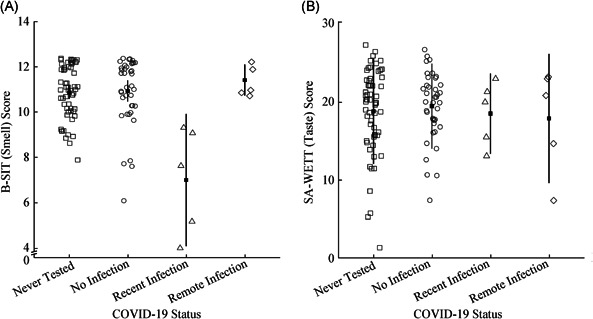
Results: Among subjects with prior SARS-CoV-2 infection, 73% reported symptoms of olfactory and/or gustatory dysfunction. Self-reported smell and taste loss were both strong predictors of COVID-19 positivity. Subjects with evidence of recent SARS-CoV-2 infection (<45 days) had significantly lower olfactory scores but equivalent gustatory scores compared to other subjects. There was a time-dependent increase in smell scores but not in taste scores among subjects with prior infection and chemosensory symptoms. The overall infection rate was 4.4%, with 2.5% reported by PCR swab.
Conclusion: Healthcare workers with recent SARS-CoV-2 infection had reduced olfaction and normal gustation on self-administered objective testing compared to those without infection. Rates of infection and chemosensory symptoms in our cohort of healthcare workers reflect those of the general public.
Keywords: Anosmia; Brief Smell Identification Test; COVID-19; Chemosensory dysfunction; Dysgeusia; Gustation; Healthcare workers; Objective testing; Olfaction; Screening; University of Pennsylvania Smell Identification Test.
© 2021 Chinese Medical Association. Production and hosting by Elsevier B.V. on behalf of KeAi Communications Co., Ltd.
Conflict of interest statement
☐ The authors declare that they have no known competing financial interests or personal relationships that could have appeared to influence the work reported in this paper. ☒The authors declare the following financial interests/personal relationships which may be considered as potential competing interests:
Figures
References
-
- Tong JY, Wong A, Zhu D, Fastenberg JH, Tham T. The prevalence of olfactory and gustatory dysfunction in COVID‐19 patients: a systematic review and meta‐analysis. Otolaryngol Head Neck Surg. 2020;163:3‐11. - PubMed
-
- Borsetto D, Hopkins C, Philips V, et al. Self‐reported alteration of sense of smell or taste in patients with COVID‐19: a systematic review and meta‐analysis on 3563 patients. Rhinology. 2020;58:430‐436. - PubMed
LinkOut - more resources
Full Text Sources
Other Literature Sources
Miscellaneous
