


Recent Advances in Our Understanding of the Diversity and Roles of Chaperone-Usher Fimbriae in Facilitating Salmonella Host and Tissue Tropism
- PMID: 33614531
- PMCID: PMC7886704
- DOI: 10.3389/fcimb.2020.628043
Recent Advances in Our Understanding of the Diversity and Roles of Chaperone-Usher Fimbriae in Facilitating Salmonella Host and Tissue Tropism
Abstract
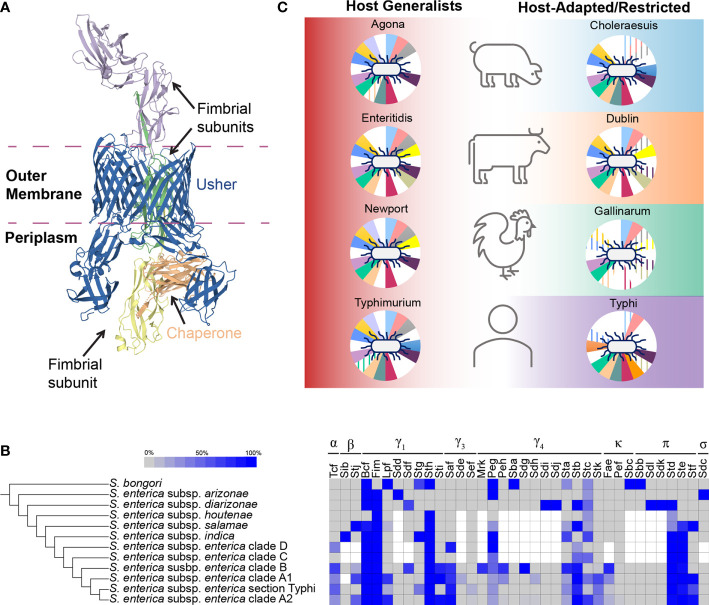
Salmonella enterica is one of the most diverse and successful pathogens, representing a species with >2,600 serovars with a variety of adaptations that enable colonization and infection of a wide range of hosts. Fimbriae, thin hair-like projections that cover the surface of Salmonella, are thought to be the primary organelles that mediate Salmonella's interaction with, and adherence to, the host intestinal epithelium, representing an important step in the infection process. The recent expansion in genome sequencing efforts has enabled the discovery of novel fimbriae, thereby providing new perspectives on fimbrial diversity and distribution among a broad number of serovars. In this review, we provide an updated overview of the evolutionary events that shaped the Salmonella chaperone-usher fimbriome in light of recent phylogenetic studies describing the population structure of Salmonella enterica. Furthermore, we discuss the complexities of the chaperone-usher fimbriae-mediated host-pathogen interactions and the apparent redundant roles of chaperone-usher fimbriae in host and tissue tropism.
Keywords: Salmonella; adhesin Salmonella; chaperone-usher; fimbriae; host-pathogen interaction.
Copyright © 2021 Cheng and Wiedmann.
Conflict of interest statement
The authors declare that the research was conducted in the absence of any commercial or financial relationships that could be construed as a potential conflict of interest.
Figures
References
-
- Aviv G., Elpers L., Mikhlin S., Cohen H., Vitman Zilber S., Grassl G. A., et al. (2017). The plasmid-encoded Ipf and Klf fimbriae display different expression and varying roles in the virulence of Salmonella enterica serovar Infantis in mouse vs. avian hosts. PLoS Path. 13, e1006559–e1006559. 10.1371/journal.ppat.1006559 - DOI - PMC - PubMed
-
- Azriel S., Goren A., Shomer I., Aviv G., Rahav G., Gal-Mor O. (2017). The Typhi colonization factor (Tcf) is encoded by multiple non-typhoidal Salmonella serovars but exhibits a varying expression profile and interchanging contribution to intestinal colonization. Virulence 8, 1791–1807. 10.1080/21505594.2017.1380766 - DOI - PMC - PubMed
-
- Bäumler A. J., Tsolis R. M., Bowe F. A., Kusters J. G., Hoffmann S., Heffron F. (1996. a). The pef fimbrial operon of Salmonella Typhimurium mediates adhesion to murine small intestine and is necessary for fluid accumulation in the infant mouse. Infect. Immun. 64, 61–68. 10.1128/IAI.64.1.61-68.1996 - DOI - PMC - PubMed
Publication types
MeSH terms
Substances
LinkOut - more resources
Full Text Sources
Other Literature Sources
