


Patellofemoral Dislocation Recurrence After a First Episode: A Case-Control Study
- PMID: 33614800
- PMCID: PMC7869156
- DOI: 10.1177/2325967120981636
Patellofemoral Dislocation Recurrence After a First Episode: A Case-Control Study
Abstract
Background: Lateral patellar dislocation can become a recurrent problem after the first episode. Identifying those patients who are at increased risk of redislocation is important for the treatment decision-making process.
Purpose: To identify clinical and radiologic risk factors for recurrence of patellar dislocation after a first episode.
Study design: Case-control study; Level of evidence, 3.
Methods: The study included patients with lateral patellar dislocation and a 1-year minimum follow-up who were seen between 2011 and 2018. Patients aged 10 to 65 years were included. Patient characteristics, physical examination (patellar apprehension, J sign), and radiographs were reviewed. The Caton-Deschamps and Insall-Salvati ratios were used to evaluate patella alta. High-grade trochlear dysplasia was defined as Dejour types B, C, and D.
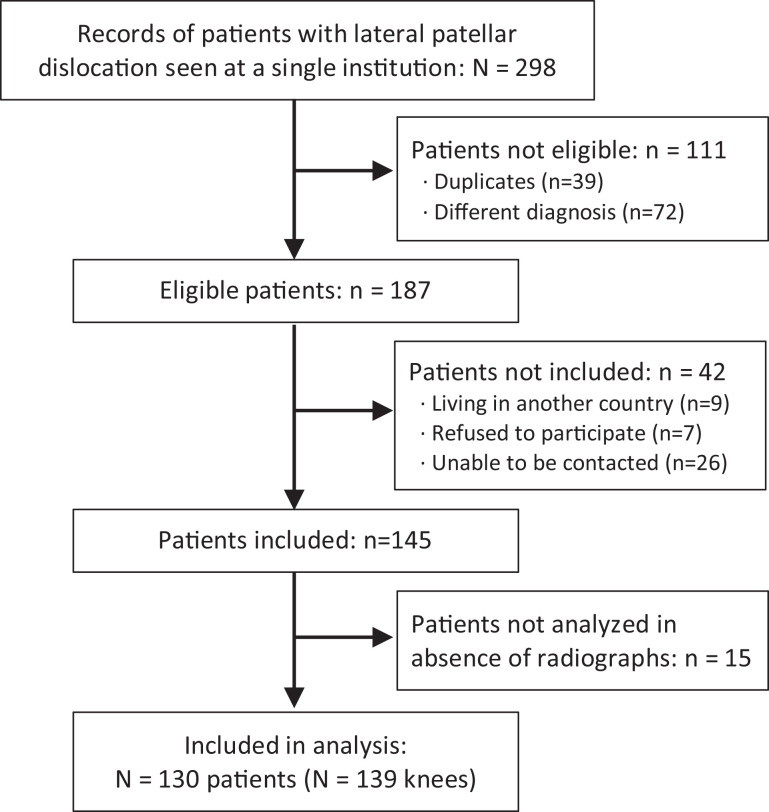
Results: A total of 130 patients (139 knees) with primary lateral patellar dislocation were included. Recurrent dislocation was seen in 83 knees (59.71%). Stepwise logistic regression analysis demonstrated that Caton-Deschamps ratio ≥1.15 (OR, 2.39; 95% CI, 1.09-5.22; P = .029), age <21 years (OR, 2.53; 95% CI, 1.11-5.77; P = .027), and high-grade trochlear dysplasia (OR, 4.17; 95% CI, 1.90-9.17; P < .001) were significantly associated with patellar redislocation. Based on the presence of these factors, the probability of dislocation after a first lateral patellar dislocation was 31.2% with no factors present, 36.6% with any 1 factor present, 71.7% with any 2 factors present, and 86.2% if all 3 conditions were present.
Conclusion: The results of this study indicated that patella alta, high-grade trochlear dysplasia, and age <21 years were independent risk factors for patellar redislocation after a first episode, with an additive effect when they were present together. This may help to guide the type of treatment for these patients.
Keywords: patella alta; patellar dislocation; patellar instability; risk factors; trochlear dysplasia.
© The Author(s) 2021.
Conflict of interest statement
The authors declared that they have no conflicts of interest in the authorship and publication of this contribution. AOSSM checks author disclosures against the Open Payments Database (OPD). AOSSM has not conducted an independent investigation on the OPD and disclaims any liability or responsibility relating thereto.
Figures
References
-
- Albee FH. The bone graft wedge in the treatment of habitual dislocation of the patella. Med Record. 1915;88:257–259.
-
- Arendt EA, Askenberger M, Agel J, Tompkins MA. Risk of redislocation after primary patellar dislocation: a clinical prediction model based on magnetic resonance imaging variables. Am J Sports Med. 2018;46(14):3385–3390. - PubMed
-
- Arendt EA, England K, Agel J, Tompkins MA. An analysis of knee anatomic imaging factors associated with primary lateral patellar dislocations. Knee Surg Sports Traumatol Arthrosc. 2017;25(10):3099–3107. - PubMed
-
- Askenberger M, Bengtsson Moström E, Ekström W, et al. Operative repair of medial patellofemoral ligament injury versus knee brace in children with an acute first-time traumatic patellar dislocation: a randomized controlled trial. Am J Sports Med. 2018;46(10):2328–2340. - PubMed
-
- Askenberger M, Janarv PM, Finnbogason T, Arendt EA. Morphology and anatomic patellar instability risk factors in first-time traumatic lateral patellar dislocations: a prospective magnetic resonance imaging study in skeletally immature children. Am J Sports Med. 2017;45(1):50–58. - PubMed
LinkOut - more resources
Full Text Sources
Other Literature Sources
