Review
. 2021 Feb 4;5(1):rkaa081.
doi: 10.1093/rap/rkaa081. eCollection 2021.

Anti-phospholipid syndrome and COVID-19 thrombosis: connecting the dots

Affiliations
Review

Anti-phospholipid syndrome and COVID-19 thrombosis: connecting the dots

Moon Ley Tung et al. Rheumatol Adv Pract. .

Abstract

As the coronavirus disease 2019 (COVID-19) pandemic, which is caused by the severe acute respiratory syndrome coronavirus 2 (SARS-CoV-2), is spreading rapidly worldwide, it has emerged as a leading cause of mortality, resulting in >1 million deaths over the past 10 months. The pathophysiology of COVID-19 remains unclear, posing a great challenge to the medical management of patients. Recent studies have reported an unusually high prevalence of thromboembolic events in COVID-19 patients, although the mechanism remains elusive. Several studies have reported the presence of aPLs in COVID-19 patients. We have noticed similarities between COVID-19 and APS, which is an autoimmune prothrombotic disease that is often associated with an infective aetiology. Molecular mimicry and endothelial dysfunction could plausibly explain the mechanism of thrombogenesis in acquired APS. In this review, we discuss the clinicopathological similarities between COVID-19 and APS, and the potential role of therapeutic targets based on the anti-phospholipid model for COVID-19 disease.

Keywords: COVID-19; anti-phospholipid antibodies; anti-phospholipid syndrome; anticoagulation; autoimmunity; molecular mimicry; oxidative stress; thrombosis.


Figures

<sc>Fig</sc>. 1
Fig. 1
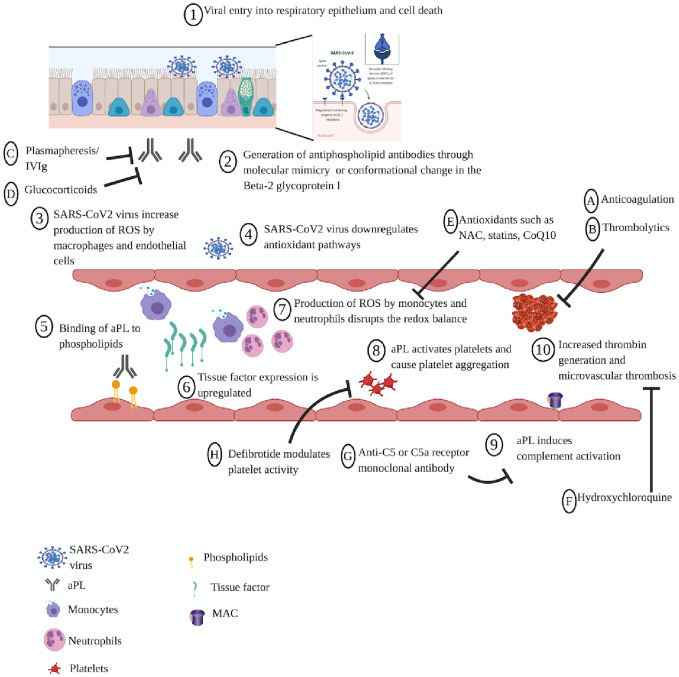
Proposed mechanisms of APS pathophysiology and potential therapeutic targets in coronavirus disease 2019 Pathophysiological mechanism of coronavirus disease 2019 (COVID-19). Viral infection of the respiratory epithelium results in endothelial damage, which triggers the production of aPLs, either through molecular mimicry of the SARS-CoV-2 with the innate β2-glycoprotein I or with the generation of a neoepitope resulting from oxidative stress leading to a conformational change in the β2-glycoprotein I. The SARS-CoV-2 induces the production of reactive oxygen species (ROS) by monocytes and endothelial cells and suppresses the antioxidant pathways at the same time. aPL binds to phospholipids and upregulates tissue factor expression, inducing monocytes and neutrophils to produce reactive oxygen species (ROS), which disrupt the redox balance and activate platelets, leading to platelet aggregation and increased thrombin generation. Proposed interventions include anticoagulation, plasmapheresis, IVIG, antioxidants, HCQ, anti-C5 or anti-C5a receptor mAb and defibrotide to reverse APS pathophysiology in COVID-19 patients. MAC, Membrane Attack Complex; NAC, N-acetylcysteine.
<sc>Fig</sc>. 2
Fig. 2
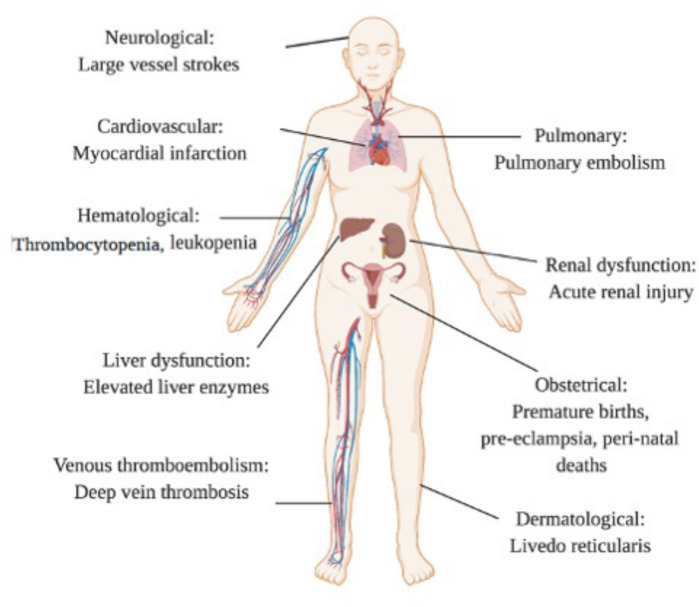
Overlapping features of APS and COVID-19 There is a significant overlap of dermatological, haematological, obstetric, pulmonary and neurological manifestations of APS with COVID-19.

References

    1. World Health Organization. Coronavirus (COVID-19) events as they happen. World Health Organization, 2020. https://covid19.who.int/table.
    1. Rodriguez-Morales AJ, Cardona-Ospina JA, Gutiérrez-Ocampo E. et al. Clinical, laboratory and imaging features of COVID-19: a systematic review and meta-analysis. Travel Med Infect Dis 2020;34:101623. - PMC - PubMed
    1. Borges do Nascimento IJ, Cacic N, Abdulazeem HM. et al. Novel coronavirus infection (COVID-19) in humans: a scoping review and meta-analysis. J Clin Med 2020;9:941. - PMC - PubMed
    1. Klok FA, Kruip MJHA, van der Meer NJM. et al. Incidence of thrombotic complications in critically ill ICU patients with COVID-19. Thromb Res 2020;191:145–7. - PMC - PubMed
    1. Lodigiani C, Iapichino G, Carenzo L. et al. Venous and arterial thromboembolic complications in COVID-19 patients admitted to an academic hospital in Milan, Italy. Thromb Res 2020;191:9–14. - PMC - PubMed

LinkOut - more resources