


Dermacentor variabilis is the Predominant Dermacentor spp. (Acari: Ixodidae) Feeding on Dogs and Cats Throughout the United States
- PMID: 33615364
- PMCID: PMC8122232
- DOI: 10.1093/jme/tjab007
Dermacentor variabilis is the Predominant Dermacentor spp. (Acari: Ixodidae) Feeding on Dogs and Cats Throughout the United States
Abstract
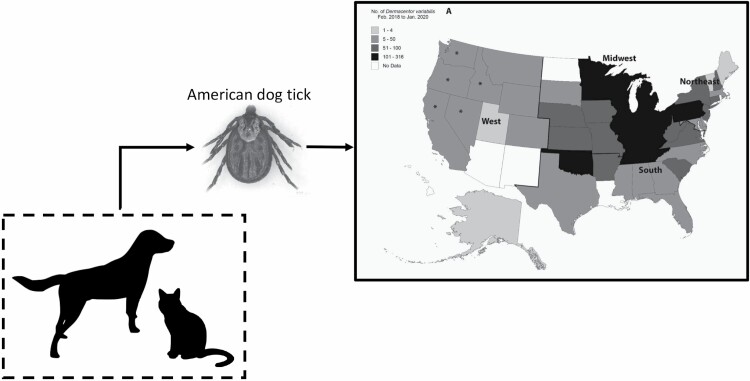
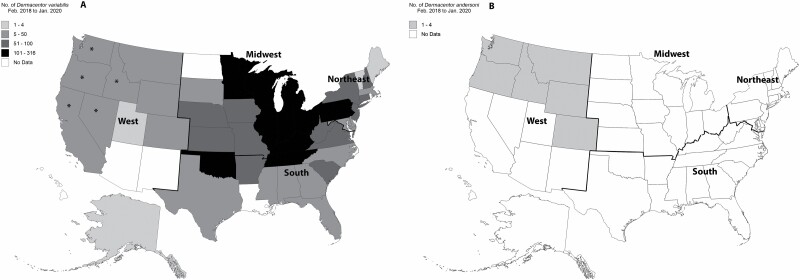
Throughout North America, Dermacentor spp. ticks are often found feeding on animals and humans, and are known to transmit pathogens, including the Rocky Mountain spotted fever agent. To better define the identity and distribution of Dermacentor spp. removed from dogs and cats in the United States, ticks submitted from 1,457 dogs (n = 2,924 ticks) and 137 cats (n = 209 ticks) from veterinary practices in 44/50 states from February 2018-January 2020 were identified morphologically (n = 3,133); the identity of ticks from regions where Dermacentor andersoni (Stiles) have been reported, and a subset of ticks from other regions, were confirmed molecularly through amplification and sequencing of the ITS2 region and a 16S rRNA gene fragment. Of the ticks submitted, 99.3% (3,112/3,133) were Dermacentor variabilis (Say), 0.4% (12/3,133) were D. andersoni, and 0.3% (9/3,133) were Dermacentor albipictus (Packard). While translocation of pets prior to tick removal cannot be discounted, the majority (106/122; 87%) of Dermacentor spp. ticks removed from dogs and cats in six Rocky Mountain states (Montana, Idaho, Wyoming, Nevada, Utah, and Colorado) were D. variabilis, suggesting this species may be more widespread in the western United States than is currently recognized, or that D. andersoni, if still common in the region, preferentially feeds on hosts other than dogs and cats. Together, these data support the interpretation that D. variabilis is the predominant Dermacentor species found on pets throughout the United States, a finding that may reflect recent shifts in tick distribution.
Keywords: Dermacentor; American dog tick; cat; dog.
© The Author(s) 2021. Published by Oxford University Press on behalf of Entomological Society of America. All rights reserved. For permissions, please e-mail: journals.permissions@oup.com.
Figures
References
-
- Bishop, F. C., and Trembley H. L.. . 1945. Distribution and hosts of certain North American ticks. J. Parasitol. 31: 1–54.
-
- Blagburn, B. L., Lindsay D. S., Vaughn J. L., Ripley N. S., Wright J. C., Lynn R. C., Kelch W. J., Ritchie G. C., Hepler D.. . 1996. Prevalence of canine parasites based on fecal flotation. Comp Cont Ed Pract Vet. 18: 483–509.
-
- Burg, J. G. 2001. Seasonal activity and spatial distribution of host-seeking adults of the tick Dermacentor variabilis. Med. Vet. Entomol. 15: 413–421. - PubMed
-
- Burgdorfer, W. 1975. A review of Rocky Mountain spotted fever (tick-borne typhus), its agent, and its tick vectors in the United States. J. Med. Entomol. 12: 269–278. - PubMed
-
- Centers for Disease Control and Prevention . 2020. Geographic distribution of ticks that bite humans. Available from https://www.cdc.gov/ticks/geographic_distribution.html.
Publication types
MeSH terms
Grants and funding
LinkOut - more resources
Full Text Sources
Other Literature Sources
Miscellaneous
