. 2021 Oct;30(5):e13304.
doi: 10.1111/jsr.13304. Epub 2021 Feb 21.

Neuronal activation and performance changes in working memory induced by chronic sleep restriction in adolescents

Affiliations

Neuronal activation and performance changes in working memory induced by chronic sleep restriction in adolescents

Maryam Alsameen et al. J Sleep Res. 2021 Oct.

Abstract

Most adolescents get less than the recommended 8-10 hr of sleep per night. Functional deficits from lack of sleep include disruption of working memory. Adult neuroimaging studies of sleep deprivation suggest diminished responses in task-related brain networks if performance degrades, but compensatory increased responses with maintained performance. This study utilized functional magnetic resonance imaging to examine compensatory and diminished brain responses in adolescents during working memory performance, comparing chronic sleep restriction and healthy sleep duration. Thirty-six healthy adolescents, 14-17 years old, experienced a 3-week protocol: (a) sleep phase stabilization; (b) sleep restriction (~6.5 hr nightly); and (c) healthy sleep duration (~9 hr nightly). After each sleep manipulation, we acquired functional magnetic resonance imaging with an NBack working memory task with four difficulty levels (0 to 3-back). NBack performance degraded with higher task difficulty, but without a detectable effect of sleep duration. ANOVA revealed main effects of both NBack difficulty and sleep in widespread brain networks. Planned contrasts showed that, compared with healthy sleep, sleep restriction resulted in greater medial prefrontal activation and weaker activation in the precuneus for the most difficult task condition. During sleep restriction, we found compensatory functional responses in brain regions that process sensory input and vigilance. However, adolescents also showed impaired performance and diminished brain responses during the hardest task level under a week of chronic sleep restriction. Chronic sleep restriction during adolescence is common. Understanding the impact of ongoing functional compensation and performance breakdown during this developmental period can have important implications for learning and educational strategies.

Keywords: adolescents; functional magnetic resonance imaging; sleep restriction; working memory.


Conflict of interest statement

Conflict of interest: The authors declare that there is no conflict of interest.

Figures
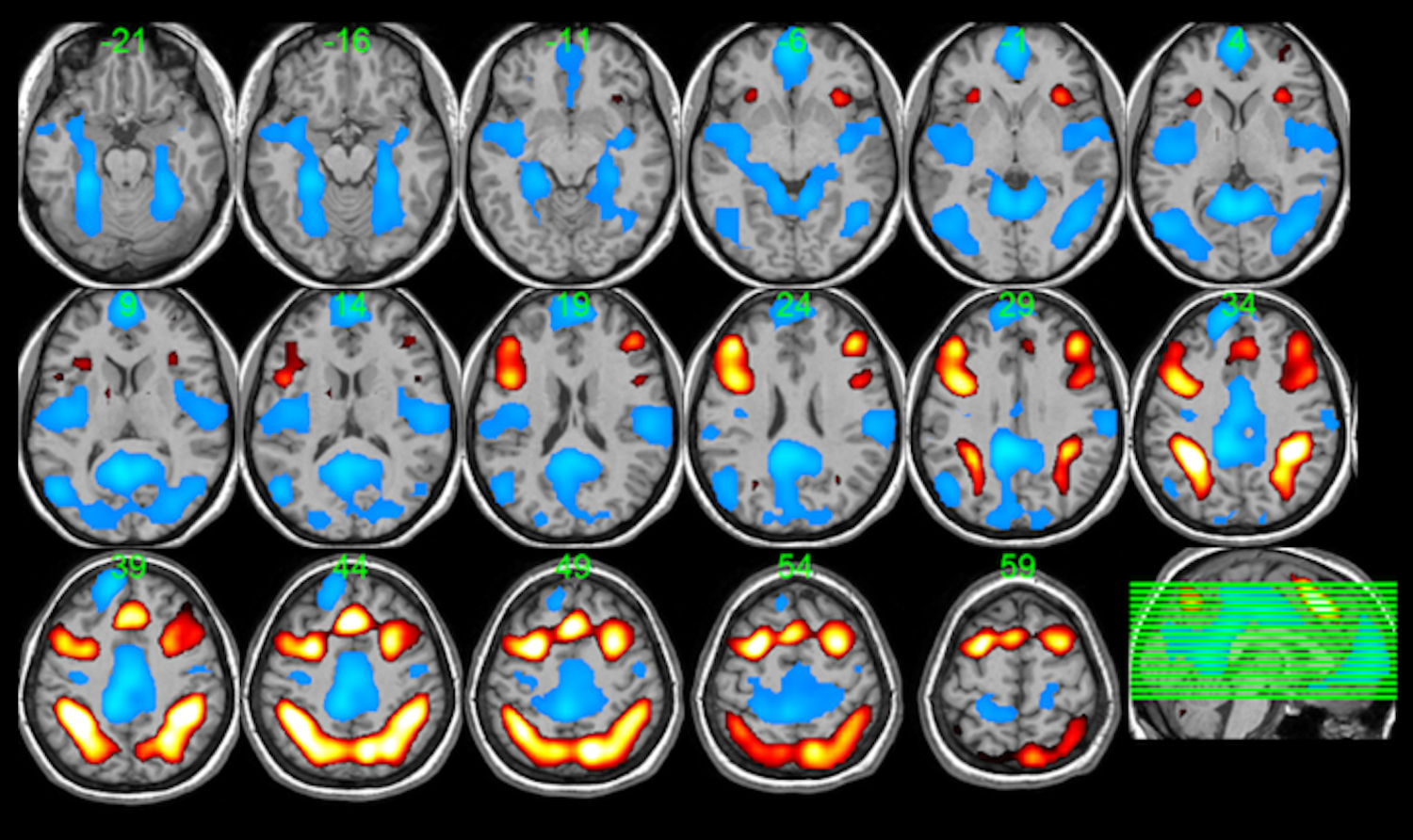
Figure 1:
Figure 1:
Composite activation map for the 2-back vs. 0-back contrast. Red regions indicate where 2-back > 0-back, while blue regions indicate where 0-back > 2-back. All regions delineate voxels with p < 0.005, family-wise error corrected.
Figure 2:
Figure 2:
Activation map of the main effect of working memory (NBack) task difficulty, with significance threshold of F=19.04, p < 0.001, family-wise error corrected.
Figure 3:
Figure 3:
Activation map of main effect of sleep (36 subjects). Hot colors refer to voxels that are more active for the contrast sleep restricted (SR) > healthy duration (HD). Cool colors refer to voxels that are activated for the opposite contrast HD > SR. Clusters were generated with nominal voxel threshold p <0.005 (T > 2.60) uncorrected. Cluster-level p < 0.05 family-wise error corrected.
Figure 4:
Figure 4:
Paired T-test activation map, showing a cluster for SR > HD for the contrast 3-back > 2-back, with nominal voxel threshold of T=2.3, cluster-level p = 0.04, family-wise error corrected after small volume correction (SVC) within the sleep effect cluster at [−2, 60, 26] (Table 3). Peak MNI coordinate [x,y,z] = [−2, 44, 22]. Anatomical regions included bilateral medial superior frontal cortex, anterior cingulate cortex, and medial orbitofrontal cortex. The bar plot shows the mean ± standard error of 3-back and 2-back response (beta parameters of first level analysis) for each sleep condition at the peak voxel.
Figure 5:
Figure 5:
Paired T-test activation map, showing a cluster for HD > SR for the contrast 3-back > 0-back, with nominal voxel threshold of T=2.3, cluster-level p = 0.002, family-wise error corrected after small volume correction (SVC) within the sleep effect cluster at [−10, −68, 50] (Table 3). Peak MNI coordinate [x,y,z] = [−22, −64, 46]. Anatomical regions included left inferior and superior parietal cortex and the precuneus. The bar plot shows the mean ± standard error of 3-back and 0-back response (beta parameters of first level analysis) for each sleep condition at the peak voxel.

References

    1. Alloway TP, & Alloway RG (2010). Investigating the predictive roles of working memory and IQ in academic attainment. Journal of Experimental Child Psychology, 106(1), 20–29. 10.1016/j.jecp.2009.11.003 - DOI - PubMed
    1. Anticevic A, Cole MW, Murray JD, Corlett PR, Wang XJ, & Krystal JH (2012). The role of default network deactivation in cognition and disease. Trends Cogn Sci, 16(12), 584–592. 10.1016/j.tics.2012.10.008 - DOI - PMC - PubMed
    1. Aronen ET, Vuontela V, Steenari MR, Salmi J, & Carlson S (2005). Working memory, psychiatric symptoms, and academic performance at school. Neurobiology of Learning and Memory, 83(1), 33–42. 10.1016/j.nlm.2004.06.010 - DOI - PubMed
    1. AS K, & NL K (2004). Kaufman Assessment Battery for Children, Second edition. Circle Pine, MN: AGS Publishing.
    1. Ashburner J, & Friston KJ (2005). Unified segmentation. Neuroimage, 26(3), 839–851. 10.1016/j.neuroimage.2005.02.018 - DOI - PubMed

Publication types

LinkOut - more resources
