


Patients with episodic migraine show increased T2 values of the trapezius muscles - an investigation by quantitative high-resolution magnetic resonance imaging
- PMID: 33615841
- PMCID: PMC8217886
- DOI: 10.1177/0333102421996374
Patients with episodic migraine show increased T2 values of the trapezius muscles - an investigation by quantitative high-resolution magnetic resonance imaging
Abstract
Background: Neck pain is frequent in patients with migraine. Likewise, evidence for inflammatory processes in the trapezius muscles is accumulating. However, non-invasive and objectively assessable correlates are missing in vivo.
Methods: Twenty-one subjects with episodic migraine (mean age: 24.6 ± 3.1 years, 18 females) and 22 controls (mean age: 23.0 ± 2.2 years, 17 females) without any history of headache prospectively underwent physical examination and quantitative magnetic resonance imaging of the trapezius muscles. A T2-prepared turbo spin-echo sequence was acquired for manual segmentation of the trapezius muscles and extraction of mean T2 values.
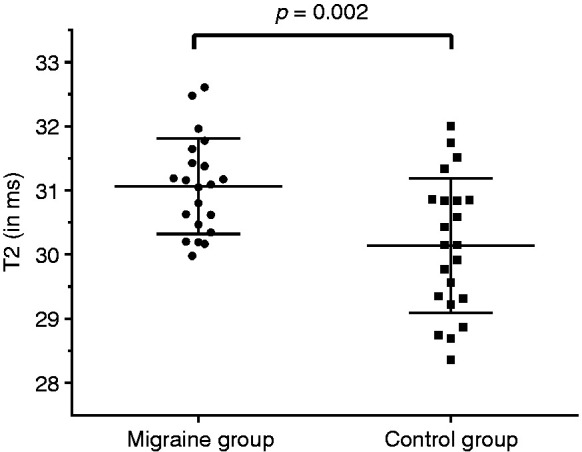
Results: There were no statistically significant differences regarding age, sex, body mass index, or number of myofascial trigger points (mTrPs) between groups. All patients with migraine presented with mTrPs in the trapezius muscles. T2 of the entire trapezius muscles was significantly higher in the migraine group when compared to controls (31.1 ± 0.8 ms vs. 30.1 ± 1.1 ms; p = 0.002).
Conclusions: Elevated T2 values of the trapezius muscles may indicate subtle inflammatory processes within musculature among patients with migraine because T2 increase is likely to stem from edematous changes. Future work may validate this finding in larger cohorts, but muscle T2 might have potential to develop into a viable in vivo biomarker for muscular affection in migraine.
Keywords: Magnetic resonance imaging; T2 mapping; migraine; myofascial trigger points; trapezius muscle; trigemino-cervical complex.
Conflict of interest statement
Figures

References
-
- Global Burden of Disease Study 2013 Collaborators . Global, regional, and national incidence, prevalence, and years lived with disability for 301 acute and chronic diseases and injuries in 188 countries, 1990–2013: A systematic analysis for the Global Burden of Disease Study 2013. Lancet 2015; 386: 743–800. - PMC - PubMed
-
- Bartsch T, Goadsby PJ. The trigeminocervical complex and migraine: Current concepts and synthesis. Curr Pain Headache Rep 2003; 7: 371–376. - PubMed
-
- Fernandez-de-Las-Penas C. Myofascial head pain. Curr Pain Headache Rep 2015; 19: 28. - PubMed
-
- Blaschek A, Milde-Busch A, Straube A, et al. Self-reported muscle pain in adolescents with migraine and tension-type headache. Cephalalgia 2012; 32: 241–249. - PubMed
MeSH terms
LinkOut - more resources
Full Text Sources
Other Literature Sources
Medical
