


Static and Dynamic Quadriceps Stretching Exercises in Patients With Patellofemoral Pain: A Randomized Controlled Trial
- PMID: 33615901
- PMCID: PMC8404765
- DOI: 10.1177/1941738121993777
Static and Dynamic Quadriceps Stretching Exercises in Patients With Patellofemoral Pain: A Randomized Controlled Trial
Abstract
Background: Limited data are available on the effect of stretching exercise in patients with patellofemoral pain (PFP) who have inflexible quadriceps, which is one of the various causes of PFP syndrome. This study compares quadriceps flexibility, strength, muscle activation time, and patient-reported outcomes after static and dynamic quadriceps stretching exercises in patients with PFP who had inflexible quadriceps.
Hypothesis: Quadriceps flexibility and strength, muscle activation time, and patient-reported outcomes would improve with dynamic quadriceps stretching as compared with static quadriceps stretching exercises.
Study design: Randomized controlled trial.
Level of evidence: Level 2.
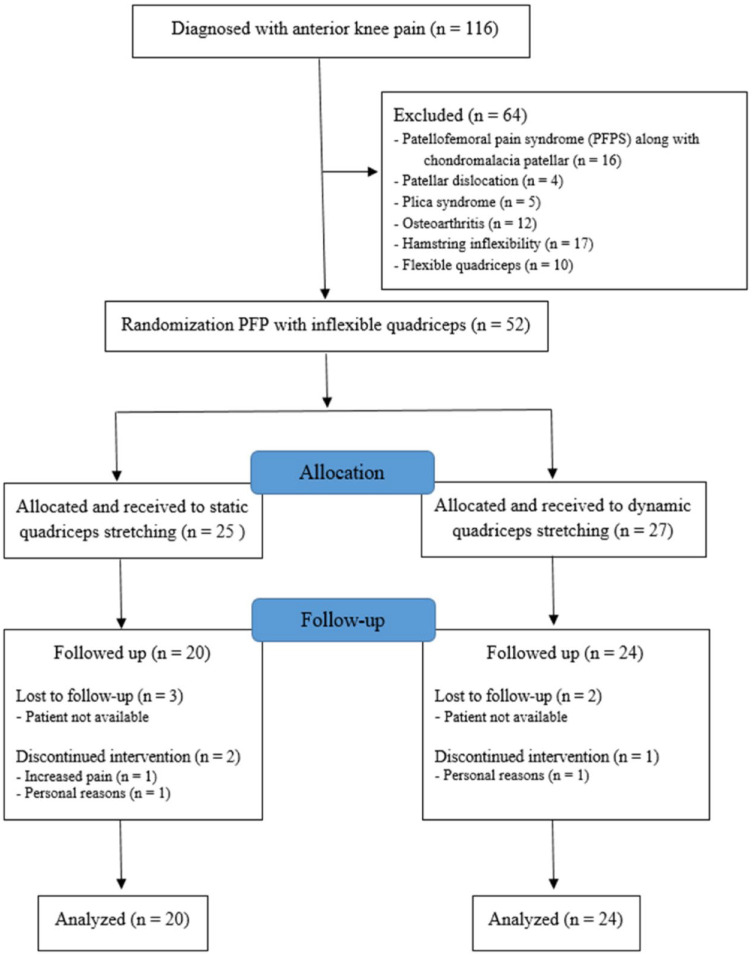
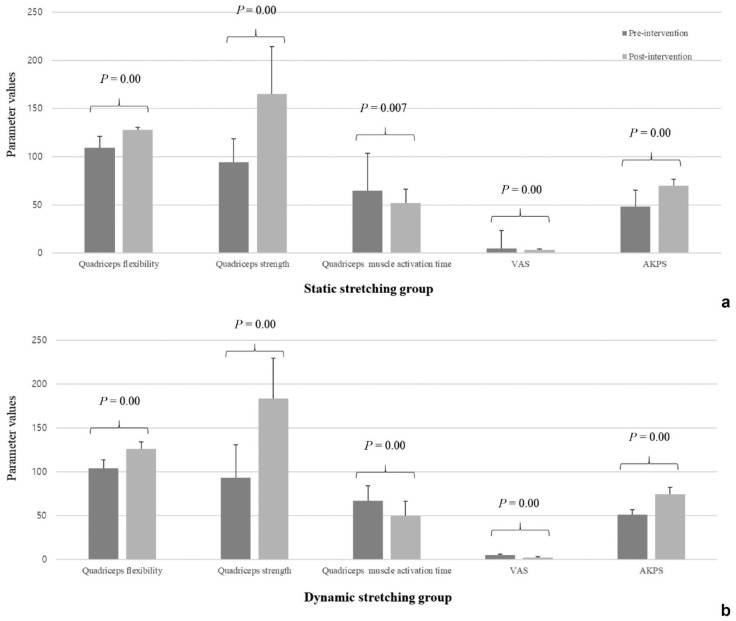
Methods: Of the 44 patients included in the study, 20 performed static stretching and 24 performed dynamic stretching. Quadriceps flexibility was assessed by measuring the knee flexion angle during knee flexion in the prone position (the Ely test). Muscle strength and muscle activation time were measured using an isokinetic device. The patient-reported outcomes were evaluated using the visual analogue scale for pain and anterior knee pain scale.
Results: No significant differences in quadriceps flexibility and strength, muscle activation time, and patient-reported outcomes in the involved knees were found between the 2 groups (P values > 0.05).
Conclusion: Quadriceps flexibility and strength, muscle activation time, and patient-reported outcomes in patients with PFP who had inflexible quadriceps showed no significant differences between the static and dynamic quadriceps stretching exercise groups.
Clinical relevance: Both static and dynamic stretching exercises may be effective for improving pain and function in patients with PFP who have inflexible quadriceps.
Keywords: dynamic stretching; muscle activation time; muscle strength; quadriceps flexibility; static stretching.
Conflict of interest statement
The authors report no potential conflicts of interest in the development and publication of this article.
Figures
References
-
- Aminaka N, Pietrosimone BG, Armstrong CW, Meszaros A, Gribble PA.Patellofemoral pain syndrome alters neuromuscular control and kinetics during stair ambulation. J Electromyogr Kinesiol. 2011;21:645-651. - PubMed
-
- Bandy WD, Irion JM.The effect of time on static stretch on the flexibility of the hamstring muscles. Phys Ther. 1994;74:845-850. - PubMed
-
- Bandy WD, Irion JM, Briggler M.The effect of static stretch and dynamic range of motion training on the flexibility of the hamstring muscles. J Orthop Sports Phys Ther. 1998;27:295-300. - PubMed
-
- Barton CJ, Lack S, Malliaras P, Morrissey D.Gluteal muscle activity and patellofemoral pain syndrome: a systematic review. Br J Sports Med. 2013;47:207-214. - PubMed
Publication types
MeSH terms
LinkOut - more resources
Full Text Sources
Other Literature Sources
Medical
Research Materials
