


Alcohol-involved motor vehicle crashes and the size and duration of random breath testing checkpoints
- PMID: 33616237
- PMCID: PMC8076098
- DOI: 10.1111/acer.14583
Alcohol-involved motor vehicle crashes and the size and duration of random breath testing checkpoints
Abstract
Objective: Sobriety checkpoints have strong empirical and theoretical support as an intervention to reduce alcohol-involved motor vehicle crashes. The purpose of this study was to examine whether checkpoint size (the number of police officers) and checkpoint duration (the amount of time in operation) affect associations between individual checkpoints and subsequent alcohol-related crash incidence.
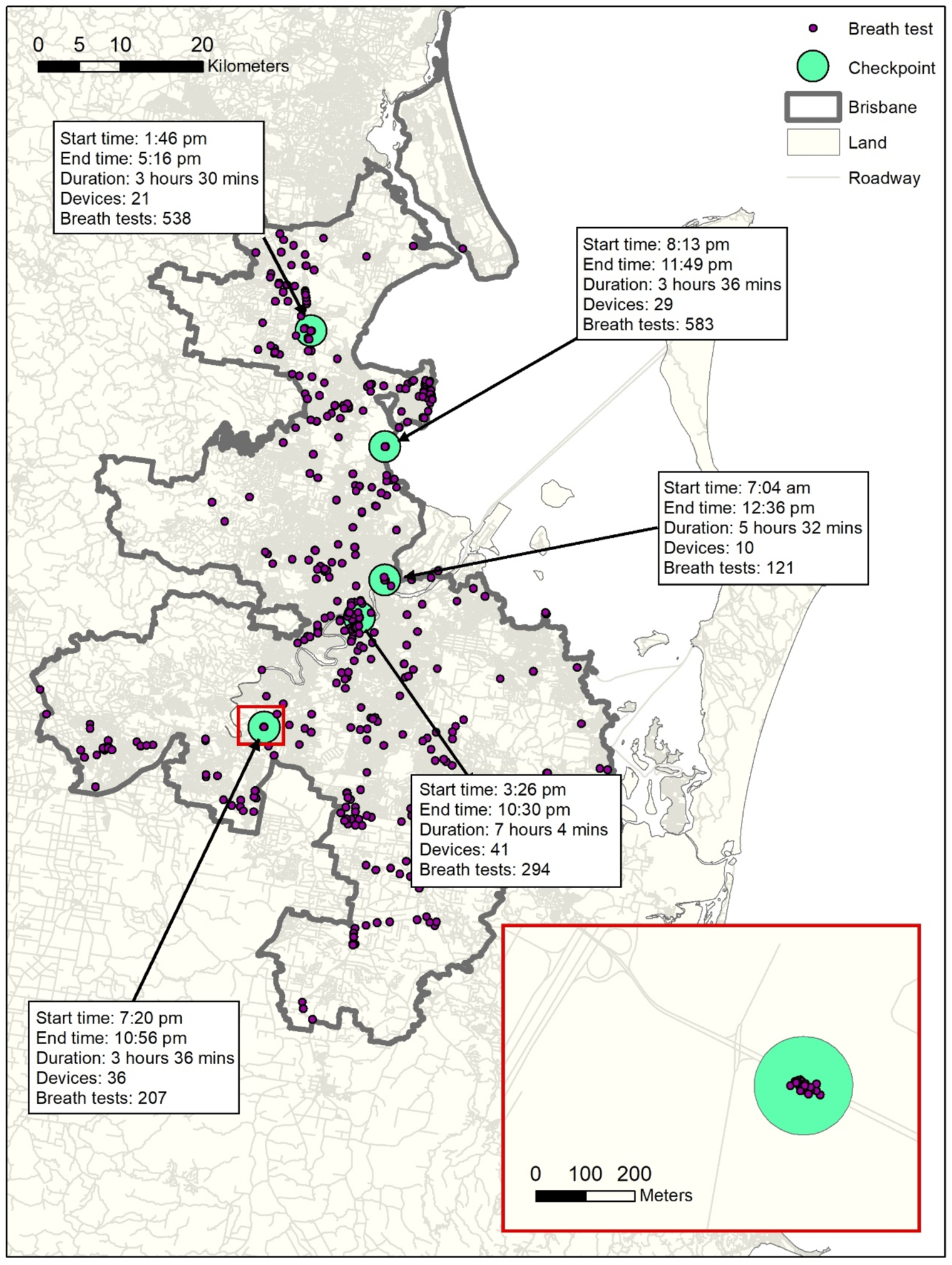
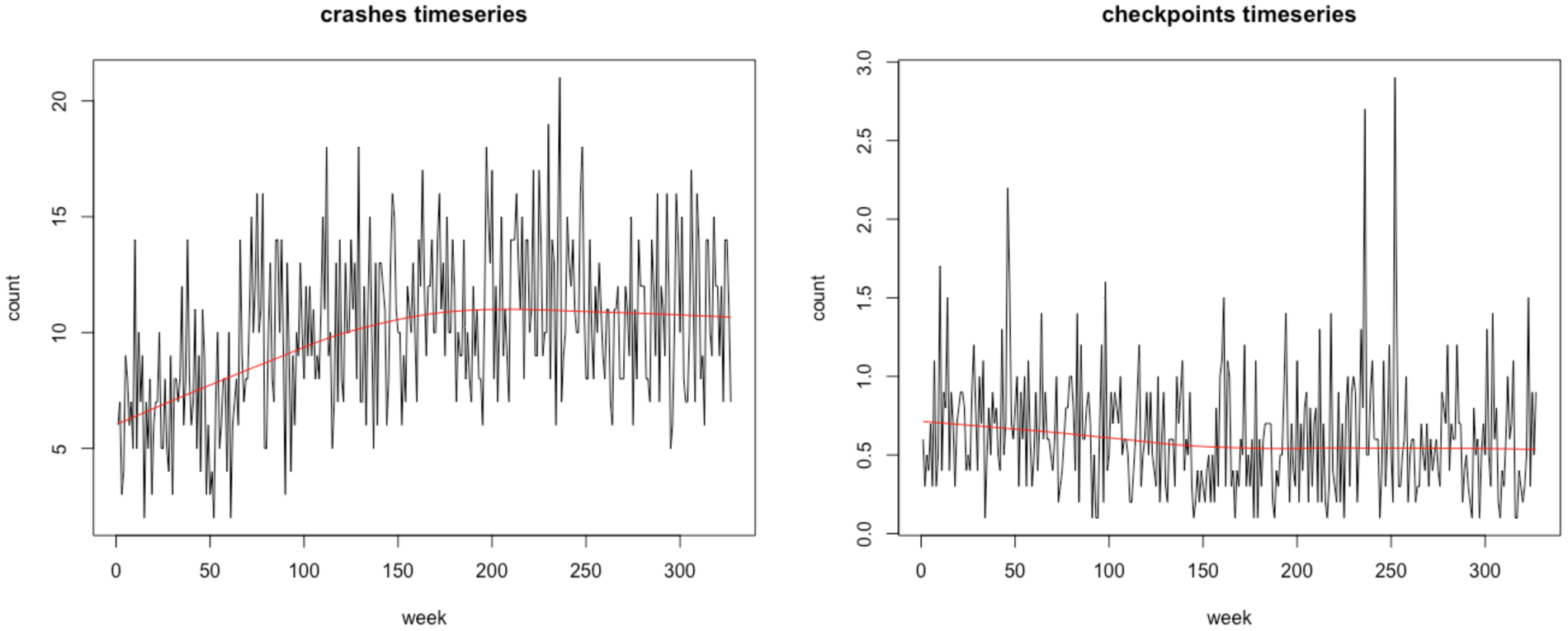
Method: Queensland Police Service provided latitude-longitude coordinates and date and time data for all breath tests that occurred in Brisbane, Australia, from January 2012 to June 2018. We applied hierarchical cluster analysis to the latitude-longitude coordinates for breath tests, identifying checkpoints as clusters of ≥25 breath tests conducted by ≥3 breath testing devices over a duration of 3 to 8 hours. Generalized linear autoregressive moving average (GLARMA) models related counts of alcohol-involved motor vehicle crashes to the number of checkpoints conducted per week, as well as 1 week prior and 2 weeks prior.
Results: A total of 3420 alcohol-related crashes occurred and 2069 checkpoints were conducted in Brisbane over the 6.5-year (339-week) study period. On average, checkpoints included a mean of 266.0 breath tests (SD = 216.3), 16.4 devices (SD = 13.7), and were 286.3 minutes in duration (SD = 104.2). Each 10 additional checkpoints were associated with a 12% decrease in crash incidence at a lag of 1 week (IRR = 0.88; 95%CI: 0.80, 0.97). We detected no differential associations according to checkpoint size or duration.
Conclusions: Sobriety checkpoints are associated with fewer alcohol-related motor vehicle crashes for around 1 week. Checkpoint size and duration do not appear to affect this relationship.
Keywords: alcohol; checkpoint; crash; motor vehicle; police; sobriety.
© 2021 by the Research Society on Alcoholism.
Figures
References
-
- Babor T, Caetano R, Casswell S, Edwards G, Giesbrecht N, Graham K, Grube JW, Hill L, Holder H, Homel R, Livingston M, Österberg E, Rehm J, Room R, Rossow I. (2010). Alcohol: No Ordinary Commodity: Research and Public Policy: Oxford University Press.
-
- Bergen G, Pitan A, Qu S, Shults RA, Chattopadhyay SK, Elder RW, Sleet DA, Coleman HL, Compton RP, Nichols JL, Clymer JM, Calvert WB, Community Preventive Services Task Force (2014). Publicized sobriety checkpoint programs: a community guide systematic review. Am J Prev Med, 46(5), 529–539. doi: 10.1016/j.amepre.2014.01.018 - DOI - PubMed
-
- Community Preventive Services Task Forve. (2014). Publicized sobriety checkpoint programs to reduce alcohol-impaired driving: recommendation of the Community Preventive Services Task Force. Am J Prev Med, 46(5), 540–541. - PubMed
-
- Dunsmuir WTM, & Scott DJ (2015). The glarma package for observation-driven time series regression of counts. J Stat Softw, 67(7), 1–36. doi: 10.18637/jss.v067.i07 - DOI
-
- Elder RW, Shults RA, Sleet DA, Nichols JL, Zaza S, & Thompson RS (2002). Effectiveness of sobriety checkpoints for reducing alcohol-involved crashes. Traffic Inj Prev, 3(4), 266–274.
Publication types
MeSH terms
Grants and funding
LinkOut - more resources
Full Text Sources
Other Literature Sources
Medical
