


Role of candidate gene variants in modulating the risk and severity of alcoholic hepatitis
- PMID: 33616244
- PMCID: PMC8076096
- DOI: 10.1111/acer.14581
Role of candidate gene variants in modulating the risk and severity of alcoholic hepatitis
Abstract
Background: Alcoholic hepatitis (AH) is a severe and life-threatening alcohol-associated liver disease. Only a minority of heavy drinkers acquires AH and severity varies among affected individuals, suggesting a genetic basis for the susceptibility to and severity of AH.
Methods: A cohort consisting of 211 patients with AH and 176 heavy drinking controls was genotyped for five variants in five candidate genes that have been associated with chronic liver diseases: rs738409 in patatin-like phospholipase domain-containing protein 3 (PNPLA3), rs72613567 in hydroxysteroid 17-beta dehydrogenase 13 (HSD17B13), rs58542926 in transmembrane 6 superfamily member 2 (TM6SF2), rs641738 in membrane bound O-acyltransferase domain containing 7 (MBOAT7), and a copy number variant in the haptoglobin (HP) gene. We tested the effects of individual variants and the combined/interacting effects of variants on AH risk and severity.
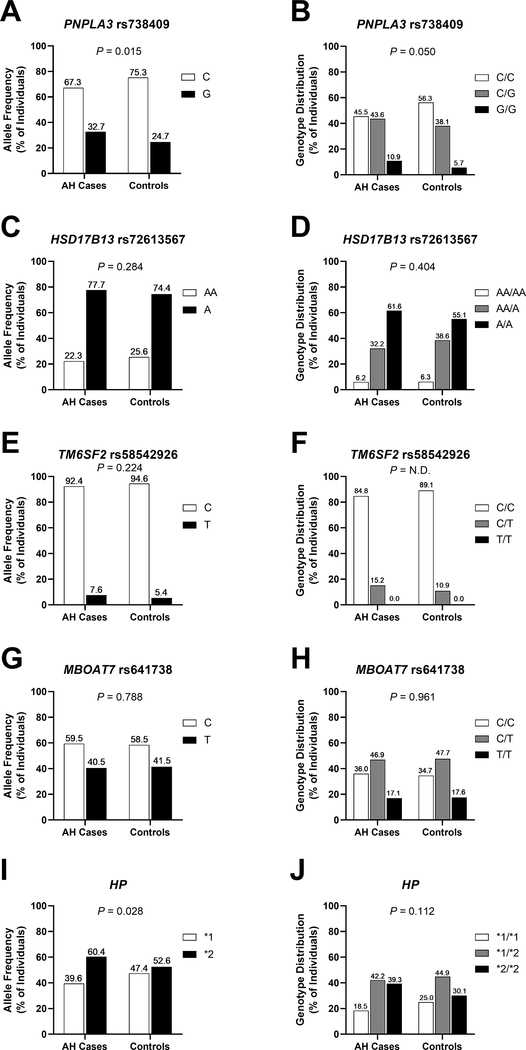
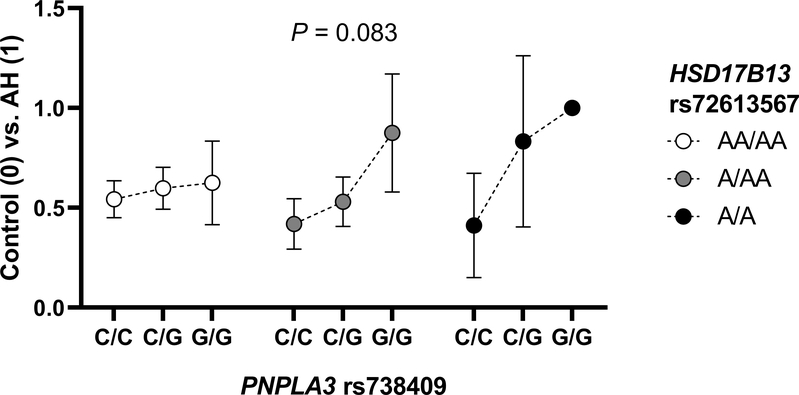
Results: We found significant associations between AH risk and the risk alleles of rs738409 (p = 0.0081) and HP (p = 0.0371), but not rs72613567 (p = 0.3132), rs58542926 (p = 0.2180), or rs641738 (p = 0.7630), after adjusting for patient's age and sex. A multiple regression model indicated that PNPLA3 rs738409:G [OR = 1.59 (95% CI: 1.15-2.22), p = 0.0055] and HP*2 [OR = 1.38 (95% CI: 1.04-1.82), p = 0.0245], when combined and adjusted for age and sex also had a large influence on AH risk among heavy drinkers. In the entire cohort, variants in PNPLA3 and HP were associated with increased total bilirubin and Model for End-stage Liver Disease (MELD) score, both measures of AH severity. The HSD17B13 rs72613567:AA allele was not found to reduce risk of AH in patients carrying the G allele of PNPLA3 rs738409 (p = 0.0921).
Conclusion: PNPLA3 and HP genetic variants increase AH risk and are associated with total bilirubin and MELD score, surrogates of AH severity.
Keywords: HSD17B13; PNPLA3; alcoholic liver disease; genetic risk; haptoglobin.
© 2021 by the Research Society on Alcoholism.
Figures
References
-
- Abul-Husn NS, Cheng X, Li AH, Xin Y, Schurmann C, Stevis P, Liu Y, Kozlitina J, Stender S, Wood GC, Stepanchick AN, Still MD, McCarthy S, O’Dushlaine C, Packer JS, Balasubramanian S, Gosalia N, Esopi D, Kim SY, Mukherjee S, Lopez AE, Fuller ED, Penn J, Chu X, Luo JZ, Mirshahi UL, Carey DJ, Still CD, Feldman MD, Small A, Damrauer SM, Rader DJ, Zambrowicz B, Olson W, Murphy AJ, Borecki IB, Shuldiner AR, Reid JG, Overton JD, Yancopoulos GD, Hobbs HH, Cohen JC, Gottesman O, Teslovich TM, Baras A, Mirshahi T, Gromada J, Dewey FE (2018) A Protein-Truncating HSD17B13 Variant and Protection from Chronic Liver Disease. N Engl J Med 378:1096–1106. - PMC - PubMed
-
- Atkinson SR, Way MJ, McQuillin A, Morgan MY, Thursz MR (2017) Homozygosity for rs738409:G in PNPLA3 is associated with increased mortality following an episode of severe alcoholic hepatitis. J Hepatol 67:120–127. - PubMed
-
- Banini BA, Cazanave SC, Yates KP, Asgharpour A, Vincent R, Mirshahi F, Le P, Contos MJ, Tonascia J, Chalasani NP, Kowdley KV, McCullough AJ, Behling CA, Schwimmer JB, Lavine JE, Sanyal AJ, Nonalcoholic Steatohepatitis Clinical Research N (2019) Haptoglobin 2 Allele is Associated With Histologic Response to Vitamin E in Subjects With Nonalcoholic Steatohepatitis. J Clin Gastroenterol 53:750–758. - PMC - PubMed
Publication types
MeSH terms
Substances
Grants and funding
LinkOut - more resources
Full Text Sources
Other Literature Sources
Research Materials
Miscellaneous
