


How the COVID-19 pandemic will change the future of critical care
- PMID: 33616696
- PMCID: PMC7898492
- DOI: 10.1007/s00134-021-06352-y
How the COVID-19 pandemic will change the future of critical care
Abstract
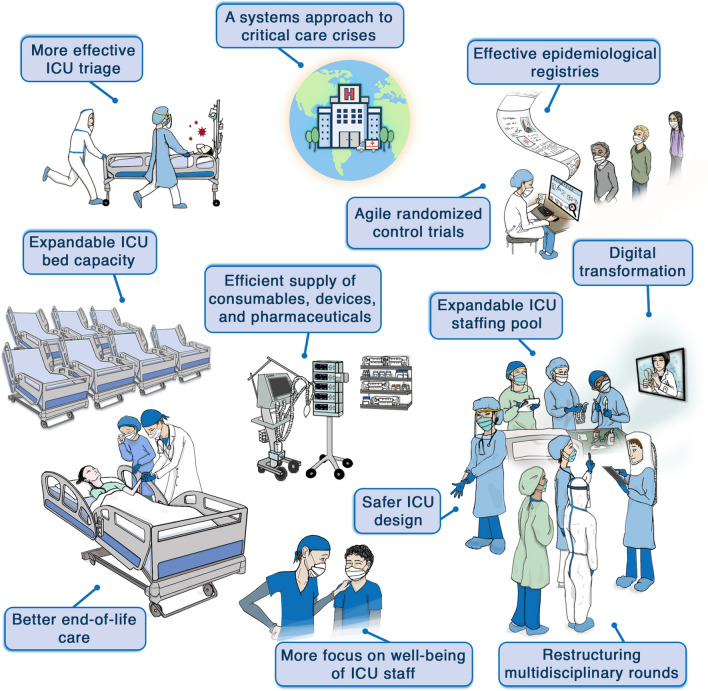
Coronavirus disease 19 (COVID-19) has posed unprecedented healthcare system challenges, some of which will lead to transformative change. It is obvious to healthcare workers and policymakers alike that an effective critical care surge response must be nested within the overall care delivery model. The COVID-19 pandemic has highlighted key elements of emergency preparedness. These include having national or regional strategic reserves of personal protective equipment, intensive care unit (ICU) devices, consumables and pharmaceuticals, as well as effective supply chains and efficient utilization protocols. ICUs must also be prepared to accommodate surges of patients and ICU staffing models should allow for fluctuations in demand. Pre-existing ICU triage and end-of-life care principles should be established, implemented and updated. Daily workflow processes should be restructured to include remote connection with multidisciplinary healthcare workers and frequent communication with relatives. The pandemic has also demonstrated the benefits of digital transformation and the value of remote monitoring technologies, such as wireless monitoring. Finally, the pandemic has highlighted the value of pre-existing epidemiological registries and agile randomized controlled platform trials in generating fast, reliable data. The COVID-19 pandemic is a reminder that besides our duty to care, we are committed to improve. By meeting these challenges today, we will be able to provide better care to future patients.
Keywords: COVID-19; Critical care; Intensive care; Pandemic; Technology.
Conflict of interest statement
YA is a member of a national committee for COVID-19 response, a Lead-Co Chair of the Think20 (T20) Taskforce for COVID-19, Saudi Arabia, an investigator on A Randomised, Embedded, Multi-factorial, Adaptive Platform Trial for Community-Acquired Pneumonia (REMAP-CAP) and a Board Member of the International Severe Acute Respiratory and Emerging Infection Consortium. J-F T is a member of Advisory Boards not directly related to the submitted manuscript but related to COVID-19: MSD, Gilead. His academic COI includes being an advisory member of the “haut conseil de santé publique”; a governmental advisory board on COVID-19 management and PI of the COVIDICUS study (PHRC 2020 NCT04344730) funded by the French Ministry of Health. EA has received fees for lectures from Gilead, Pfizer, Baxter, and Alexion. His research group has been supported by Ablynx, Fisher and Payckle, Jazz Pharma, and MSD. The other authors did not declare conflicts of interests.
Figures
References
-
- Society of Critical Care Medicine. ICU readiness assessment: we are not prepared for COVID-19. Available at: https://www.sccm.org/Blog/April-2020/ICU-Readiness-Assessment-We-Are-Not.... Accessed 12 Dec 2020
-
- Grasselli G, Pesenti A, Cecconi M. Critical care utilization for the COVID-19 outbreak in Lombardy, Italy: early experience and forecast during an emergency response. JAMA. 2020;323:1545–1546. - PubMed
Publication types
MeSH terms
LinkOut - more resources
Full Text Sources
Other Literature Sources
Medical
