


The intracellular domain of homomeric glycine receptors modulates agonist efficacy
- PMID: 33617876
- PMCID: PMC7995613
- DOI: 10.1074/jbc.RA119.012358
The intracellular domain of homomeric glycine receptors modulates agonist efficacy
Abstract
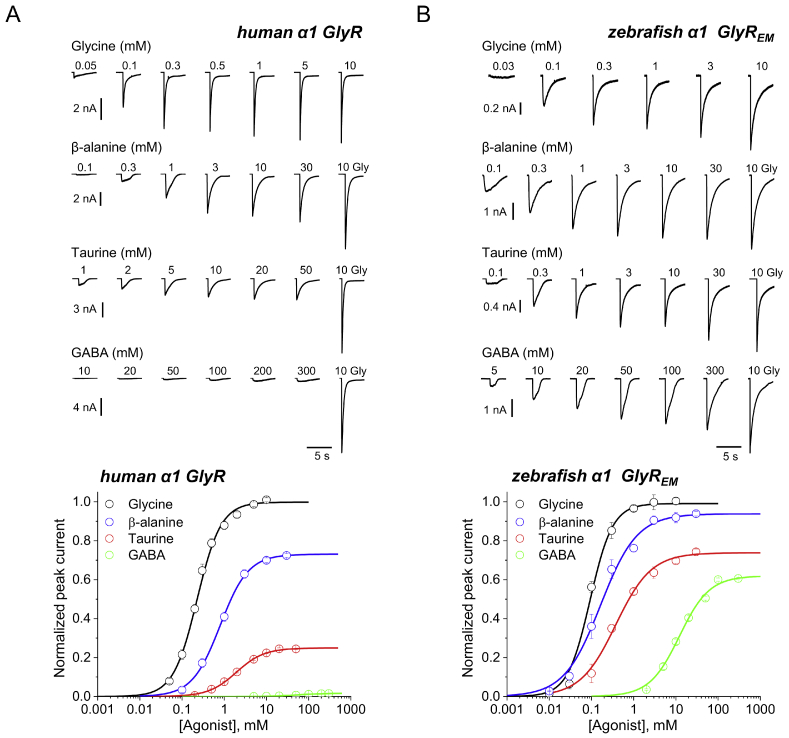
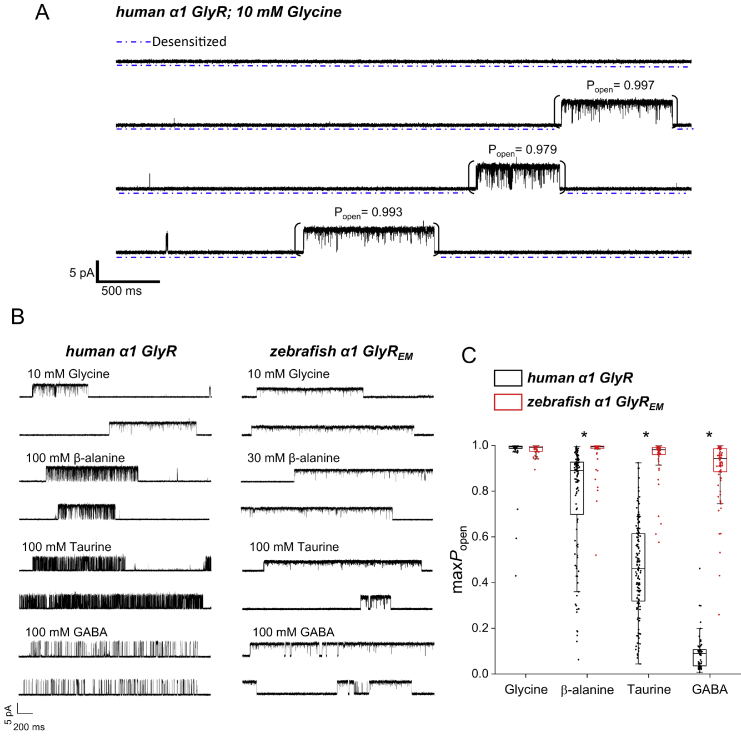
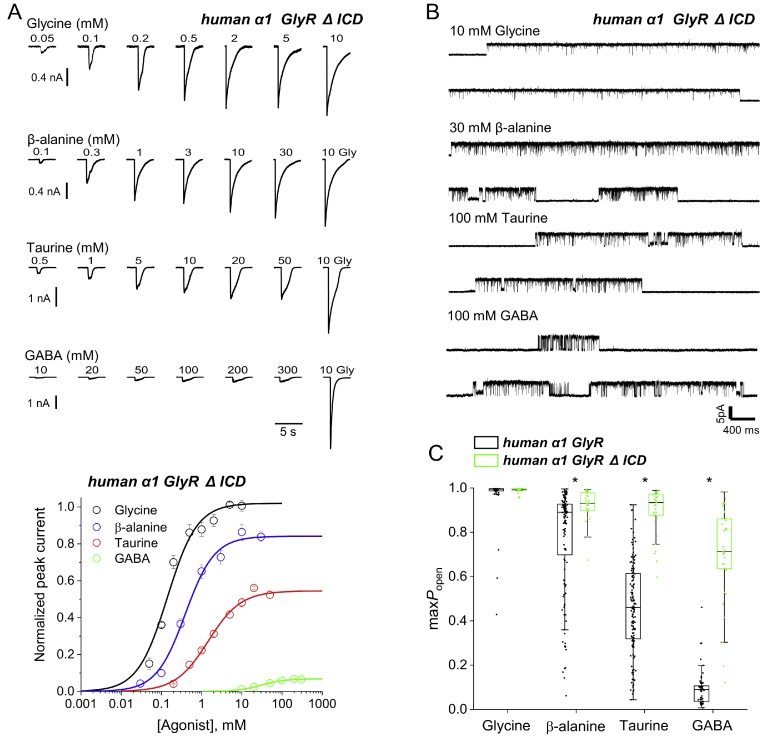
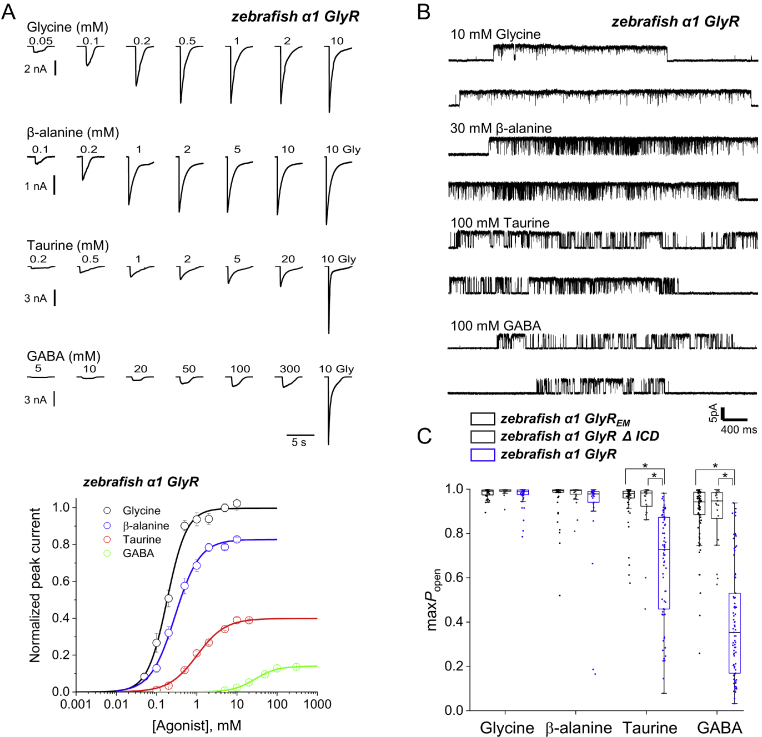
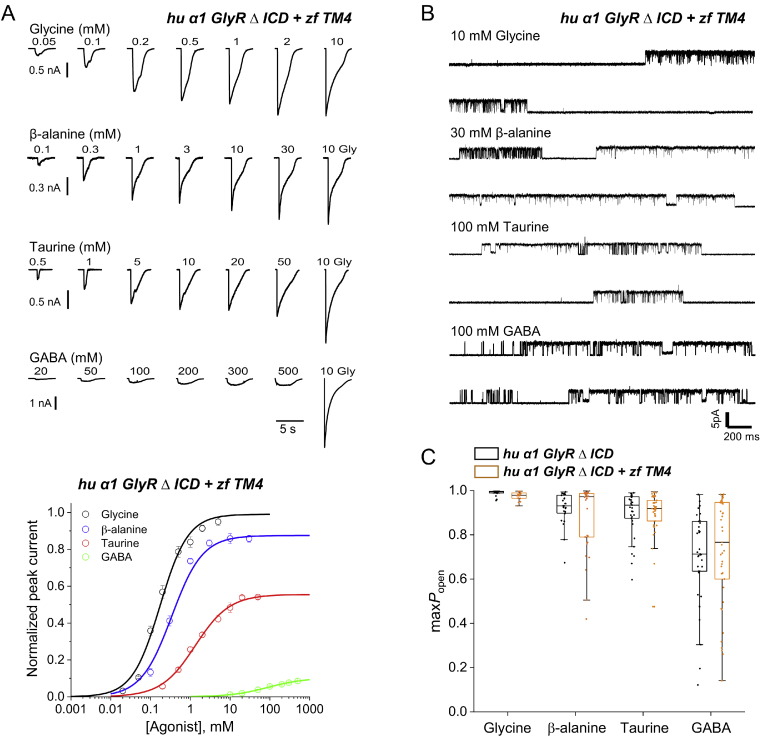
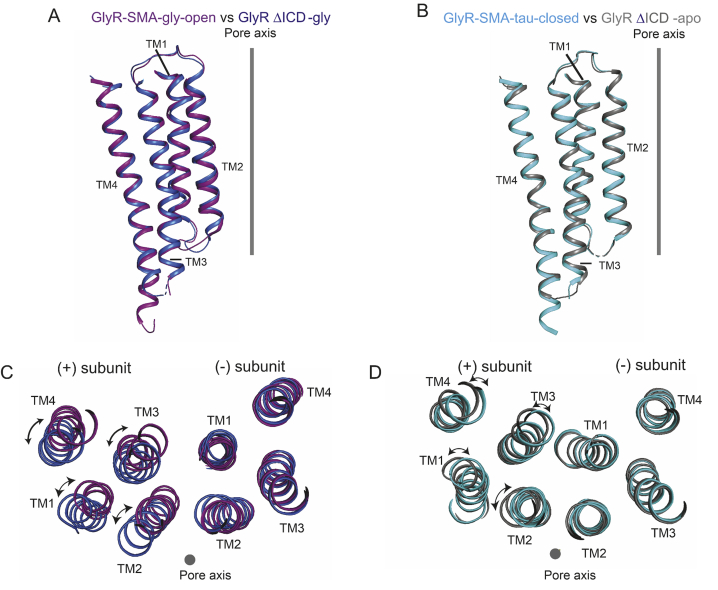
Like other pentameric ligand-gated channels, glycine receptors (GlyRs) contain long intracellular domains (ICDs) between transmembrane helices 3 and 4. Structurally characterized GlyRs are generally engineered to have a very short ICD. We show here that for one such construct, zebrafish GlyREM, the agonists glycine, β-alanine, taurine, and GABA have high efficacy and produce maximum single-channel open probabilities greater than 0.9. In contrast, for full-length human α1 GlyR, taurine and GABA were clearly partial agonists, with maximum open probabilities of 0.46 and 0.09, respectively. We found that the elevated open probabilities in GlyREM are not due to the limited sequence differences between the human and zebrafish orthologs, but rather to replacement of the native ICD with a short tripeptide ICD. Consistent with this interpretation, shortening the ICD in the human GlyR increased the maximum open probability produced by taurine and GABA to 0.90 and 0.70, respectively, but further engineering it to resemble GlyREM (by introducing the zebrafish transmembrane helix 4 and C terminus) had no effect. Furthermore, reinstating the native ICD to GlyREM converted taurine and GABA to partial agonists, with maximum open probabilities of 0.66 and 0.40, respectively. Structural comparison of transmembrane helices 3 and 4 in short- and long-ICD GlyR subunits revealed that ICD shortening does not distort the orientation of these helices within each subunit. This suggests that the effects of shortening the ICD stem from removing a modulatory effect of the native ICD on GlyR gating, revealing a new role for the ICD in pentameric ligand-gated channels.
Copyright © 2021 The Authors. Published by Elsevier Inc. All rights reserved.
Conflict of interest statement
Conflict of interest The authors declare that they have no conflicts of interest with the contents of this article.
Figures
References
-
- Lynch J.W. Molecular structure and function of the glycine receptor chloride channel. Physiol. Rev. 2004;84:1051–1095. - PubMed
-
- Huang X., Chen H., Michelsen K., Schneider S., Shaffer P.L. Crystal structure of human glycine receptor α3 bound to antagonist strychnine. Nature. 2015;526:277–280. - PubMed
-
- Huang X., Shaffer P.L., Ayube S., Bregman H., Chen H., Lehto S.G., Luther J.A., Matson D.J., McDonough S.I., Michelsen K., Plant M.H., Schneider S., Simard J.R., Teffera Y., Yi S., Zhang M., DiMauro E.F., Gingras J. Crystal structures of human glycine receptor α3 bound to a novel class of analgesic potentiators. Nat. Struct. Mol. Biol. 2017;24:108–113. - PubMed
-
- Bocquet N., Nury H., Baaden M., Le Poupon C., Changeux J.P., Delarue M., Corringer P.J. X-ray structure of a pentameric ligand-gated ion channel in an apparently open conformation. Nature. 2009;457:111–114. - PubMed
Publication types
MeSH terms
Substances
Grants and funding
LinkOut - more resources
Full Text Sources
Other Literature Sources
Molecular Biology Databases
