. 2021 Feb 22;17(1):22.
doi: 10.1186/s12992-021-00672-w.

A cross-country core strategy comparison in China, Japan, Singapore and South Korea during the early COVID-19 pandemic

Affiliations

A cross-country core strategy comparison in China, Japan, Singapore and South Korea during the early COVID-19 pandemic

Haiqian Chen et al. Global Health. .

Abstract

Background: The study aimed to analyze the effectiveness of COVID-19 strategies adopted by China, Japan, Singapore, and South Korea.

Methods: We extracted publicly available data from various official websites, summarized the strategies implemented in these four countries, and assessed the effectiveness of the prevention and control measures adopted by these countries.

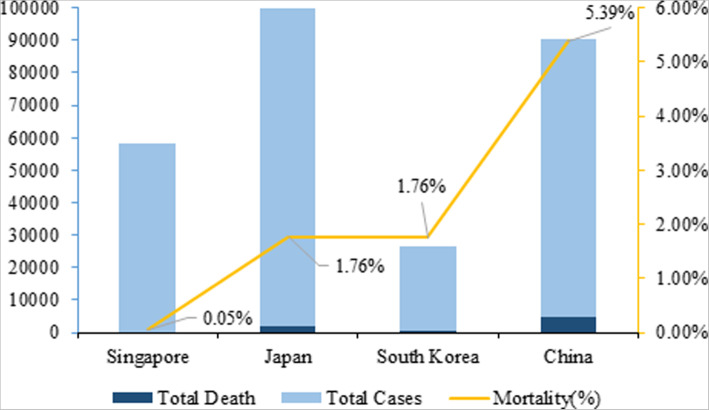
Results: As of October 28, 2020, the growth of daily new confirmed cases has stabilized in China, Singapore, and South Korea. In Japan, the daily new confirmed cases increased sharply since it lifted a state of emergency, but case-fatality maintains at a lower level. The growth of total cases is near stagnant in China and Singapore, with a case-fatality of 5.39 and 0.05% respectively. The case-fatality rate between Japan and South Korea is identical at 1.76%, however, Japan's growth rate of cases has increased more rapidly than South Korea.

Conclusion: This study found that China, Japan, Singapore, and South Korea accessed the situation within their own borders and implemented different intervention strategies to curb the spread of COVID-19 and maintain lower rates of case-fatality. China, Singapore, and South Korea adopted the containment strategy, while Japan adopted the mitigation strategy. Although Japan's case-fatality maintained at a low level, daily new cases increased faster than the other three countries. This result indicated that a mitigation strategy could be inferior to a containment strategy.

Keywords: COVID-19; Containment strategy; Core strategy comparison; Mitigation strategy.


Conflict of interest statement

The authors have no conflicts of interest to declare.

Figures
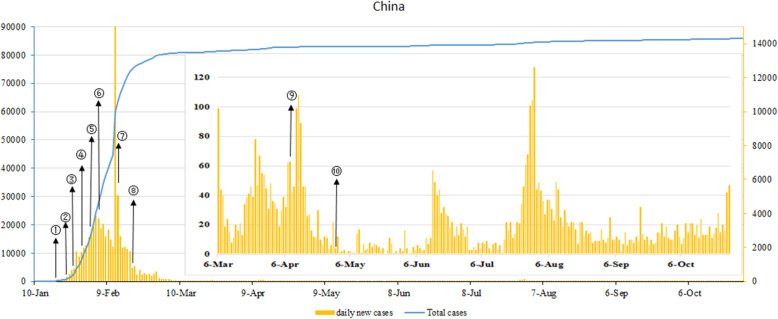
Fig. 1
Fig. 1
COVID-19 outbreak curve and timeline of implementation of major interventions in China. Note: ① Jan 20, 2020, classification of infectious diseases. ② On Jan 23, Wuhan lockdown. ③ On Jan 25, a leading group was established by the central government to respond to the COVID-19 outbreak. ④ On Jan 29, raising the public health emergency response to the highest level in all localities. ⑤ On Feb 2, classifying management of “four categories of personnel”. ⑥ On Feb 5, makeshift hospitals in operation. ⑦ On Feb 13, pairing assistance. ⑧ On Feb 19, launching massive community screening. ⑨ On April 8, lifted the lockdown of Wuhan city. ⑩ On April 29, China had entered into a phase of ongoing prevention and control
Fig. 2
Fig. 2
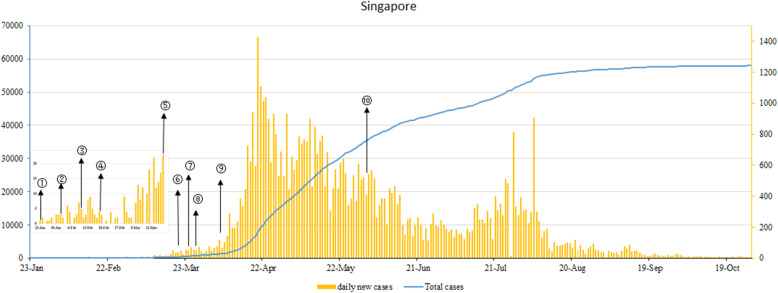
COVID-19 outbreak curve and timeline of implementation of major interventions in Singapore. Note: ① On Jan 23, the first case of COVID-19 was reported and established a Multi-Ministry Task Force. ② Since Feb 1, Singapore imposed entry restrictions on visitors from China; returning residents and long-term pass holders are subject to a 14-days quarantine. ③ On Feb 10, Activating a network of more than 800 (PHPCs). ④ On Feb 18, issued isolation decree. ⑤ Since March 17, inbound travelers who have symptoms such as fever and cough must take throat swabs. ⑥ On March 30, the government of Singapore launched the “Trace Together” APP. ⑦ Since March 24, prohibiting short-term visitors and cruise ship stops. ⑧ Since March 27, everyone who enters Singapore without a Stay Home Notice at a designated facility must wear an electronic tracker. ⑨ Since April 5, the government implemented strict community and social measures and encouraged people to telecommute. ⑩ Since June 1, normal social life has gradually been restored in three stages
Fig. 3
Fig. 3
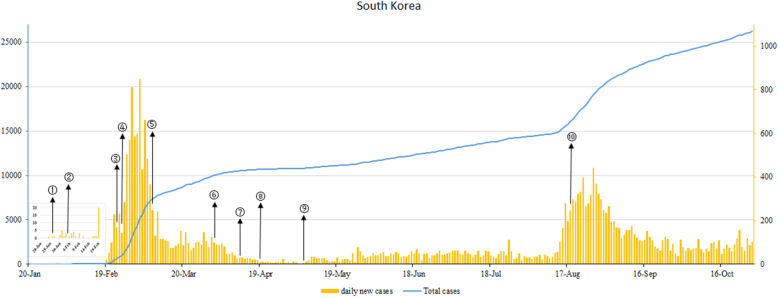
COVID-19 outbreak curve and timeline of implementation of major interventions in South Korea. Note: ① Jan 27, raising the public alert level to orange (3 out of 4 levels). ② Since Feb 4, a special entry procedure was introduced for all passengers entering South Korea from China and gradually extended to all global arrivals. ③ Feb 23, raising the public alert to the highest level and launching Drive-through screening centers. ④ On Feb 25, the Korean government imposed strict blockades in Daegu city and North Gyeongsang province. ⑤ On March 8, the nationwide distribution of public face masks. ⑥ Since April 1, all travelers entering South Korea are subject to a 14-day quarantine from the day after arrival. ⑦ On April 11, the government required that people who breached the self-quarantine rule should be worn electronic wristbands. ⑧ On April 19, softening social distancing measures. ⑨ On May 6, South Korea began to enter the phase of normal life and epidemic prevention and control. ⑩ On August 18, the Korean government declared a secondary level of social distance and banned gatherings of 50 people indoors
Fig. 4
Fig. 4
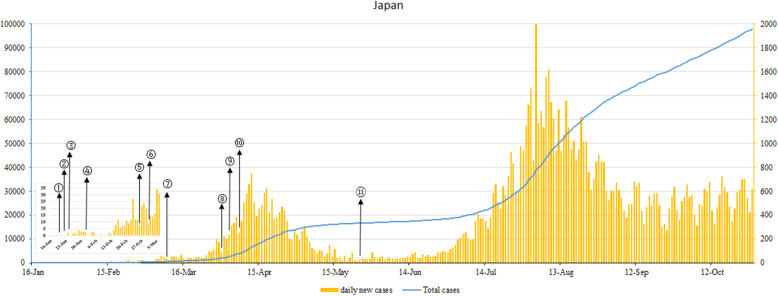
COVID-19 outbreak curve and timeline of implementation of major interventions in Japan. Note: ① On Jan 21, issued level 1 risk warning of infectious diseases to the whole of China. ② On Jan 23, issued level 2 risk warning of infectious diseases to Wuhan, China. ③ On Jan 24, issued level 3 risk warning of infectious diseases to the whole of Hubei province, including Wuhan city, and suspended travel in China’s Hubei province.④ On Feb 1, the decree allowed authorities to require suspected patients to accept quarantines and be hospitalized, and banning travelers from China’s Hubei and Zhejiang provinces. ⑤ On Feb 26, the prime minister recommended that self-restraint remains for 2 weeks, so the concerts and theaters are suspended or postponed nationwide. ⑥ On March 2, nationwide school closure. ⑦ On March 9, Japanese who entered from China and South Korea should be isolated at designated places. ⑧ On March 31, Japan prohibited visitors entering from 49 countries or regions (such as United States, England, China, South Korea, and so on), and also advised their citizens not to travel to these countries and regions. ⑨ On April 3, Japan tightened border control measures, banning foreigners from 73 countries and regions, including China. ⑩ On April 7, the prime minister declared a “state of emergency” order and the establishment of the “new lifestyle” that prevents the spread of infection, including avoiding “3Cs” (closed spaces, crowded places, and close-contact settings). ⑪ On May 25, Japan lifted the “state of emergency” order nationwide
Fig. 5
Fig. 5
Total cases, total death and case-fatality rates in four countries (as of October 28, 2020)

References

    1. Peeri NC, Shrestha N, Rahman MS, et al. The SARS, MERS and novel coronavirus (COVID-19) epidemics, the newest and biggest global health threats: what lessons have we learned? Int J Epidemiol. 2020;49(3):717–726. doi: 10.1093/ije/dyaa033. - DOI - PMC - PubMed
    1. COVID-19 CORONAVIRUS PANDEMIC. https://www.worldometers.info/coronavirus/#countries. Accessed 28 Nov 2020.
    1. Alanezi F, Aljahdali A, Alyousef SM, et al. A comparative study on the strategies adopted by the United Kingdom, India, China, Italy, and Saudi Arabia to contain the spread of the COVID-19 pandemic. J Healthcare Leadersh. 2020;12:117–131. doi: 10.2147/JHL.S266491. - DOI - PMC - PubMed
    1. Wei C, Wang Q, Yuanqiu L, et al. Early containment strategies and core measures for prevention and control of novel coronavirus pneumonia in China. Zhonghua Yu Fang Yi Xue Za Zhi. 2020;54:239–243. - PubMed
    1. Li Z, Chen Q, Feng L, et al. Active case finding with case management: the key to tackling the COVID-19 pandemic. Lancet. 2020;396(10243):63–70. doi: 10.1016/S0140-6736(20)31278-2. - DOI - PMC - PubMed

Publication types