


Antidepressant use in Sweden: an intersectional multilevel analysis of individual heterogeneity and discriminatory accuracy (MAIHDA)
- PMID: 33620003
- PMCID: PMC9096592
- DOI: 10.1177/1403494821993723
Antidepressant use in Sweden: an intersectional multilevel analysis of individual heterogeneity and discriminatory accuracy (MAIHDA)
Abstract
Introduction: Antidepressants are among the most commonly prescribed drugs in Sweden. However, we lack detailed knowledge on the socioeconomic and demographic distribution of antidepressant use in the population. To fill this gap, we performed an intersectional multilevel analysis of individual heterogeneity and discriminatory accuracy.
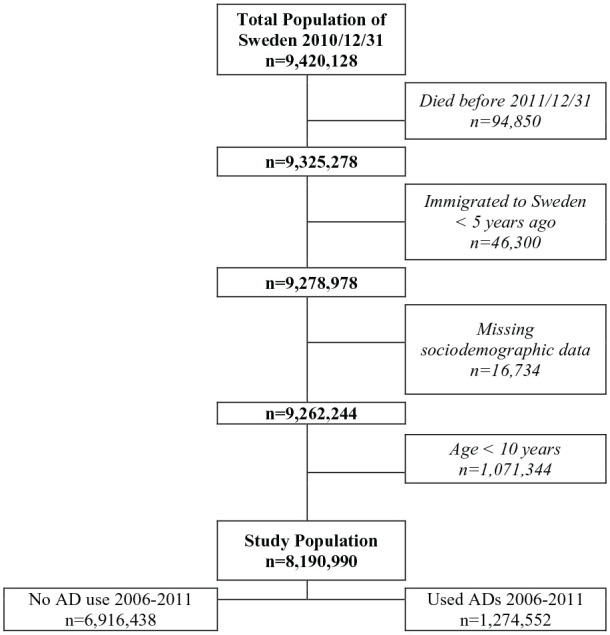
Methods: Analysing all Swedish residents older than 10 years (n=8,190,990), we measured the absolute risk of antidepressant use across 144 intersectional strata defined by combinations of age, gender, income, country of birth and psychiatric diagnosis. We calculated the strata-specific absolute risk of antidepressant use in a series of multilevel logistic regression models. By means of the variance partitioning coefficient and the area under the receiver operating characteristic curve, we quantified the discriminatory accuracy of the intersectional contexts (i.e. strata) for discerning those who use antidepressants from those who do not.
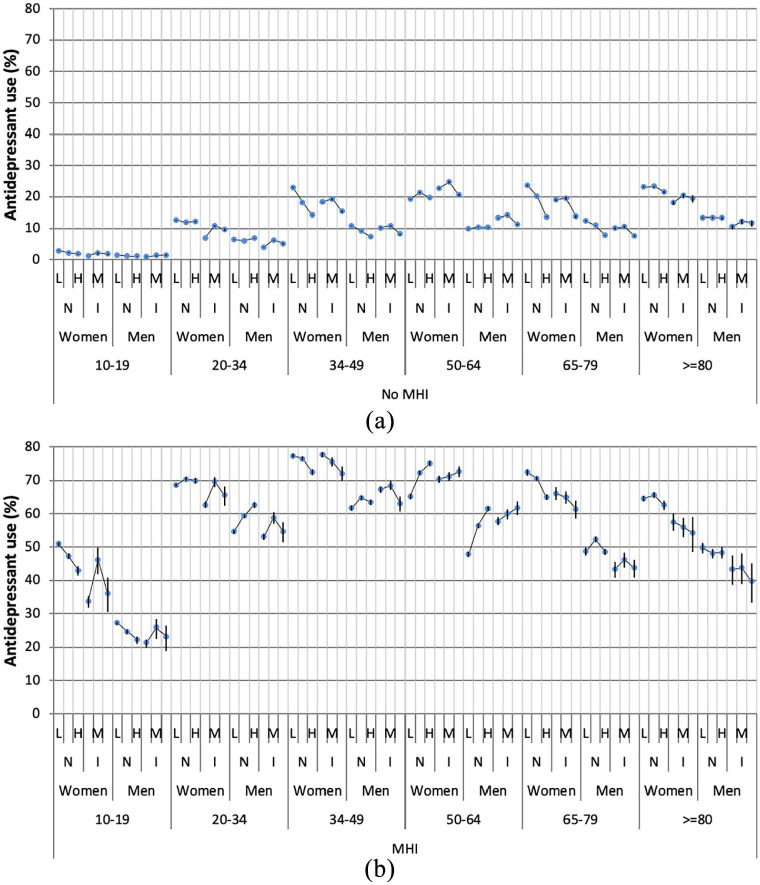
Results: The absolute risk of antidepressant use ranged between 0.93% and 24.78% among those without a psychiatric diagnosis, and between 21.41% and 77.56% among those with a psychiatric diagnosis. Both the variance partitioning coefficient of 41.88% and the area under the receiver operating characteristic curve of 0.81 were considerable.
Conclusions: Besides overt psychiatric diagnoses, our study shows that antidepressant use is mainly conditioned by age, which might express the embodiment of socioeconomic conditions across the individual life course. Our analysis provides a detailed and highly discriminatory mapping of the heterogeneous distribution of antidepressant use in the Swedish population, which may be useful in public health management.
Keywords: Antidepressants; MAIHDA; Sweden; intersectionality; socioeconomic factors.
Conflict of interest statement
Figures
References
-
- Organisation for Economic Co-operation and Development. Pharmaceutical market. Health Statistics. 2016. https://www.oecd-ilibrary.org/content/data/data-00545-en (accessed 20 June 2020).
-
- The National Board of Health and Welfare. Läkemedelsregistret. 2018. [updated 2020/07/09]. https://www.socialstyrelsen.se/statistik-och-data/register/alla-register... (accessed 20 July 2020).
-
- Melchior M, Chastang J-F, Leclerc A, et al. Low socioeconomic position and depression persistence: longitudinal results from the GAZEL cohort study. Psychiatry Res 2010;177:92–96. - PubMed
-
- Turner RJ, Lloyd DA. The stress process and the social distribution of depression. J Health Soc Behav 1999;40:374–404. - PubMed
-
- Andersen I, Thielen K, Nygaard E, et al. Social inequality in the prevalence of depressive disorders. J Epidemiol Community Health 2009;63:575. - PubMed
MeSH terms
Substances
LinkOut - more resources
Full Text Sources
Other Literature Sources
Medical
Miscellaneous
