


Effects of Smartphone-Based Stress Management on Improving Work Engagement Among Nurses in Vietnam: Secondary Analysis of a Three-Arm Randomized Controlled Trial
- PMID: 33620328
- PMCID: PMC7943341
- DOI: 10.2196/20445
Effects of Smartphone-Based Stress Management on Improving Work Engagement Among Nurses in Vietnam: Secondary Analysis of a Three-Arm Randomized Controlled Trial
Abstract
Background: Work engagement is important for employee well-being and work performance. However, no intervention study has investigated the effect of an eMental Health intervention on work engagement among workers in low- and middle-income countries (LMICs).
Objective: The aim of the study was to examine the effects of a newly developed smartphone-based stress management program (ABC Stress Management) on improving work engagement among hospital nurses in Vietnam, an LMIC.
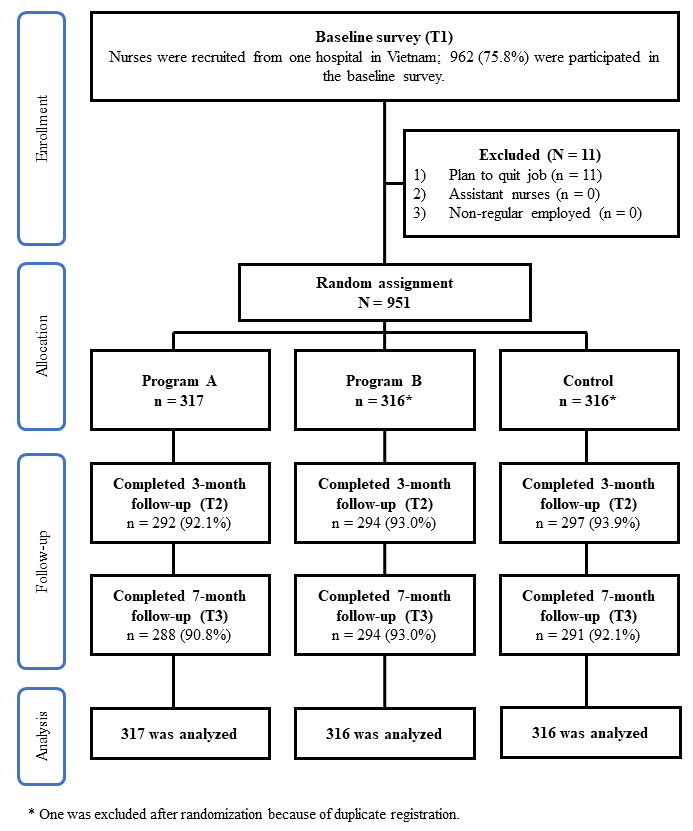
Methods: Full-time registered nurses (n=949) were randomly assigned to one of 2 intervention groups or a control group. The intervention groups were a 6-week, 6-lesson program offering basic cognitive behavioral therapy (CBT-based stress management skills), provided in either free-choice (program A) or fixed order (program B). Work engagement was assessed at baseline and 3-month and 7-month follow-ups in each of the 3 groups.
Results: The scores of work engagement in both intervention groups improved from baseline to 3-month follow-up, and then decreased at the 7-month follow-up, while the score steadily increased from baseline to 7-month follow-up in the control group. Program B showed a significant intervention effect on improving work engagement at the 3-month follow-up (P=.049) with a small effect size (Cohen d= 0.16; 95% CI 0.001 to 0.43]). Program A showed nonsignificant trend (d=0.13; 95% CI -0.014 to 0.41; P=.07) toward improved engagement at 3 months. Neither program achieved effectiveness at the 7-month follow-up.
Conclusions: The study demonstrated that a fixed order (program B) delivery of a smartphone-based stress management program was effective in improving work engagement in nurses in Vietnam. However, the effect was small and only temporary. Further improvement of this program is required to achieve a greater effect size and more sustained, longer lasting impact on work engagement.
Trial registration: University Hospital Medical Information Network Clinical Trials Registry UMIN000033139; tinyurl.com/55gxo253.
International registered report identifier (irrid): RR2-10.1136/bmjopen-2018-025138.
Keywords: LMICs; South-East Asia; digital health; health care professionals; mental health; occupational health; stress management; workplace.
©Natsu Sasaki, Kotaro Imamura, Thuy Thi Thu Tran, Huong Thanh Nguyen, Kazuto Kuribayashi, Asuka Sakuraya, Thu Minh Bui, Quynh Thuy Nguyen, Nga Thi Nguyen, Giang Thi Huong Nguyen, Melvyn Weibin Zhang, Harry Minas, Yuki Sekiya, Kazuhiro Watanabe, Akizumi Tsutsumi, Akihito Shimazu, Norito Kawakami. Originally published in the Journal of Medical Internet Research (http://www.jmir.org), 23.02.2021.
Conflict of interest statement
Conflicts of Interest: NK reports grants from Infocom Corp, Fujitsu Ltd, Fujitsu Software Technologies, and TAK Ltd and personal fees from the Occupational Health Foundation, Japan Dental Association, Sekisui Chemicals, Junpukai Health Care Center, and Osaka Chamber of Commerce and Industry outside the submitted work.
References
-
- Christian M, Garza A, Slaughter J. Work engagement: a quantitative review and test of its relations with task and contextual performance. Personnel Psychol. 2011;64(1):89–136. doi: 10.1111/j.1744-6570.2010.01203.x. - DOI
-
- Halbesleben J. Work Engagement: A Handbook of Essential Theory and Research. London: Routledge; 2010. A meta-analysis of work engagement: relationships with burnout, demands, resources, and consequences; pp. 102–117.
-
- Schaufeli WB, Salanova M, González-romá V, Bakker AB. The measurement of engagement and burnout: a two sample confirmatory factor analytic approach. J Happiness Stud. 2002;3(1):71–92. doi: 10.1023/A:1015630930326. - DOI
-
- Halbesleben JR, Wheeler AR. The relative roles of engagement and embeddedness in predicting job performance and intention to leave. Work Stress. 2008 Jul;22(3):242–256. doi: 10.1080/02678370802383962. - DOI
-
- Knight C, Patterson M, Dawson J. Work engagement interventions can be effective: a systematic review. Eur J Work Org Psychol. 2019 Apr 06;28(3):348–372. doi: 10.1080/1359432x.2019.1588887. - DOI
Publication types
MeSH terms
Associated data
- Actions
LinkOut - more resources
Full Text Sources
Other Literature Sources
Medical
Miscellaneous
