


Analysis of Active and Passive Tobacco Exposures and Blood Pressure in US Children and Adolescents
- PMID: 33620445
- PMCID: PMC7903259
- DOI: 10.1001/jamanetworkopen.2020.37936
Analysis of Active and Passive Tobacco Exposures and Blood Pressure in US Children and Adolescents
Abstract
Importance: Hypertension is a leading cause of cardiovascular disease in adults; preclinical associations between hypertension and cardiovascular disease are seen in childhood. Nicotine is a known toxin, but its association with pediatric hypertension is unclear.
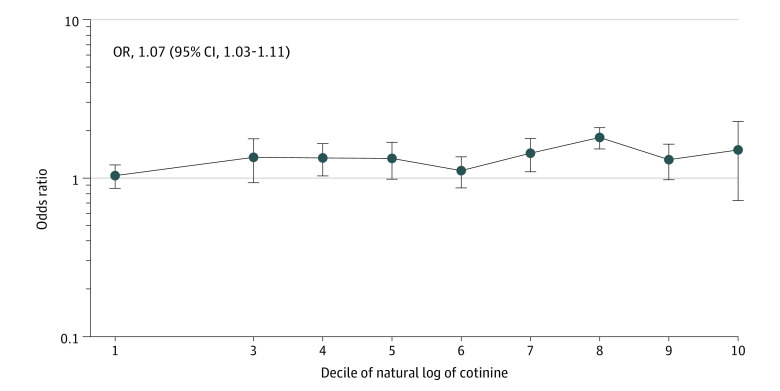
Objective: To test the hypothesis that tobacco exposure is associated with the presence of elevated blood pressure in US children and adolescents and that this association is dose dependent.
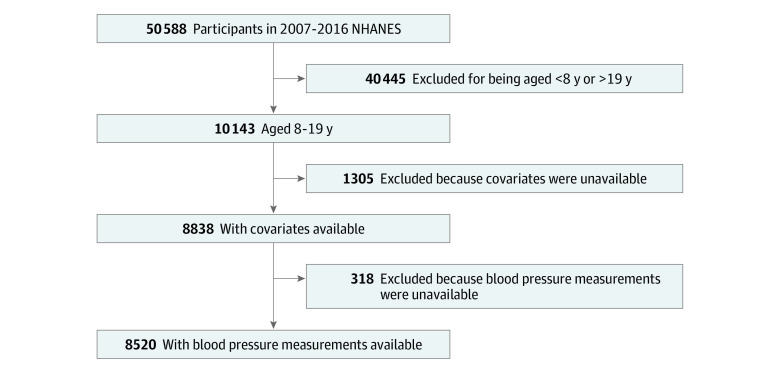
Design, setting, and participants: This cross-sectional study used data from the 2007 to 2016 National Health and Nutrition Examination Survey (NHANES), a population-based nationally representative sample of US children and adolescents. Children were eligible if they were aged 8 to 19 years at the time of participation in the main NHANES study. Exclusion criteria included those of the main NHANES study, inability to complete testing, or missing questionnaires. Of the 10 143 participants in NHANES aged 8 to 19 during the study years, 8520 were included in the analysis. Analysis was conducted from October 12, 2019, to July 9, 2020.
Exposures: Tobacco exposure, defined as serum cotinine levels greater than 0.05 µg/L, or reporting living with a smoker or smoking themselves.
Main outcomes and measures: Elevated blood pressure, classified as greater than 90% for a child's age, sex, and height according to the 2017 American Academy of Pediatrics Clinical Practice Guidelines. The a priori hypothesis that there is a positive association between tobacco exposure and elevated blood pressure in the study population was tested. Analysis included logistic regression with adjustment for possible confounders. Subgroup and sensitivity analyses were conducted.
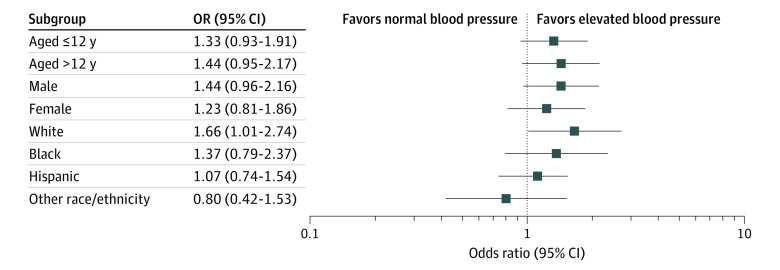
Results: A total of 8520 children were included in the analysis, representing 41 million US children. The mean (SD) age of the participants was 13.1 (0.05) years, 51% (95% CI, 49%-52%) were male, and 58% (95% CI, 54%-62%) were non-Hispanic White individuals. Participants with any tobacco smoke exposure were more likely than those without exposure to be older (mean [SD] age, 13.3 [0.07] years vs 12.8 [0.06] years), male (53% [95% CI, 51%-55%] vs 49% [95% CI, 47%-50%]), and non-Hispanic Black individuals (19% [95% CI, 16%-22%] vs 10% [95% CI, 8%-12%]). The odds of having elevated blood pressure was 1.31 (95% CI, 1.06-1.61) for any tobacco exposure after adjustment; odds were similar across subgroups and remained significant in multiple sensitivity analyses.
Conclusions and relevance: This study suggests that tobacco exposure is associated with elevated blood pressure in US children and adolescents. This modifiable risk factor represents a target for further research into reducing hypertension in children and adolescents.
Conflict of interest statement
Figures
References
-
- Whelton PK, Carey RM, Aronow WS, et al. . 2017 ACC/AHA/AAPA/ABC/ACPM/AGS/APhA/ASH/ASPC/NMA/PCNA Guideline for the prevention, detection, evaluation, and management of high blood pressure in adults: a report of the American College of Cardiology/American Heart Association Task Force on Clinical Practice Guidelines. J Am Coll Cardiol. 2018;71(19):e127-e248. doi:10.1016/j.jacc.2017.11.006 - DOI - PubMed
-
- Flynn JT, Kaelber DC, Baker-Smith CM, et al. ; Subcommittee on Screening and Management of High Blood Pressure in Children . Clinical practice guideline for screening and management of high blood pressure in children and adolescents. Pediatrics. 2017;140(3):e20171904. doi:10.1542/peds.2017-1904 - DOI - PubMed
Publication types
MeSH terms
Substances
Grants and funding
LinkOut - more resources
Full Text Sources
Other Literature Sources
Medical
