


Luts-V: A new simplified score for assessing lower urinary tract symptoms in men
- PMID: 33620997
- PMCID: PMC7993949
- DOI: 10.1590/S1677-5538.IBJU.2020.0278
Luts-V: A new simplified score for assessing lower urinary tract symptoms in men
Abstract
Objectives: Develop and validate a new and simplified score for evaluating the lower urinary tract symptoms in men.
Materials and methods: We modified the existing visual prostate symptom score, including changes in the images, sequence, and new alternatives, resulting in a new visual score (LUTS visual score-LUTS-V). For the validation of the new tool, we used the International Prostatic Symptom Score as the gold-standard and the new LUTS-V to 306 men. The total IPSS score and the total LUTS-V score of each subject were evaluated to determine the agreement between the two instruments. ROC curve was used to evaluate the diagnostic accuracy and best cut-off of LUTS-V. Sensitivity, specificity, and diagnostic odds ratios were used to describe the diagnostic properties.
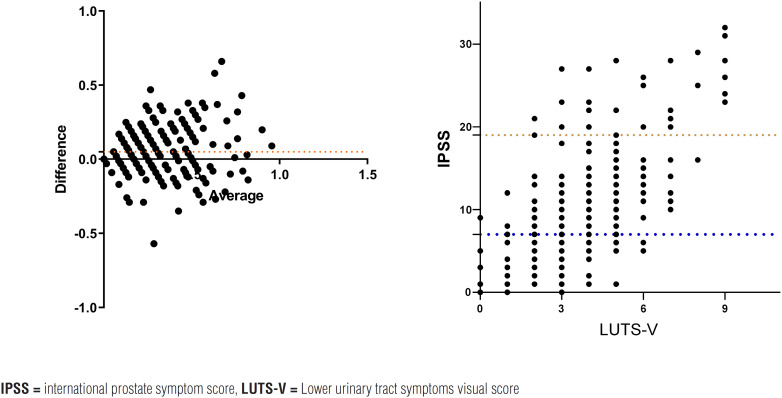
Results: The mean age of the participants was 59 [52-87] years. There was a significant correlation between LUTS-V and IPSS. (r=0.72 (p<0.0001). The Bland-Altman analyzes demonstrate good agreement between the two questionnaires (bias=5.6%). LUTS-V demonstrated excellent diagnostic accuracy in detecting the most serious cases with an area under the ROC curve of 83% [78-87%] 95% CI. p <0.001). LUTS-V >4 was the best threshold, with a sensitivity of 74% and specificity of 78%.
Conclusions: LUTS-V is a simple, self-administered tool with a significant discriminatory power to identify subjects with moderate to severe LUTS and may represent a useful instrument for the diagnosis and follow-up of men with urinary symptoms.
Keywords: Men; Prostate; Validation Study [Publication Type].
Copyright® by the International Brazilian Journal of Urology.
Conflict of interest statement
None declared.
Figures


Comment in
-
Editorial Comment: Luts-V: A new simplified score for assessing lower urinary tract symptoms in men.Int Braz J Urol. 2021 May-Jun;47(3):533-534. doi: 10.1590/S1677-5538.IBJU.2020.0278.1. Int Braz J Urol. 2021. PMID: 33620998 Free PMC article. No abstract available.
References
-
- 1. Irwin DE, Milsom I, Hunskaar S, Reilly K, Kopp Z, Herschorn S, et at. Population-based survey of urinary incontinence, overactive bladder, and other lower urinary tract symptoms in five countries: results of the EPIC study. Eur Urol. 2006; 50:1306-14. - PubMed
-
- 2. Soler R, Gomes CM, Averbeck MA, Koyama M. The prevalence of lower urinary tract symptoms (LUTS) in Brazil: Results from the epidemiology of LUTS (Brazil LUTS) study. Neurourol Urodyn. 2018; 37:1356-64. - PubMed
-
- 4. Reggio E, de Bessa J Jr, Junqueira RG, Timm O Jr, Sette MJ, Sansana V, et al. Correlation between lower urinary tract symptoms and erectile dysfunction in men presenting for prostate cancer screening. Int J Impot Res. 2007; 19:492-5. - PubMed
-
- 5. Coyne KS, Wein AJ, Tubaro A, Sexton CC, Thompson CL, Kopp ZS, et at. The burden of lower urinary tract symptoms: evaluating the effect of LUTS on health-related quality of life, anxiety and depression: EpiLUTS. BJU Int. 2009; 103 (Suppl 3):4-11. - PubMed
MeSH terms
LinkOut - more resources
Full Text Sources
Other Literature Sources
Medical
