


Associations between symptoms of pain, insomnia and depression, and frailty in older adults: A cross-sectional analysis of a cohort study
- PMID: 33621722
- PMCID: PMC9940903
- DOI: 10.1016/j.ijnurstu.2021.103873
Associations between symptoms of pain, insomnia and depression, and frailty in older adults: A cross-sectional analysis of a cohort study
Abstract
Background: Frailty is prevalent in older adults and has adverse effects on multiple health outcomes. Pain, insomnia, and depressive symptoms are commonly seen and treatable symptoms in older adults and are associated with frailty. However, it is unknown whether these symptoms are independently associated with frailty and how they interact with each other creating a greater impact on frailty than individual symptoms. It is important to understand these associations for nurses to provide high-quality patient-centered care for older adults with frailty.
Objectives: To determine independent associations of pain, insomnia, and depressive symptoms with frailty and examine their synergistic impact on frailty among older adults.
Design: A cross-sectional analysis of a cohort study.
Setting: Communities in the United States.
Participants: Community-dwelling older adults from the National Health and Aging Trend Study (N = 7,609), a nationally representative survey of Medicare Beneficiaries in the United States.
Methods: Frailty status was determined by five criteria of the Physical Frailty Phenotype: exhaustion, low physical activity, weakness, slowness, and shrinking. Pain was determined by self-reports of bothersome pain in the last month. Insomnia included self-reports of difficulty initiating sleep and difficulty maintaining sleep. Depressive symptom was assessed by the Patient Health Questionnaire-2. Logistic regression models were used adjusting for sociodemographic, health-related and behavioral covariates.
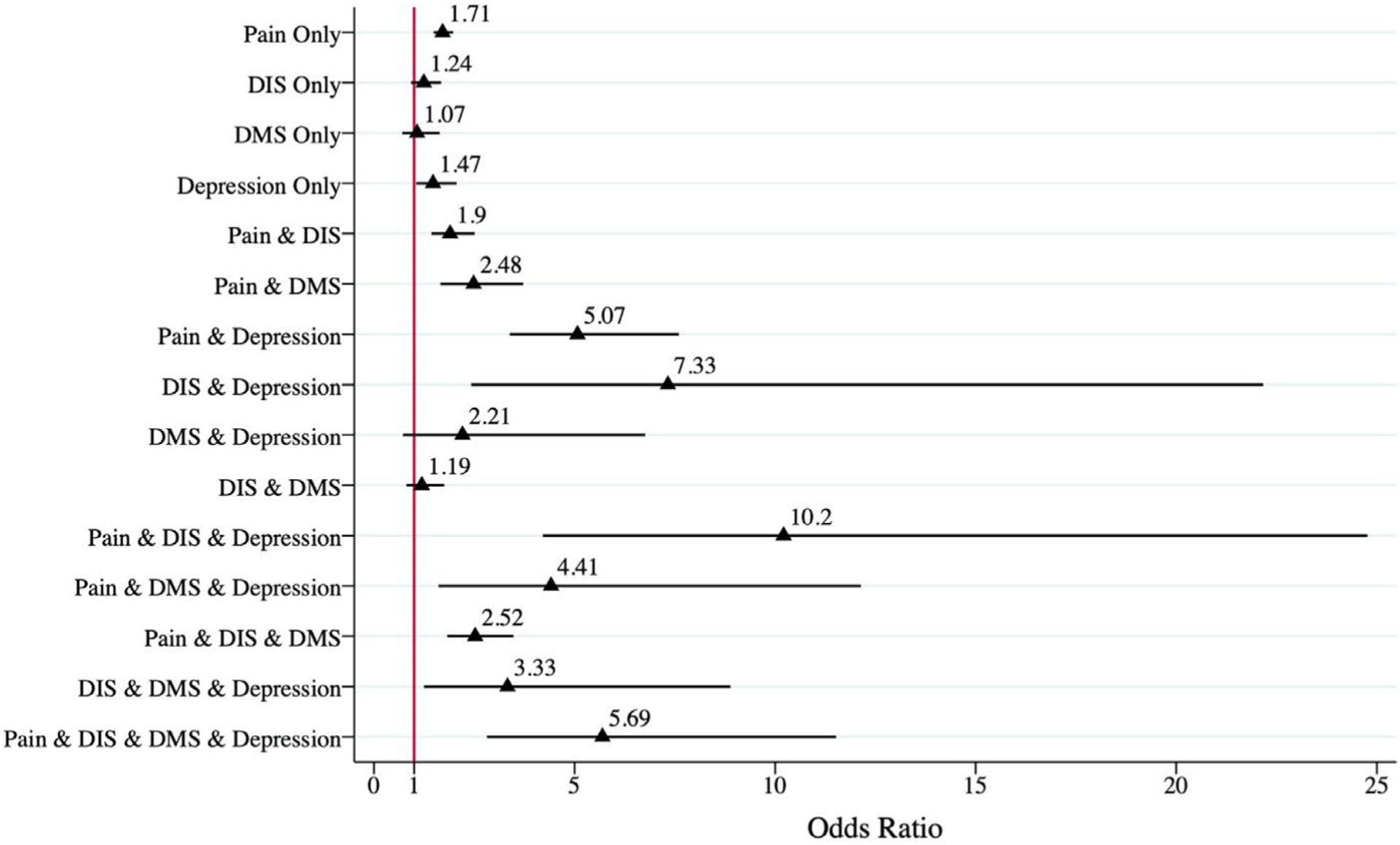
Results: The sample was mainly under 80 years old (72%), female (57%), and non-Hispanic White (81%). Approximately 53% experienced bothersome pain, 11% had difficulty initiating sleep, 6% had difficulty maintaining sleep, and 15% had depressive symptom; 46% were pre-frail and 14% were frail. Independent associations with pre-frailty and frailty were found in pain (odds ratio [OR]: 1.81, 95% CI: 1.60, 2.04), difficulty initiating sleep (OR: 1.23, 95% CI: 1.04, 1.46) and depressive symptom (OR: 2.29, 95% CI: 1.85, 2.84). Interaction terms between pain and depressive symptom (OR: 1.87, 95% CI: 1.14, 3.07), and between difficulty initiating sleep and depressive symptom (OR: 2.66, 95% CI: 1.15, 6.13) were significant, suggesting a synergistic impact on pre-frailty and frailty.
Conclusions: Pain, difficulty initiating sleep, and depressive symptoms are independent risk factors of frailty and may have a synergistic impact on frailty. Interventions should be developed to address these symptoms to reduce the adverse effects of frailty.
Keywords: Depression; Frailty; Insomnia; Pain; Symptom.
Copyright © 2021. Published by Elsevier Ltd.
Conflict of interest statement
Declaration of Competing Interest
None.
Figures
Comment in
-
Associations between symptoms of pain, insomnia and depression, and frailty in older adults: Comment on Liu et al. (2021).Int J Nurs Stud. 2021 Nov;123:104068. doi: 10.1016/j.ijnurstu.2021.104068. Epub 2021 Aug 21. Int J Nurs Stud. 2021. PMID: 34517963 No abstract available.
References
-
- Arnardottir ES, Maislin G, Schwab RJ, Staley B, Benediktsdottir B, Olafsson I, Juliusson S, Romer M, Gislason T, Pack AI, 2012. The interaction of obstructive sleep apnea and obesity on the inflammatory markers C-reactive protein and interleukin-6: the Icelandic sleep apnea cohort. Sleep 35 (7), 921–932. doi: 10.5665/sleep.1952. - DOI - PMC - PubMed
-
- Avila-Funes JA, Helmer C, Amieva H, Barberger-Gateau P, Le Goff M, Ritchie K, Portet F, Carrière I, Tavernier B, Gutiérrez-Robledo LM, Dartigues JF, 2008. Frailty among community-dwelling elderly people in France: the three-city study. J. Gerontol. A Biol. Sci. Med. Sci 63 (10), 1089–1096. doi: 10.1093/gerona/63.10.1089. - DOI - PMC - PubMed
-
- Blanken TF, Benjamins JS, Borsboom D, Vermunt JK, Paquola C, Ramautar J, Dekker K, Stoffers D, Wassing R, Wei Y, Van Someren EJW, 2019. Insomnia disorder subtypes derived from life history and traits of affect and personality. Lancet Psychiatry 6 (2), 151–163. doi: 10.1016/S2215-0366(18)30464-4. - DOI - PubMed
MeSH terms
Grants and funding
LinkOut - more resources
Full Text Sources
Other Literature Sources
Medical
